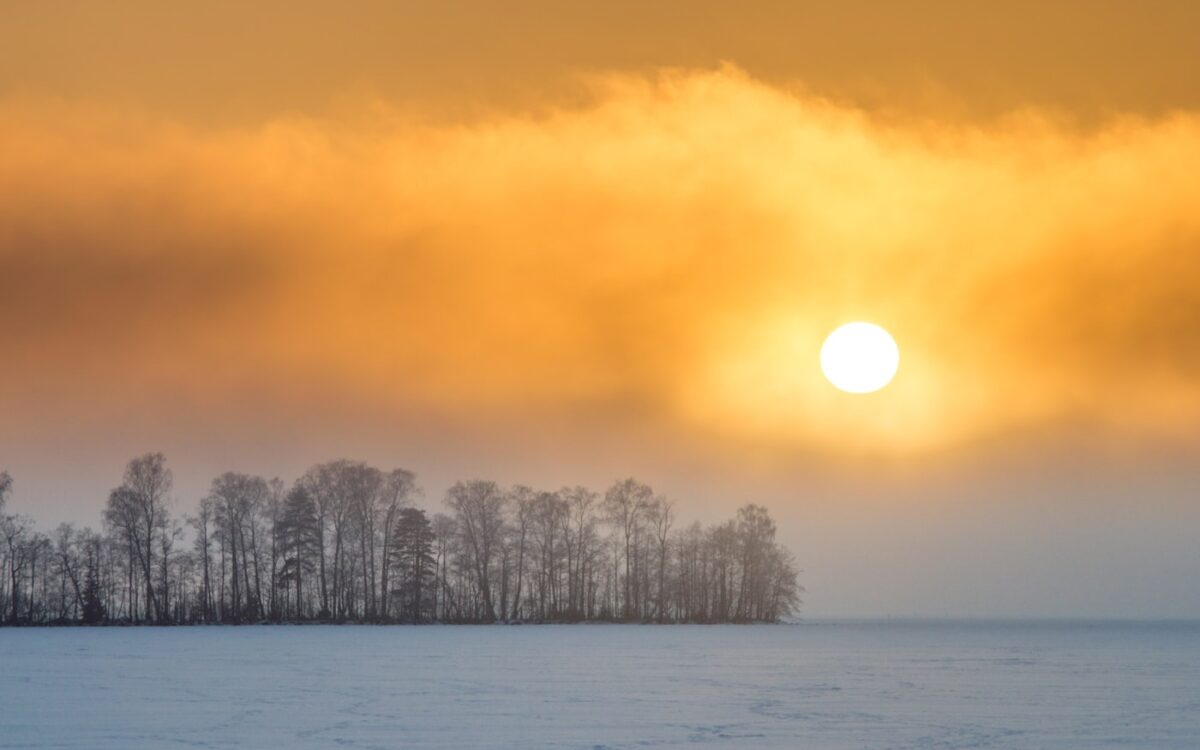
A person with a Bǐng Fire (丙 bǐng) Day Master (日主 rìzhǔ) is the sun of the sixty-pillar system — broad daylight, radiant, generous with its warmth. Set that sun against the depth of winter and you get the hardest baseline the stem can be dealt. Bing fire born in winter means the sun rides low over a frozen sky: the Water season, branches 亥子丑, running Nov 7 – Feb 3 (from Li Dong 立冬 to before Li Chun 立春). Remember that these are solar-term seasons, not calendar months, so a birth in early November or late January-into-February can fall on the far side of the boundary. Verify it on the Butcher Boy calculator before you take the label at face value.
Dormant (死 sǐ): the season controls your element
The seasonal state here is 死 sǐ — Dormant — the season controls your element: weakest baseline; support and timing matter more than effort. The season element Water relative to Fire controls Fire (power/pressure season). This is the sun in the one climate built to overpower it. Water does not merely cool Bǐng; in its own season it presses on the Fire the way authority presses on the individual.
Read through the nature of the stem, and the winter sun is not extinguished so much as diminished. It still rises — Bǐng is Yang Fire, and even a low winter sun clears the mist by noon — but it works short hours against a long cold. The classic mistake is to read a dormant Bǐng as a failure of character. It is not. It is a strong-tempered stem handed a season that will not warm to it, and the person often knows that gap intimately: the drive is there, the returns lag.
What this season asks of you
Because Water in winter is the sun’s Officer and Seven Killings — the power that controls it — this is a pressure season, and pressure seasons are survived on resource and allies, not on pushing harder. The single most useful thing for a dormant Bǐng is Wood, which turns the abundant Water back into fuel for the Fire rather than a flood against it. Companion Fire helps too: a hearth of several small flames holds heat that one exposed flame loses. Earth can matter as well, banking the Water so it stops overwhelming the light.
In working terms, bing fire born in winter should lean on timing. This is not the chart to force a decisive move in the coldest years; it is the chart that waits for a Wood or Fire luck pillar and then moves with real backing. Effort spent without support in a pressure season tends to exhaust the flame. Effort placed when the resource has arrived reads completely differently — the same sun, finally given a warm day to work in. The weak-chart logic behind this — resource and companions favorable, output, wealth and power set aside for now — is laid out in full in the favorable elements for Fire Day Masters guide.
The three winter months are not equally cold
Winter’s branches — 亥, 子 and 丑 — each hide different stems, and for a pressured Bǐng those differences matter more than in any comfortable season.
亥 Hài, the Pig month
Early winter hides Rén 壬 and Jiǎ 甲. The Rén is the sun’s Seven Killings 七杀, the sharpest form of pressure — but the buried Jiǎ is Indirect Resource 偏印, a seed of Wood inside the flood. A Pig-month Bǐng carries its own lifeline: the very branch that presses it also stores the fuel that can revive it, if the chart lets that Wood surface.
子 Zǐ, the Rat month
Midwinter hides only Guǐ 癸, the sun’s Direct Officer 正官. This is the purest, most single-minded Water of the year — pressure without any hidden gift. A Rat-month Bǐng leans hardest on what the other three pillars supply.
丑 Chǒu, the Ox month
Late winter hides Jǐ 己, Guǐ 癸 and Xīn 辛. 丑 is one of the transitional Earth branches 辰未戌丑, where Earth gathers strength at the season’s end — the frozen ground begins to bank the Water, easing the pressure slightly before spring turns.
The caveats that change everything
Season is only half the verdict. Winter sets the weakest baseline, but it does not close the case — the roots in the other three branches, the hidden stems (藏干 cánggān) they carry, and the balance of the whole chart finish the judgement. A winter Bǐng sitting on 巳 or 午 Fire, or drawing on 寅 Wood, can be far sturdier than the season alone suggests. There is a wrinkle inside winter too: the branch 丑 at the tail of the season is a transitional Earth month where Earth begins to gather, subtly draining the Water’s pressure late in the window.
This is why practitioners never stop at the season. To see how the whole chart is weighed, read the guide to the strong versus weak Day Master, then the Bing Fire Day Master profile for how this sun behaves once strength is settled. For the same stem in the season that feeds rather than fights it, compare Bing Fire born in spring, and for the control cycle that makes Water the sun’s master, the five elements in Ba Zi. The other two quarters round out the picture: Bing Fire born in summer is the same sun at maximum strength, and Bing Fire born in autumn shows it fighting uphill through the wealth season rather than under direct pressure.
Before you read winter as a verdict on your chart, confirm both halves of the equation: that your Day Master really is Bǐng Fire, and that your birth truly lands inside the solar-term winter. Plot both for free on the Butcher Boy calculator and read the season off the chart rather than the calendar.