Ask people to name a divination method and two come up first: the I Ching (易经 yì jīng), the ancient Chinese Book of Changes, and Tarot, the European card system. Both are old, both are still used daily, and both are often misunderstood as fortune-telling machines. They are not that. Each is a structured way of putting language to a moment you are already living. This is a fair, side-by-side look at how they are built, how a reading actually works, and the different pictures of life they carry. If you are weighing which one to sit with, the honest answer is that they do different jobs well.
Two structures: 64 hexagrams versus 78 cards
The I Ching is a closed system of 64 hexagrams (六十四卦 liù shí sì guà). Each hexagram is a stack of six lines, and each line is either solid (yang 阳 yáng) or broken (yin 阴 yīn). Two three-line trigrams (八卦 bā guà) — Heaven, Earth, Thunder, Water, Mountain, Wind, Fire, Lake — sit one atop the other, and every possible pairing gives exactly 8 by 8, or 64 figures. Nothing is added or removed. The whole book is a fixed map, and a reading simply lands you somewhere on it.
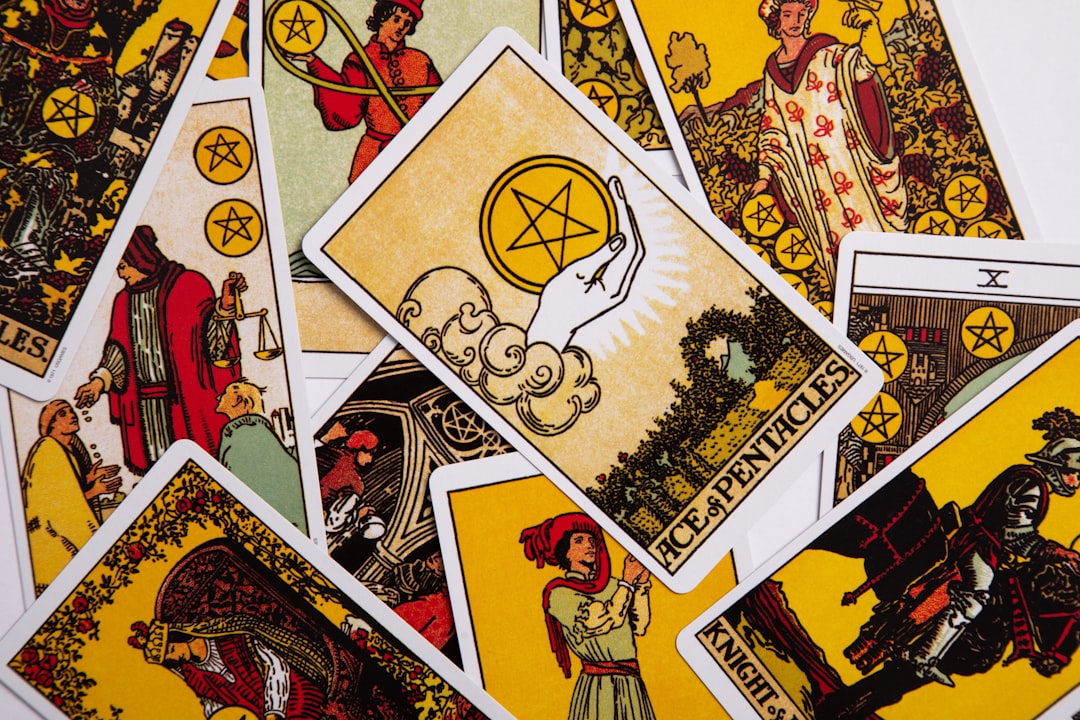
Tarot is a deck of 78 cards in two groups. The 22 Major Arcana carry the large life themes — The Fool, Death, The Tower, The Star. The 56 Minor Arcana run in four suits (Wands, Cups, Swords, Pentacles), each with numbered and court cards, closer to the texture of daily situations. Because the deck is shuffled and cards are drawn into positions, Tarot builds meaning through combination and spread rather than a fixed sequence. Its vocabulary is broad and pictorial where the I Ching’s is spare and geometric.
Neither structure is superior. The I Ching trades range for depth: 64 well-defined states, each with centuries of commentary. Tarot trades a single map for flexibility: 78 images that recombine into an enormous number of layouts.
How a reading actually works
The mechanics differ more than most people expect.
- I Ching: You hold a question, then cast a hexagram line by line, from the bottom up. The traditional methods are three coins (fast) or yarrow stalks (slower, ritual). Each cast produces a value that is young or old yin, or young or old yang. Old lines are changing lines: they transform into their opposite and generate a second hexagram. The first hexagram is the present shape of your situation; the changing lines are where it is under tension; the second is where it tends to move. You then read the Judgment and Image — the counsel and the natural picture — in plain terms.
- Tarot: You shuffle with a question in mind and lay cards into a spread, each position carrying a meaning (past, present, obstacle, likely outcome, and so on). A three-card draw is common; the ten-card Celtic Cross is the classic larger layout. The reader interprets each card in its position, then reads the cards against one another — which suits dominate, which cards repeat, whether the Major Arcana are crowding in with big themes.
What both share is the honest part: the method surfaces a pattern, and a person interprets it against a real situation. Neither the hexagram nor the card decides anything. They give you a well-made mirror and a shared language to think out loud in.
Philosophy: change versus archetype
This is where the two genuinely diverge, and it is the most useful thing to understand before choosing.
The I Ching is a philosophy of change. Its whole premise is that situations are never static — they are always tending toward something, and wisdom is reading the direction and timing of that motion. That is why changing lines matter so much: the system is less interested in a snapshot than in the current. It grew out of the same yin-yang and five-element (五行 wǔ xíng) logic that underpins the rest of Chinese metaphysics, so it reads life as flow, phase, and appropriate response. Its counsel tends to be about conduct: when to act, when to wait, how to meet a moment without forcing it.
Tarot, especially in modern practice, leans on archetype. Its images map recurring human figures and passages — the innocent beginner, the sudden collapse, the patient hope, the reckoning. A reading often works psychologically: the cards name a role you are in or a pattern you keep repeating, and the value is recognition. Where the I Ching asks “which way is this moving and what does it ask of me”, Tarot often asks “what am I actually facing, and what part of me is in play”.
Put simply: the I Ching is a compass for timing and direction; Tarot is a mirror for theme and psychology. Many people who use both say exactly that.
Side by side
- Origin: I Ching — ancient China, one of the oldest classics. Tarot — late-medieval Europe, playing cards that became a divination system.
- Structure: I Ching — 64 fixed hexagrams of six lines. Tarot — 78 cards, 22 Major and 56 Minor Arcana.
- How you generate it: I Ching — cast coins or stalks, build line by line. Tarot — shuffle and deal into a spread.
- Core idea: I Ching — change, timing, direction. Tarot — archetype, theme, psychology.
- Output: I Ching — a situation and where it tends, sometimes a second hexagram. Tarot — a narrative built from cards in positions.
- Feel: I Ching — spare, philosophical, counsel-driven. Tarot — pictorial, expansive, character-driven.
Which one is for you
If you are drawn to questions of timing, conduct, and “what is the right move now”, the I Ching tends to fit. Its answers are quiet and practical, and because the system is fixed and deterministic once the lines are cast, it rewards returning to the same hexagrams over years and watching your reading of them deepen. If you think visually, respond to imagery, and want a reading that names emotional patterns and roles, Tarot often speaks more directly. There is no rule against using both, and many practitioners keep one for direction and one for reflection.
A good first-timer’s tip: whichever you choose, ask a real, open question rather than a yes/no one. Both systems answer “how should I approach this” far better than “will this happen”.
Trying the I Ching without the ritual
Coins and yarrow stalks are lovely, but you do not need them to start. The casting is a fixed procedure — six line values build one hexagram, and the changing lines flip to reveal the next — so it can be done cleanly by tool. You can cast a hexagram with our free I Ching tool, which builds your primary and resulting hexagrams and gives you the plain-language judgment to reflect on, no account needed.
The I Ching is also the root of the wider Chinese metaphysical tradition. Its trigrams and yin-yang logic are the same building blocks used in Ba Zi (八字 bāzì), the Four Pillars system that reads the pattern in your birth data rather than a single cast. If a hexagram tells you the shape of a moment, a Ba Zi chart tells you the shape of a life — and you can plot your own chart free with the calculator to see how the same elements play out over time.
Sit with whichever method matches your question. If you want to start today, cast a hexagram with the free I Ching tool and read where your moment is tending. And if you would rather have a chart on the table and a practitioner to think it through with, a paid reading is one calm hour with a written summary to keep.