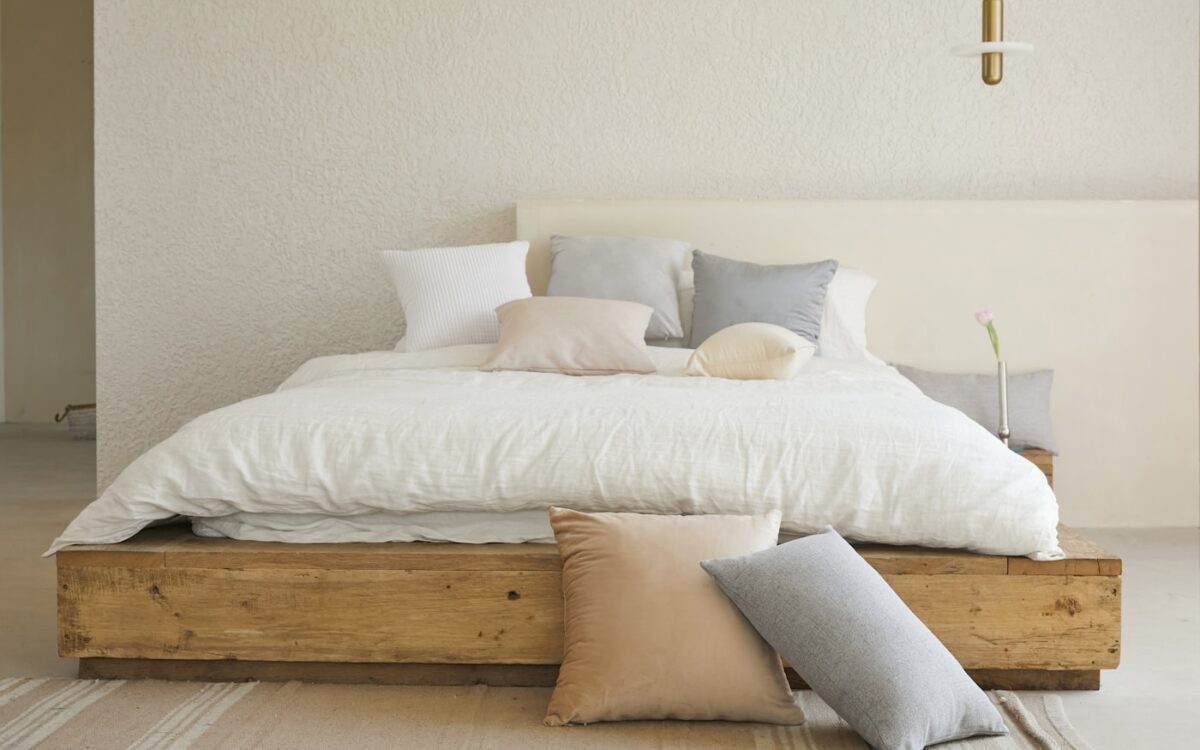
Feng Shui and the Bed Itself: Headboard, Frame, Storage
6 min read·
Updated
Most feng shui (风水 fēng shuǐ) advice about the bedroom is about where the bed goes. This is about the bed itself — the object you sleep on, before you have moved it an inch. A good feng shui bed is one thing held together: solid backing at your head, an open frame that breathes, and nothing stagnant stored inside or beneath it. Get the object right and placement becomes easier, because you are working with a piece of furniture that already supports rest rather than fighting it. This is Form School (峦头 luán tóu) thinking — the older, landform-reading branch of feng shui — applied to a single item.
A solid headboard: the mountain at your head
The most important feature of any bed is a solid, unbroken headboard. Practitioners call the support behind a sleeper the “mountain” (靠山 kào shān) — the backing that lets the nervous system stand down. A bed with no headboard, or with a slatted, barred, or cut-out one, leaves the crown of your head exposed to the open room and to whatever qi (氣 qì) — the vital current of a space — moves across it through the night.
Choose a headboard that is full, upholstered or panelled rather than open, and tall enough to rise above the pillows. Wood and padded fabric are the calm, grounding choices; a low bar of metal or a run of open rails gives the eye and the body nothing to rest against. Avoid two mattresses pushed together with a gap down the middle behind a split headboard — for a couple, one continuous headboard across a single frame reads as one shared support, which is the point. The headboard is where a feng shui bed either works or does not, so it is worth more attention than the rest of the frame combined.
风水 · Feng Shui
Find your lucky directions. Plot your chart free and see your feng shui Kua number and the directions that favour you — computed in your browser.
Under the bed matters as much as above it. Qi should be able to circulate freely around a sleeping body, which means the bed wants air moving beneath it. A frame that lifts the mattress a clear span off the floor, on legs, lets that current pass through. A divan or platform bed sealed to the ground, or a mattress laid straight on the floor, traps still, stagnant air right where you spend a third of your life unconscious.
Aim for a frame with visible legs and open space underneath, high enough to sweep a hand through but not so high the bed feels perched. In compact Singapore flats the instinct runs the other way — toward beds that sit low and store everything below — but the sleeping body does better with the floor clear and the air moving. If you already own a solid-base bed, the fix is less about replacing it and more about what you refuse to cram inside it, which is the next point.
Storage drawers and the clutter underneath
The single most common quiet problem we find in a feng shui bed is storage. Drawer beds, ottoman lift-up frames, and the ordinary habit of sliding boxes and suitcases underneath all fill the space beneath a sleeper with dense, stationary stuff. Qi stalls around it, and you sleep on top of a stagnant layer every night. Old paperwork, exercise gear, anything sharp or mechanical, and objects with unresolved emotional weight are the worst things to keep there.
The ideal is simple: keep the space under the bed open and empty. Where storage is genuinely unavoidable — and in a small home it often is — restrict it hard to soft, sleep-related items only: spare bedding, linen, off-season blankets, boxed and tidy rather than loose. Nothing with an active charge, nothing sharp, nothing to do with work. A drawer of clean linen is a mild compromise the room can absorb; a lift-up base packed with the overflow of a whole household is not. If you are weighing storage against space, our notes on small bedroom feng shui work through where to give ground and where to hold the line.
Second-hand and hand-me-down beds
A bed carries the imprint of its use, and a second-hand or hand-me-down bed carries someone else’s. This is one place where feng shui and plain sense point the same way. A bed passed on after a divorce, a serious illness, a death, or a bankruptcy is one we would gently steer a client away from, not because the frame is cursed but because you inherit the residue — and the associations — of a chapter that ended badly for its last owner.
A bed from a healthy, happy source, or from close family whose story you know and trust, is a different matter and can be perfectly sound. If the history is unknown, the caution is the same you would apply to any intimate object: a new mattress at minimum, a thorough clean of the frame, and a clear-eyed sense of where it came from. When the provenance is genuinely murky and the price is the only reason to keep it, a new bed is the cleaner start. The bed is the most personal object in the home; it is the last place to economise on a story you cannot verify.
Materials, shape, and the elements
The bed’s material and shape carry an element, and feng shui reads them through the same five elements (五行 wǔ xíng) — Wood, Fire, Earth, Metal, Water — that shape a Ba Zi (八字 bāzì) chart. Wood is the natural bedroom element: warm, growing, and calming, which is why timber frames and upholstered headboards feel restful. In the productive cycle Wood feeds Fire, so a heavily red, angular, or fiery bed can tip a room toward stimulation where you want stillness. A great deal of hard metal — bright chrome, sharp corners, a cold bar frame — brings a cutting, active quality that some sleepers find restless.
None of this is rigid. A metal-framed bed is not “bad”; it simply leans toward a more active element, and a room can balance it with soft textiles, timber nightstands, and grounding earth tones. Rounded or gently curved corners are kinder to the flow of qi than hard right angles pointing at the sleepers. Because feng shui is Ba Zi’s spatial sibling, the same element logic that guides a bed’s material also guides the room’s colours — worth reading together if you want the fuller picture rather than a single rule. Our primer on the five elements in Ba Zi sets out the cycles the room borrows.
Object first, then position
The bed as an object and the bed’s position are two layers, and this piece is only the first. Once the frame is sound — solid headboard, open base, nothing stagnant beneath, a story you trust — the next question is where it sits in the room and which way it faces. That is covered in depth in our guide to feng shui bed placement and position, and the personalised direction layer, judged against your own Kua number (本命卦 běn mìng guà), is deterministic and specific to you — so we compute it rather than guess it in an article.
Start with the object, because it costs nothing to get right and it sets the ceiling on how well any placement can work. When you are ready for the personal layer, plot your chart free with the calculator to find your governing element and, from there, the sleeping arrangement that suits you.