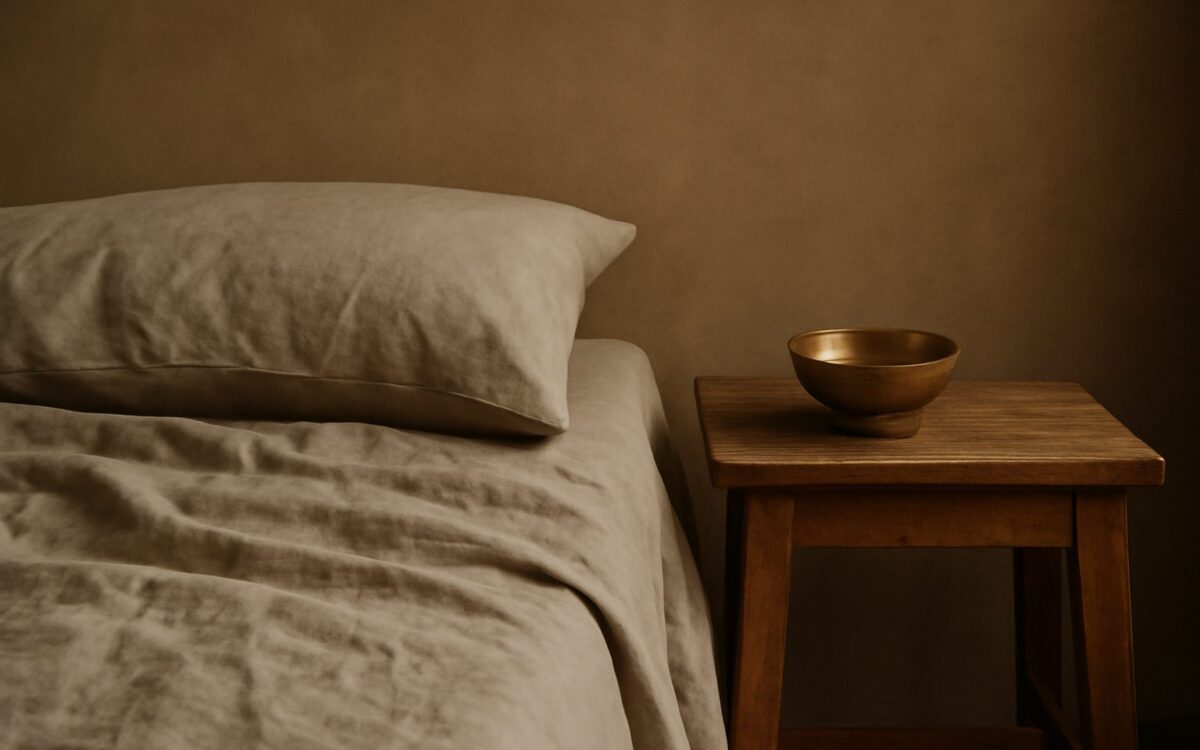
A good feng shui bedroom layout is less about lucky objects and more about where you put the heavy things and how the room breathes around them. Feng shui (风水 fēng shuǐ, “wind and water”) reads a space the way Ba Zi (八字 bāzì) reads a person, and the bedroom is where that reading matters most, because you spend a third of your life in it unconscious and undefended. Most of what follows is Form School (峦头 luán tóu) — the older, landform-and-placement tradition — which means it is universal and needs no birth date to apply.
Start from the commanding position
Before you place a single piece of furniture, find the commanding position (命位 mìng wèi). Stand at the doorway and look into the room. The bed wants to sit where you can see the door from your pillow without lying directly in its path — diagonally across from the door is the classic answer. The logic is plainly physical: a sleeper who can see who enters, yet is not in the line of traffic, settles more deeply. Everything else in the layout arranges itself around this one decision, so make it first.
Two things anchor the bed there. The headboard goes against a solid wall, not a window, so there is real support behind your head. And the foot of the bed should not point straight out through the open door — the old texts call that the “coffin position,” and while the name is dramatic, the discomfort of feet-first exposure to a doorway is genuine. If your only workable wall forces one of these compromises, our fuller treatment of feng shui bed placement and position walks through the trade-offs.
风水 · Feng Shui
Find your lucky directions. Plot your chart free and see your feng shui Kua number and the directions that favour you — computed in your browser.
The bed and its pair of nightstands
Once the bed is committed, the layout turns on symmetry. Flank the bed with two nightstands of roughly equal size — a matched pair, one on each side, with clear space to approach from both. In the Western Bagua (八卦 bā guà) map, which aligns the zones to the entrance rather than to true compass directions, the far corner of the bedroom from the door carries the Southwest 坤 Kūn zone of love and partnership, and a balanced pair of stands is the everyday way that principle shows up in a room: two people, two sides, equal footing.
This holds even if you sleep alone. A single nightstand jammed against one wall while the other side of the bed is shoved tight to a corner reads as a room built for one and closed to a second person. Leaving both sides open, each with its own small table and lamp, keeps the space hospitable to a partnership — present or future. Matched lamps reinforce it. None of this is decoration for its own sake; it is the layout quietly stating that there is room for two.
Wardrobe, storage, and the flow of qi
Tall, heavy pieces — the wardrobe, a chest, a bookcase — belong along the walls, ideally where they do not loom directly over the pillow. A wardrobe pressing close above the headboard creates a sense of overhead weight that works against rest; set it to the side or the far wall instead. The aim is for qi (气 qì), the room’s vital current, to move around the furniture rather than being trapped or forced into a narrow channel.
That flow is why clutter matters more here than anywhere. The space under the bed should stay open where possible, so air and attention pass freely beneath you; if storage is unavoidable in a small room, keep it to soft, sleep-related things like linens rather than a jumble of unrelated stuff. Keep pathways to the door and around the bed unobstructed. A room you can walk through cleanly in the dark is, almost always, a well-arranged room.
Reading the door and window lines
Layout is really the art of managing two lines: the door line and the window line. Qi enters at the door and moves toward the windows, and you do not want the bed marooned in that draft. Avoid placing the bed directly between the door and a window, where it sits in the through-current. Avoid the headboard under a window, where there is no solid support and the night’s temperature swings and light fall straight onto your head.
Where the room’s shape leaves no perfect wall, you choose the lesser compromise: a solid headboard wall usually wins, and a window behind the bed can be softened with a heavy curtain or a genuinely tall, firm headboard standing in for the missing wall. If a mirror on the wardrobe or dresser reflects the bed, reposition or cover it — a reflection facing the bed is one of the more disruptive layout faults, and one of the easiest to miss when you are arranging by daylight.
Keep work out of the sleeping zone
A desk in the bedroom is the modern layout’s hardest problem. The five elements (五行 wǔ xíng) explain why: a workstation carries active, striving Fire and Wood energy, while sleep wants the quiet, receptive quality of Water and Earth. Putting the two in one room asks the same space to stimulate and to settle, and it tends to do neither well. If the home genuinely has no other room for a desk, screen it off — a curtain, a low shelf, even turning the desk to face away from the bed — so the eye at rest does not land on unfinished work. The productive and controlling relationships behind these pairings are set out in our note on the five elements in Ba Zi, and the same cycles drive feng shui’s colour and material choices. In a studio, where one room carries every job, our guide to small apartment feng shui explains how to zone the space while keeping the commanding position.
Balance the room in the same spirit. A pair of anything — lamps, stands, small pieces of art — steadies a space more than a single striking object. Symmetry is not fussiness; it is the layout reading as calm. The living room follows a similar logic of balanced groupings, set out in our guide to arranging a living room for good feng shui.
The personalised layer: your Kua direction
Everything so far is Form School and applies to any sleeper. There is a second, Compass School (理气 lǐ qì) layer that personalises the arrangement: the Kua number (本命卦 běn mìng guà), computed from birth year and sex, sorts each person into an East group or a West group, each with four auspicious directions to orient the crown of the head toward. This is deterministic — a real formula and a fixed table, not something to eyeball — so we explain the system rather than guess your directions here. To fine-tune the bed’s facing once the layout is set, start with your birth chart on the free calculator and read how the groups work in feng shui bed direction. Get the Form-School layout right first, then let the Kua layer refine which way you sleep.