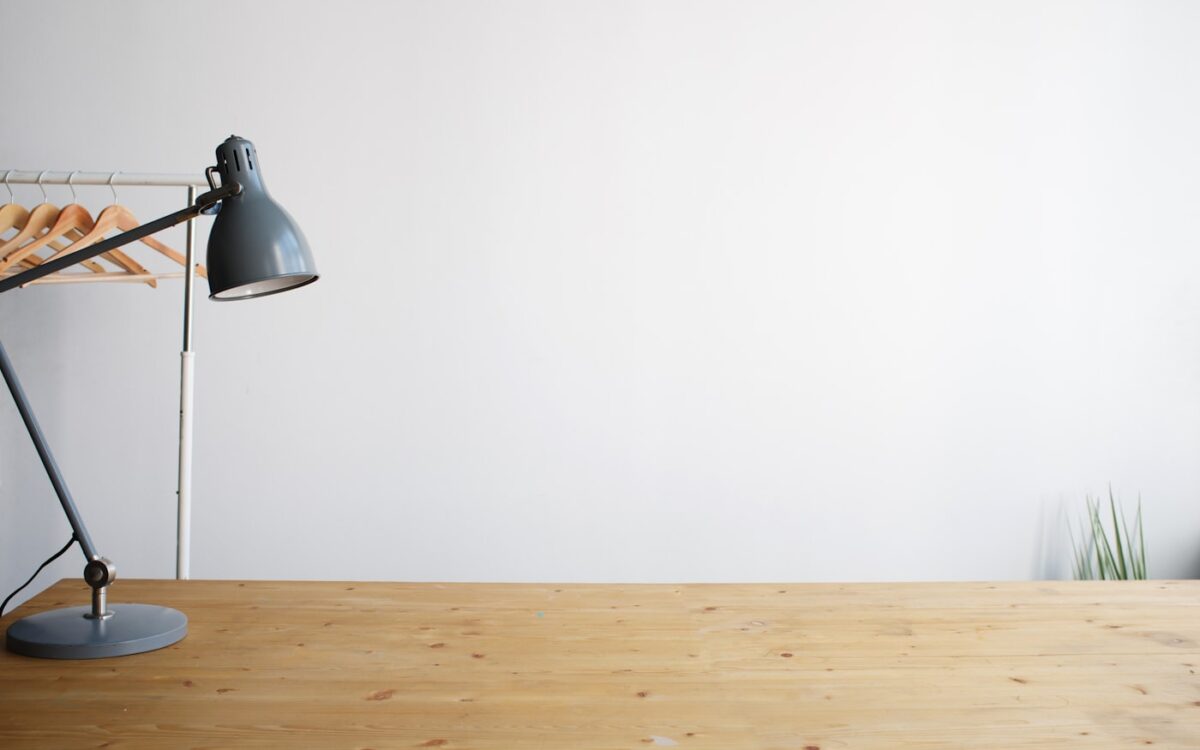
Good feng shui desk placement begins with one question that has nothing to do with luck: from where you sit, can you see who is coming? A desk is the seat you occupy for most of your working hours, and where it sits in the room shapes how supported, alert, and settled you feel. Feng shui (风水 fēng shuǐ, “wind and water”) reads the room the way Ba Zi (八字 bāzì) reads the person — and for a desk, the first and most useful principle is universal, requiring no birth data and no compass at all.
Start with the commanding position
The single most important rule in feng shui desk placement is the commanding position (命位 mìng wèi). It comes from Form School (峦头 luán tóu), the older branch of feng shui that reads the shapes and flow of a space rather than its compass directions. The idea is straightforward: you want to sit in a position of natural authority and awareness.
Three conditions make a commanding position:
You can see the door from your seat, so nothing approaches you unseen.
You are not directly in line with the door — placed diagonally opposite it is ideal.
Your back is to a solid wall, not a window or an open doorway.
Sitting with your back to the door is the classic mistake. The body never fully relaxes when its blind spot faces the entrance, and over long working days that low background tension shows up as distraction and fatigue. Facing a wall with your back to the room is a milder version of the same problem — you lose your sense of the space. A wall behind you gives what practitioners call a “mountain of support” (靠山 kào shān): something solid at your back, the way a good chair with a high back steadies you more than a stool.
If the room simply will not allow it — a fixed built-in desk, a shared office, a wall of windows — the common remedy is a mirror placed so you can see the door’s reflection while you work, restoring the line of sight the layout took away. For the wider room logic around this, see our guide to feng shui office layout.
风水 · Feng Shui
Find your lucky directions. Plot your chart free and see your feng shui Kua number and the directions that favour you — computed in your browser.
Once the desk sits in a commanding position, the second layer is which way you face while working. This belongs to Compass School (理气 lǐ qì), the branch that uses direction and time formulas rather than shapes. Here the system is deterministic — it is computed, not felt — so it is worth explaining honestly rather than hand-waving.
Each person has a Kua number (本命卦 běn mìng guà) from 1 to 9, calculated from birth year and sex. The Kua sorts everyone into one of two groups:
East group — Kua 1, 3, 4, and 9 — whose favourable directions are East, Southeast, South, and North.
West group — Kua 2, 6, 7, and 8 — whose favourable directions are West, Northwest, Northeast, and Southwest.
Within your group, the four auspicious directions each carry a flavour. 生气 (Sheng Qi) supports drive and success — often the one to face at a work desk. 天医 (Tian Yi) supports health and steadiness, 延年 (Yan Nian) supports relationships, and 伏位 (Fu Wei) supports stability and focus. Facing your Sheng Qi direction while you work is the classic desk application.
What no honest article can do is hand you a per-Kua table from memory. The exact birth-year-to-Kua formula differs by sex and across the year 2000, the Kua 5 case maps differently for men and women, and the year boundary sits near Li Chun (立春 lì chūn) in early February rather than 1 January — so a late-January birthday may belong to the prior year. Getting a direction wrong is worse than giving none. Compute your Kua from your birth data with the free calculator, then orient your chair toward the auspicious direction that suits the work.
A practical note: the commanding position wins where the two layers conflict. If facing your best direction means turning your back to the door, keep the commanding position and choose the best-facing direction available within it. Form first, compass second.
What to keep on the desk
The surface itself carries qi (气 qì), the vital current feng shui works with. The governing principle is simple — clear surfaces let energy move; clutter stalls it. A desk buried under paper reads, quite literally, as unfinished business that never leaves your field of view. Keep only what the current work needs to hand.
Beyond clearing, a few placements help:
Solid back corner. The far corner of the desk, on the side away from the door, is the support corner. A small solid object there — a stone, a heavy book, a short lamp — reinforces your “mountain.”
The far-left wealth area. Looking at your desk from your chair, the far-left zone maps to wealth and growth in the Bagua (八卦 bāguà). A small healthy plant here is the common choice, as Wood energy suits growth. Keep it genuinely alive; a dying plant does the opposite of what you want.
A little open space in front. The area directly before you, called the “bright hall” (明堂 míng táng), wants to stay open — a clear patch of desk gives thinking room, the way a courtyard gives a building air.
Materials with intention. Timber and stone read as grounded and enduring; a small metal object sharpens focus. These map to the five elements (五行 wǔ xíng), whose productive and controlling cycles are the same ones that run through the five elements in Ba Zi — feng shui is simply that logic applied to a room.
Avoid the obvious drains: sharp edges or shelf corners pointing at your seat (a “poison arrow”), a mirror reflecting your screen, and the tangle of cables and clutter that gathers under the desk where you cannot see it but still sit above it all day.
Fitting the desk to the whole room
A well-placed desk still lives inside a larger space, and the two should agree. In a dedicated workspace, the desk anchors the room and everything else arranges around it — the reasoning we lay out in feng shui for the office. When the desk shares a room with the rest of your life, the trade-offs shift; our guide to the feng shui home office covers working from home, and the feng shui hub connects the room-by-room pieces.
Placement, direction, and a clear surface are the three levers, and they build on each other in that order — command the room first, then face your direction, then tend what sits on the desk. To find the facing direction that is actually yours rather than a generic one, compute your Kua and elements from your birth data with the free Ba Zi calculator, and set your chair to face the way that supports the work in front of you.