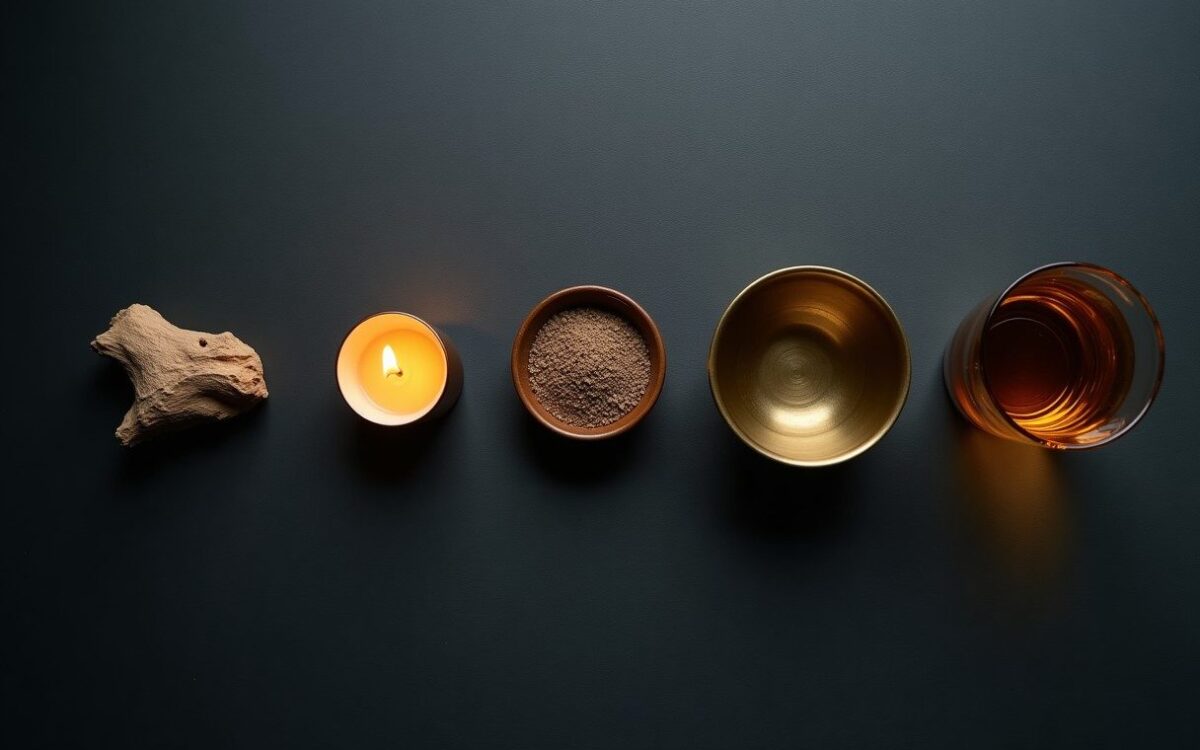
The five elements, 五行 (wǔ xíng), are Wood, Fire, Earth, Metal and Water. They are the framework under almost every Chinese tradition we write about: Ba Zi, feng shui, the calendar, face reading and traditional medicine all use them. This page is the overview. It covers what the elements are, how they relate, and what each one is matched with.
What “five elements” really means
The English word “element” suggests five substances that make up the world, like the Greek earth, air, fire and water. That is not quite the Chinese idea. The character 行 (xíng) means “to move” or “to act”. Many scholars prefer to translate 五行 as the five phases or five agents.
So Wood is less “timber” than the quality of growth: the push of a shoot in spring. Fire is the height of activity, Metal is contraction and harvest, Water is rest and storage, and Earth is the steady centre that every change passes through. The elements describe how things change, not what they are made of.
They sit inside the older pairing of yin and yang. Each element has a yang and a yin form, which is how five elements become the ten Heavenly Stems.
The two cycles
The elements matter because of how they relate. Two cycles carry most of the meaning.
- The generating cycle (相生 xiāng shēng): Wood feeds Fire, Fire makes Earth (ash), Earth bears Metal (ore), Metal carries Water (condensation on cool metal), and Water nourishes Wood.
- The controlling cycle (相克 xiāng kè): Wood parts Earth (roots break soil), Earth dams Water, Water puts out Fire, Fire melts Metal, and Metal cuts Wood.
Neither cycle is good or bad. Generating can smother, the way too much water rots a plant. Control can be useful, the way a riverbank keeps water on course. Our page on the five elements in Ba Zi goes into how a chart reader weighs these relations, and why counting elements gives the wrong answer.
The five elements table
Over two thousand years, Chinese thinkers matched each element with a direction, a season, a colour and much more. The table below gives the correspondences most often used today.
| Element | Direction | Season | Colour | Stems | Branches |
|---|---|---|---|---|---|
| Wood 木 | East | Spring | Green | 甲 乙 | 寅 卯 |
| Fire 火 | South | Summer | Red | 丙 丁 | 巳 午 |
| Earth 土 | Centre | Season transitions | Yellow | 戊 己 | 辰 戌 丑 未 |
| Metal 金 | West | Autumn | White | 庚 辛 | 申 酉 |
| Water 水 | North | Winter | Black, dark blue | 壬 癸 | 亥 子 |
Earth is the odd one out. It has no season of its own. Instead it governs the passage between seasons, which is why four of the twelve branches (辰 戌 丑 未) are Earth. The stems and branches are explained in full in our guide to heavenly stems and earthly branches.
Other correspondences
- Planets: the Chinese names of the five visible planets follow the elements. Jupiter is 木星 (the Wood star), Mars 火星, Saturn 土星, Venus 金星 and Mercury 水星.
- Virtues: Confucian writers paired benevolence 仁 with Wood, propriety 礼 with Fire, trust 信 with Earth, righteousness 义 with Metal and wisdom 智 with Water.
- Numbers: the He Tu diagram gives 1 and 6 to Water, 2 and 7 to Fire, 3 and 8 to Wood, 4 and 9 to Metal, and 5 and 10 to Earth. These pairs are used in feng shui and in reading lucky numbers.
- The body: traditional Chinese medicine pairs Wood with the liver, Fire with the heart, Earth with the spleen, Metal with the lungs and Water with the kidneys, plus a taste and an emotion for each. We mention this as cultural background only. It is not medical advice, and we do not give any.
Where the idea comes from
The earliest list of the five appears in the “Great Plan” chapter of the Book of Documents, 《尚书·洪范》, which names them in the order Water, Fire, Wood, Metal, Earth. In the Warring States period, the philosopher 邹衍 (Zōu Yǎn) built them into a theory of change that was applied to seasons, dynasties and the cosmos. By the Han dynasty the correspondences were everywhere, from court ritual to the calendar.
That long history is why the system can look inconsistent. Different schools added correspondences at different times, and not every table agrees in every detail. One correspondence that still draws questions, the pairing of elements with organ systems, is weighed carefully in health in Ba Zi.
How the elements are used today
- Ba Zi: every stem and branch in a birth chart has an element, and the reading turns on how they support and restrain one another. The Chinese zodiac elements page shows how a birth year gets its element, and why that is only one layer of the chart.
- Feng shui: elements guide colours, materials and placement. Our page on your feng shui birth element covers the personal side.
- Face reading: the five element face shapes sort faces by their outline.
- The calendar: every year, month, day and hour carries a stem and a branch, so every moment has an elemental character.
Finding your own elements
People often ask “what element am I?” The common answer, from the birth year alone, is the weakest one. In Ba Zi, the element that describes you is your Day Master, the stem of your birth day, and it is read against the other seven characters of your chart.
The quickest way to see yours is to plot your chart. Our free Ba Zi calculator shows all eight characters with their elements in a few seconds, in your browser.