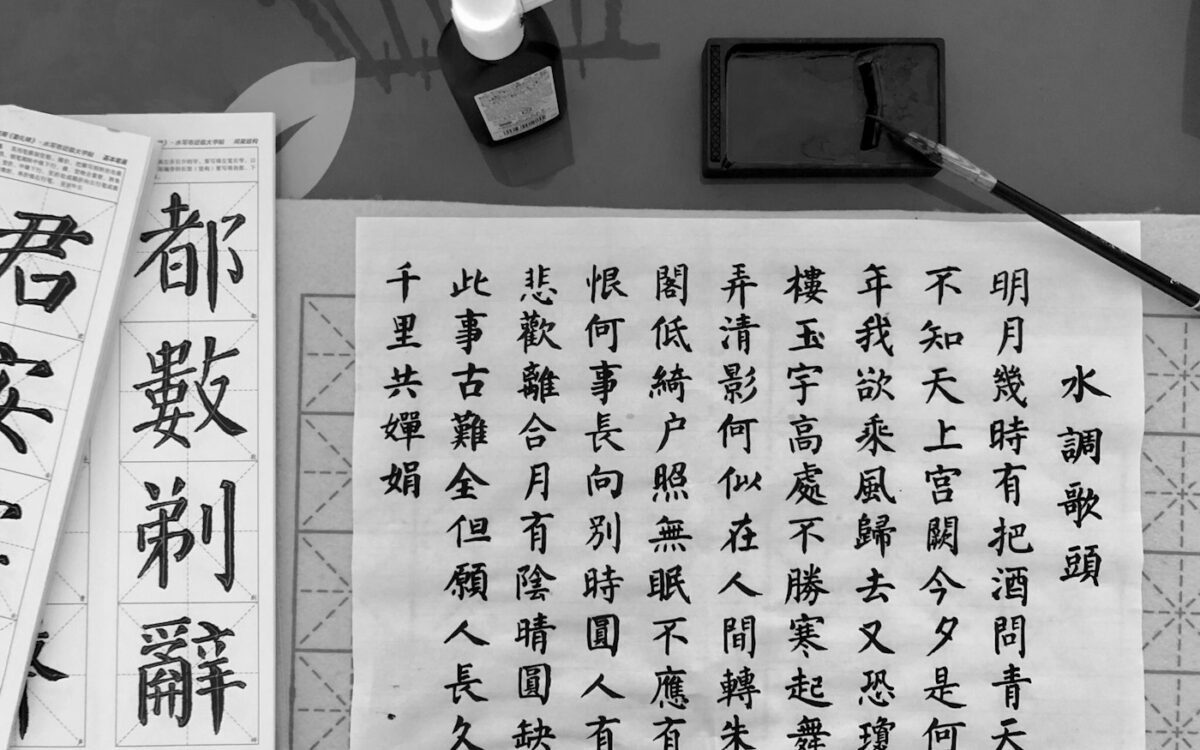
Ba Zi is written in an alphabet of exactly twenty-two characters: ten heavenly stems (天干 tiāngān) and twelve earthly branches (地支 dìzhī). Every year, month, day and hour is one stem sitting on one branch. Learn the alphabet and charts stop looking like magic — the same twenty-two characters, recombined, are the entire vocabulary of the system.
The ten heavenly stems
The stems are the five elements, each in a yang and a yin form: Jiǎ 甲 and Yǐ 乙 (Wood), Bǐng 丙 and Dīng 丁 (Fire), Wù 戊 and Jǐ 己 (Earth), Gēng 庚 and Xīn 辛 (Metal), Rén 壬 and Guǐ 癸 (Water). Yang forms act outwardly — the bonfire, the river. Yin forms work by influence — the lamp flame, the morning dew. The pairing matters more than the element: two Fire people can share an element and nothing else.
Stems are the visible, active layer of a chart. They sit on top of each pillar, they interact directly with one another, and one of them — the day stem — is your Day Master, the character the whole chart is measured against. When practitioners say a chart “shows” something plainly, they usually mean it is written in the stems.
The twelve earthly branches
The branches are better known by their animal names — Zǐ 子 the Rat through Hài 亥 the Pig — but the animals are mnemonics, not meanings. Each branch is a slice of the year and a slice of the day: Yín 寅 is the first month of spring and 3–5 a.m.; Wǔ 午 is midsummer and midday. When a reading mentions your animal, it is reading one branch out of four.
Where stems are weather, branches are terrain. They are the seasonal, rooted layer — slower to act, harder to change, and the place where a stem either finds footing or floats. A stem with a matching element in the branches beneath it is “rooted” and behaves with far more force than one without.
Why ten stems but twelve branches
The counts differ because they measure different things. The stems count the five elements twice over — once yang, once yin. The branches count the twelve stations of the year and of the day: twelve months from one Li Chun (立春 lìchūn) to the next, twelve double-hours around the clock. Ten describes qualities; twelve describes positions in time. A pillar needs both: what the energy is, and where in the cycle it stands.
The mismatch also produces the pairing logic. Stems and branches combine strictly like-with-like: yang stems sit only on yang branches, yin stems only on yin branches. That halves the possible pairings from 120 to sixty — the sixty-cycle below — and it is why you will never meet a Jiǎ Chǒu or a Yǐ Zǐ pillar in a correctly plotted chart.
Hidden stems: what the branches conceal
Here is the part the beginner guides skip: every branch contains one to three hidden stems (藏干 cánggān). Yín 寅 carries Jiǎ 甲 Wood as its main qi, plus Bǐng 丙 Fire and Wù 戊 Earth. That is why two charts with identical visible elements can behave completely differently — the basement inventory differs. It is also why counting visible elements is a rough sketch at best, as we discuss in The Five Elements in Ba Zi.
The full inventory, branch by branch — first stem listed is the main qi (本气 běnqì), the dominant voice:
| Branch | Animal | Hidden stems (main qi first) |
|---|---|---|
| Zǐ 子 | Rat | Guǐ 癸 (Yin Water) |
| Chǒu 丑 | Ox | Jǐ 己 (Yin Earth), Guǐ 癸 (Yin Water), Xīn 辛 (Yin Metal) |
| Yín 寅 | Tiger | Jiǎ 甲 (Yang Wood), Bǐng 丙 (Yang Fire), Wù 戊 (Yang Earth) |
| Mǎo 卯 | Rabbit | Yǐ 乙 (Yin Wood) |
| Chén 辰 | Dragon | Wù 戊 (Yang Earth), Yǐ 乙 (Yin Wood), Guǐ 癸 (Yin Water) |
| Sì 巳 | Snake | Bǐng 丙 (Yang Fire), Wù 戊 (Yang Earth), Gēng 庚 (Yang Metal) |
| Wǔ 午 | Horse | Dīng 丁 (Yin Fire), Jǐ 己 (Yin Earth) |
| Wèi 未 | Goat | Jǐ 己 (Yin Earth), Dīng 丁 (Yin Fire), Yǐ 乙 (Yin Wood) |
| Shēn 申 | Monkey | Gēng 庚 (Yang Metal), Rén 壬 (Yang Water), Wù 戊 (Yang Earth) |
| Yǒu 酉 | Rooster | Xīn 辛 (Yin Metal) |
| Xū 戌 | Dog | Wù 戊 (Yang Earth), Xīn 辛 (Yin Metal), Dīng 丁 (Yin Fire) |
| Hài 亥 | Pig | Rén 壬 (Yang Water), Jiǎ 甲 (Yang Wood) |
Notice the pattern: four branches carry a single stem, and the rest carry a main qi plus one or two residual voices. In practice the main qi does most of the work; the minor stems matter at the margins and in combination years. For worked examples of how the hidden layer changes a reading, see the hidden stems reference table.
The sixty pairs
Stems and branches combine in a fixed sixty-step cycle (六十甲子 liùshí jiǎzǐ), opening with Jiǎ Zǐ 甲子 — which is why the same year pillar returns every sixty years, and why your 60th birthday is a homecoming in the calendar’s own terms. Days follow the same sixty-cycle, unbroken, which is how the calculator can compute your day pillar for any date since 1930.
How to use the alphabet
Start small. Find your four stems and four branches, and for each branch note its main qi from the table above — that alone tells you more than any animal summary. Then ask the practitioner’s questions: which stems are rooted in the branches below them, and what does the hidden layer add to the visible count? Those two questions turn the alphabet into reading.
From there, the rest of the system is combinations of these twenty-two characters: the Ten Gods are stem-to-stem relationships, clashes and harmonies are branch-to-branch relationships, and luck pillars are simply more stem-branch pairs arriving on schedule. Nothing new is ever added to the vocabulary — which is precisely why the alphabet is worth an evening of study.
Ready to see which of the twenty-two characters you are built from? Plot your chart, then start with how to read it.