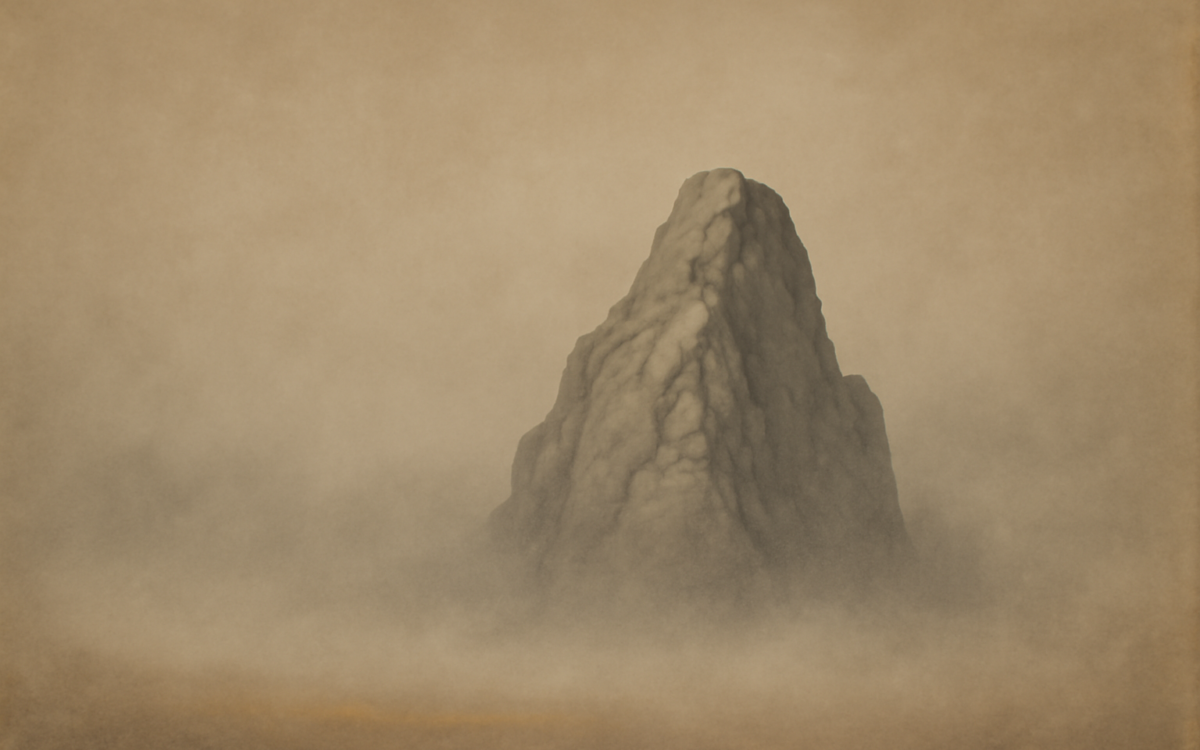
Hexagram 15, 謙 Qiān (Modesty, sometimes rendered Humbling), is one of the quietly favourable figures in the Book of Changes. It sets Kun (坤 kūn), Earth, above and Gen (艮 gèn), Mountain, below. The composition is striking: the mountain, the tallest thing in the landscape, sits beneath the level plain of the earth. What is by nature high has taken the low place. That single picture carries the whole meaning of the hexagram.
In most figures the strong element rises and the yielding settles. Here the order is inverted on purpose. Greatness is present, mountain-sized, but it is held under the surface rather than shown off. This is why hexagram 15 is read as genuine modesty rather than mere meekness. Modesty in the I Ching is not smallness; it is real substance that does not need to announce itself.
The two trigrams: mountain beneath earth
Gen, the Mountain, is the trigram of stillness and of keeping firm — solid, weighty, immovable. Kun, the Earth, is receptive, level, yielding. When the mountain sits inside the earth, the immovable strength is real but covered. Nothing about the surface boasts of what lies underneath.
Read as a person, this is someone of genuine capacity who carries it lightly. The strength (Gen) is inward and grounding; the outward manner (Kun) is even and unassuming. In a reading, hexagram 15 tends to describe a moment where holding back, levelling yourself with others, and letting the work speak will carry further than display.
易经 · Book of Changes
Cast your own hexagram. Six throws build your hexagram and any changing lines, each linked to a plain reading. Free, in your browser.
The overall counsel of Qiān is unusually warm. Where many hexagrams promise success only under conditions, this one suggests that the modest person carries matters through to completion. The traditional line of thought is that heaven pours down and brightens what is low, and the earth’s low places let the high find its level — so the humble are not diminished but raised.
The practical translation is simple. Success here is not seized; it accrues. The person who does not push to the front, who reduces where there is too much and adds where there is too little, meets less resistance and finishes what they start. Modesty is treated as an active discipline of balancing, not as passivity. It is the one attitude that other people rarely resent, which is why it opens doors that force closes.
The Image: bringing the high down to the low
The natural picture is the mountain hidden within the earth. The lesson drawn from it is one of levelling: the person of hexagram 15 takes from where there is excess and gives to where there is lack, so that things are made even. Rather than let a high point tower and a low point languish, the modest hand evens the distribution.
In conduct this means trimming your own claims and reinforcing what is weak around you. You do not flatten yourself into nothing; you bring what is inflated down to a workable level and lift what is neglected. That evenness is the source of the hexagram’s staying power — even ground does not collapse the way a top-heavy structure does.
Practical guidance: work, relationships, timing
In work, hexagram 15 favours the person who does the job well and lets recognition arrive on its own schedule. Take the lower seat, credit the people around you, and keep your genuine strength in reserve rather than on display. This is a good figure for negotiation, for joining an established group, and for any situation where others are watching to see whether success has made you overbearing.
In relationships, it counsels evenness — not making yourself large at another’s expense, not competing to be seen. Listening more than asserting tends to deepen trust here. In timing, this is not a moment to seize the front. It is a moment to consolidate quietly; advantage comes to the one who is content to be underestimated for a while.
As always, read this as tendency rather than verdict. Hexagram 15 describes where the current is running, not a fixed outcome. The counsel is that a modest, levelling posture is the one most in tune with the moment — not that any particular result is guaranteed.
Changing lines: where Modesty shifts
The lines of Qiān are among the steadiest in the whole book; modesty is one of the few qualities the I Ching treats as favourable at every stage. Still, the way a line changes tells you where the situation is tending. When a moving line turns Gen (the lower Mountain) into another trigram, the figure moves toward the family of hexagrams around Gen and Kun — for instance toward its neighbour Hexagram 16, 豫 Yù (Enthusiasm), where held-back strength is released into movement and response.
The reading practice is straightforward. Note which lines are changing, let them mark the active edge of the situation, and follow them to the resulting hexagram to see where modest ground is moving next. A tool casts and computes the lines; the interpretation is where the judgement lives.