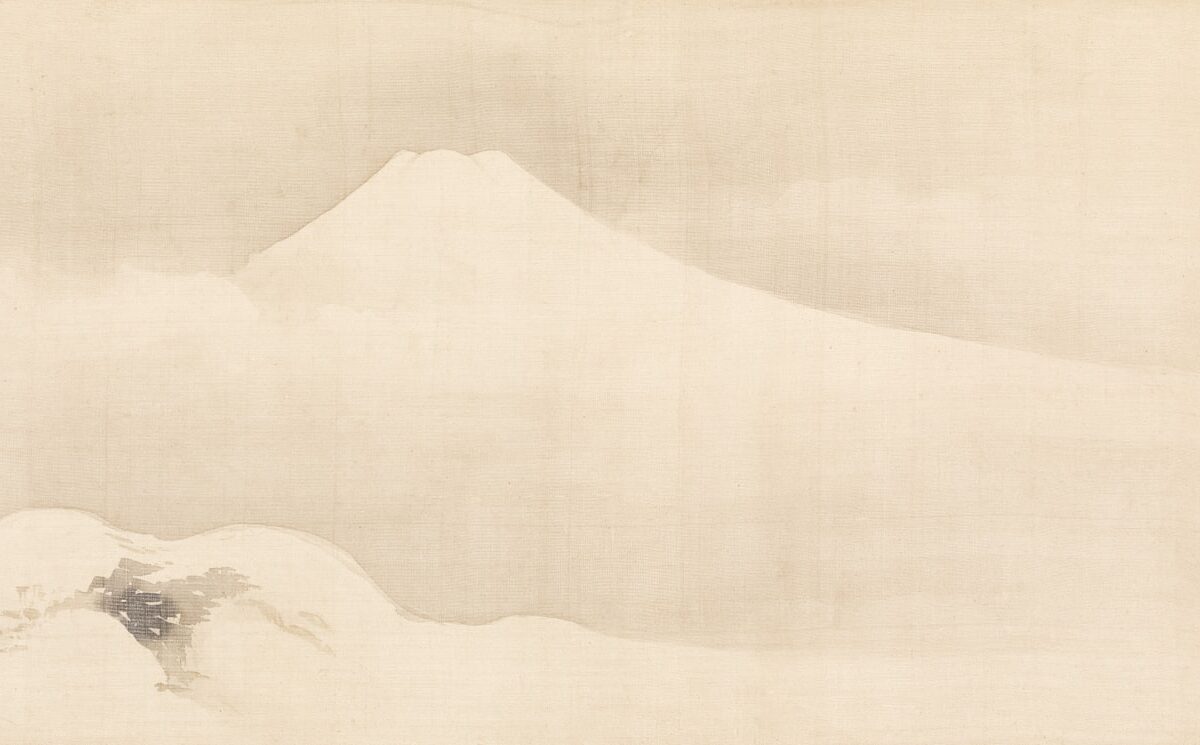
Hexagram 26 is 大畜 (dà xù), usually rendered Great Taming or Great Accumulating. It sets the trigram Gen (艮 gèn), Mountain, above the trigram Qian (乾 qián), Heaven. A mountain holding the whole sky within it is a large image: the greatest creative force there is, gathered and held still by the keeping quality of the mountain. This is what hexagram 26 pictures — not force spent, but force stored.
Where its neighbour 小畜 (xiǎo xù), Small Taming, restrains by gentle influence, Great Taming restrains by weight and character. The energy underneath is Heaven itself, strong and upward-moving. The mountain does not fight it; it contains it, the way a reservoir holds a river without stopping the water from being powerful. The lesson of the pairing is that real strength is measured by how much can be held in reserve, not how much is discharged at once.
The Judgment: strength held for a worthy use
The Judgment of hexagram 26 counsels perseverance and, in a phrase, that it “furthers one to cross the great water” — that is, a large undertaking is supported. But the crossing comes after the holding, not instead of it. The counsel is twofold. First, that the person who accumulates great strength should not consume it privately; the classic reading favours not taking one’s nourishment privately at home, meaning to put one’s gathered resources into public service rather than hoard them.
Second, that restraint here is a form of respect for one’s own power. To tame something great, you must be great enough to tame it — steady, disciplined, and clear about why the force is being held back. In practitioner terms, hexagram 26 describes a season of building capital of every kind: knowledge, capability, reputation, means. The counsel is to keep gathering, keep your conduct firm, and trust that the accumulation itself is the work, so that when the moment to act arrives the reserve is deep enough to matter.
易经 · Book of Changes
Cast your own hexagram. Six throws build your hexagram and any changing lines, each linked to a plain reading. Free, in your browser.
The Image of Great Taming is Heaven within the Mountain. The lesson drawn from it is that the superior person acquaints themselves with the words and deeds of the past in order to strengthen their character. The picture teaches by analogy: a mountain contains vast stores of stone and ore, formed over long time and held motionless until they are needed. So the person under this hexagram stores up what has been learned before — the sayings, the histories, the tested examples — and lets that inheritance become inner substance.
This is why hexagram 26 is often read as a scholar’s or a builder’s sign. The accumulation it favours is not only material. It is the daily, unglamorous storing of what is durable: study, practice, savings, and the slow firming of one’s own conduct. The mountain does nothing dramatic, yet everything of value is inside it.
Practical guidance: what this hexagram tends toward
In work, hexagram 26 tends to favour consolidation over expansion. It is a good season to deepen skill, build reserves, and prepare a large project rather than launch it prematurely. Energy is present in abundance; the discipline is to hold and direct it. Impatience is the classic error here — discharging strength for a small return when holding it a little longer would allow a great one.
In relationships, the pattern points to steadiness and restraint that carry respect rather than coldness. Strong feeling is held with dignity, not vented. A bond built under this influence tends to draw on shared values and a stored history together, which is why it can support a large joint undertaking when the time comes.
On timing, read hexagram 26 as tendency rather than verdict: the accumulating phase is not the acting phase, but it is what makes the acting phase possible. If you are holding back and it feels like waiting, the hexagram suggests the waiting has substance. When the reserve is genuinely deep, the same energy that was contained becomes the strength to cross the great water. You can explore how this restraint-then-release rhythm shows up in your own timing through the free Ba Zi calculator.
Changing lines: how Great Taming shifts
Changing lines are the active edge of a reading — the places where hexagram 26 is already moving toward something else. The lower lines tend to describe restraint met early: holding back at the outset, when pressing forward would meet danger, and the merit of not forcing the way. The upper lines describe the accumulation ripening — the point where what was tamed is finally released upward and the stored strength finds its road, often read through the image of the way of heaven opening at the top.
Which lines are moving reshapes the counsel, and flipping them yields a second hexagram that names where the situation tends. A single changing line at the top, for instance, moves toward a very different picture of nourishment and what is taken in. For the fuller map of how each figure relates, see the overview of all 64 hexagrams, the neighbouring Hexagram 27, 頤 Yí, and the I Ching hub for how casting and changing lines work together.
Read hexagram 26 as an invitation to build quietly and hold what you gather until it is deep enough to serve. To see how the same trigrams and elements run through your own chart, plot it free with the Ba Zi calculator.