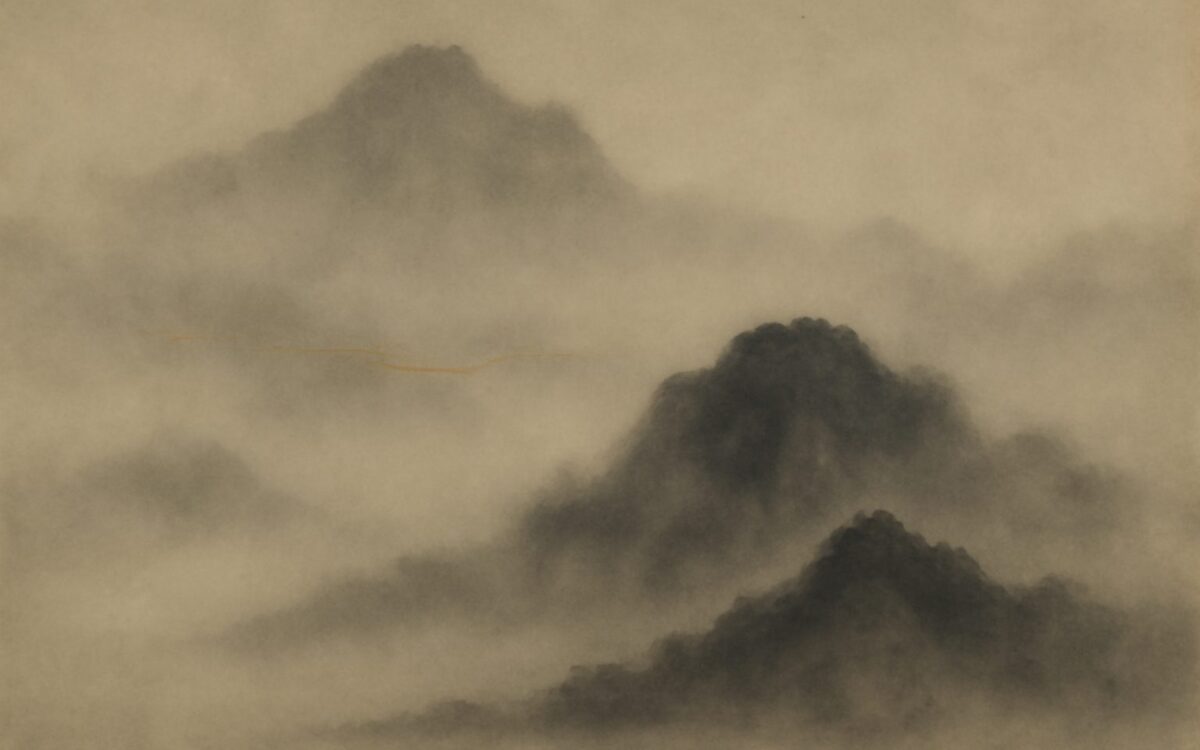
Hexagram 56, 旅 (lǚ) — The Wanderer, sometimes rendered Sojourning — is one of the traveller’s figures in the Book of Changes. It pairs the trigram Li (離 lí), Fire, in the upper place over the trigram Gen (艮 gèn), Mountain, in the lower place. The mountain sits still while fire moves across its slope, never resting on any one point for long. That is the whole picture of the hexagram in a single image: something bright and quick passing over something solid that stays behind. You are the flame, not the mountain. You are moving through a place that is not your own.
Read the two trigrams together and the mood becomes clear. Gen is stillness, keeping-in-place, the ground you cannot take with you. Li is brightness, clarity, the seeing eye — but also fire, which cannot linger or it consumes what holds it. The Wanderer is the condition of being far from home, dependent on the goodwill of strangers, carrying little and owning less. In 旅 Lǚ the small and correct move succeeds; the large ambition does not belong to a traveller’s circumstance.
The Judgment — success in small things
The counsel of hexagram 56 is modest and specific. A wanderer can meet with a measure of success, but only through smallness, care, and correct conduct. This is not the place for grand undertakings. A traveller who throws their weight around, who behaves in a borrowed house as if it were their own estate, quickly loses the shelter and goodwill they depend on.
The practitioner’s reading is this: when you are on unfamiliar ground, your assets are reserve, courtesy, and clear sight — not force or accumulation. Keep your affairs light enough to carry. Stay reserved with those you do not yet know. Persevere in what is upright and you keep the standing that lets a stranger be treated well. The Judgment does not promise arrival; it promises that good conduct on the road is what keeps the road open.
易经 · Book of Changes
Cast your own hexagram. Six throws build your hexagram and any changing lines, each linked to a plain reading. Free, in your browser.
The Image — fire on the mountain
The Image of the Wanderer shows fire on the mountain, moving grass to grass, never staying. The lesson the old commentary draws from it concerns how the wise person handles matters that cannot be held over — chiefly, questions of punishment and delay. Fire does not dwell; so the counsel is to be clear and swift where a matter must be settled, and never to let disputes or penalties drag on the way a fire is not allowed to smoulder.
In plainer working terms: a traveller cannot afford lingering conflict. What is unresolved becomes a weight, and a weight is the one thing the Wanderer must not carry. Settle cleanly, keep clarity like Li’s own brightness, and move on without a trail of unfinished business behind you. The stillness of the mountain reminds you where your caution should sit; the passing of the fire reminds you not to make a permanent home of a temporary situation.
Practical guidance — reading the tendency
As a tendency rather than a verdict, hexagram 56 tends to come up around situations of transition, unfamiliarity, and reduced footing. In work, it favours the consultant, the visitor, the newcomer, the one operating outside their own territory. The move that succeeds here is the small, correct, well-mannered one: doing the job cleanly, keeping your overheads light, not overreaching in a room where you have no seniority yet. Guard your reputation and your composure — for a traveller these are the only capital that carries.
In relationships, the Wanderer speaks to a phase of not-quite-belonging: a connection where you are the guest, or a period when you feel between homes. The counsel is warmth without presumption. Offer courtesy, do not demand permanence, and let trust be earned rather than assumed. On timing, this is a passing condition. The situation is in motion by nature, so read it as a stage to move through with care, not a place to dig in.
The classic mistake under this hexagram is to behave as though the ground were yours — to accumulate, to assert, to settle disputes by weight. That is how the Wanderer loses shelter. Travel light, stay clear-eyed, keep your conduct correct, and the small things go well.
Changing lines — where it can shift
Because the Wanderer is a hexagram of motion, its lines describe the stages of a journey — the anxious beginning, the shelter found and the shelter lost, the standing gained among strangers. A changing line marks the point where the situation is actively turning, and flipping it yields a second hexagram that shows where the road tends. Keep the same principle across whichever line moves: smallness and correctness protect the traveller, while grasping and lingering expose them. Read the moving line as the live edge of the moment, and the hexagram it points to as the direction of travel, not a fixed destination.
The I Ching describes the shape of a moment and where it is tending, not a settled fate. To see how the same trigrams and five-element logic play out in your own chart — the fire, the mountain, and how you meet the world — plot your Four Pillars free with the Ba Zi calculator. For more on the Book of Changes, start at the I Ching hub or browse the full hexagram overview and read the Wanderer alongside its neighbour, Hexagram 57, 巽 Xùn.
Read in sequence · Previous: Hexagram 55, 豐 Fēng (Abundance) · Next: Hexagram 57, 巽 Xùn (The Gentle)