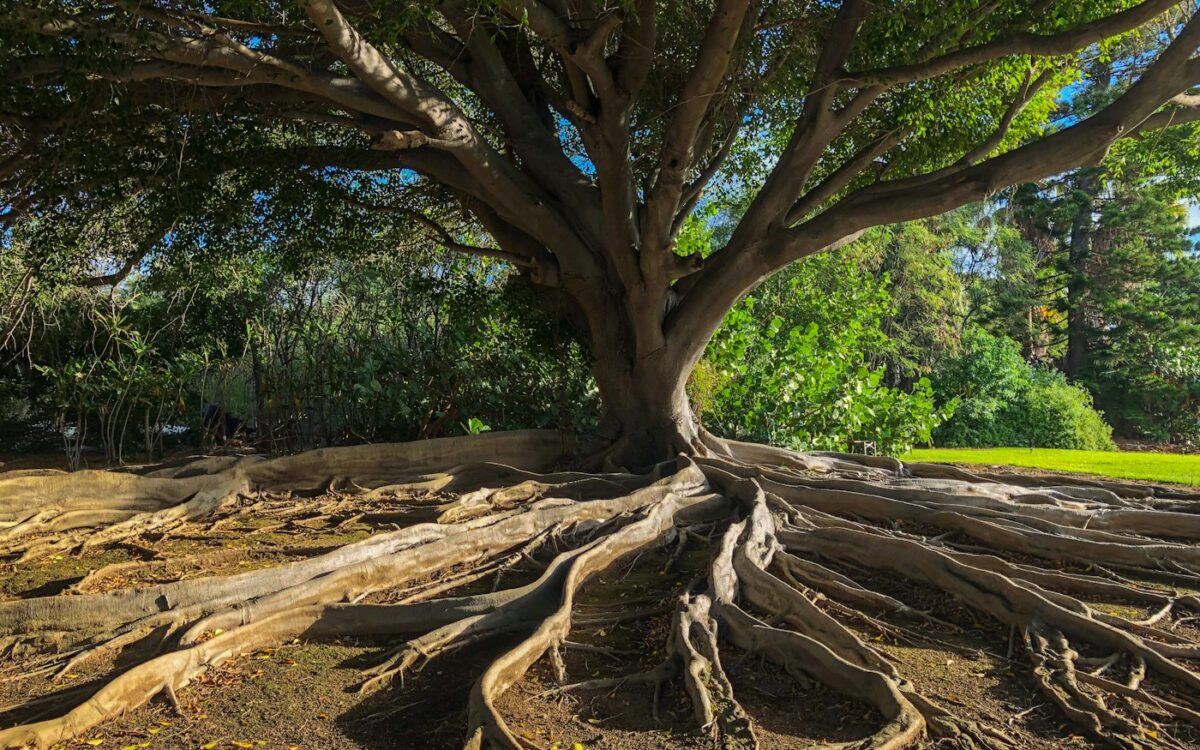
The Jia Yin day pillar (甲寅 jiǎ yín) stacks Yang Wood on the Tiger, itself a Wood branch. Jiǎ (甲 Yang Wood) is the tall tree, and Yín (寅 the Tiger) is its own native ground — the branch where Jiǎ finds its root and its full strength. This is a great tree standing in its own forest, roots sunk deep into home soil. Wood on Wood, it is one of the most self-rooted pillars in the sixty, and everything about it speaks of standing firm.
Because the day pillar is your seat in your own chart, Jia Yin describes a person who meets the world from a settled base — hard to move, sure of where they stand.
Personality
Jiǎ is the upright, pioneering stem — principled, forward-growing, the natural lead tree in any stand. On the Tiger, that uprightness is anchored. The branch’s main energy reads as Friend (比肩 bǐjiān) to the Day Master, the companion star, and because the Tiger is Jiǎ’s own root, it lands as deep self-assurance rather than mere company.
So this is a strongly self-possessed pillar. Jia Yin people tend to be independent, resolute and generous within their own domain — leaders who look after those under their canopy and do not bend easily to pressure. The shadow of that root is stubbornness: certainty can shade into inflexibility. Beneath the trunk, the Tiger also stores an Eating God and Indirect Wealth, which adds warmth, expressiveness and a real enterprising streak — this tree not only stands, it produces and provides. Read Jia Yin as rooted integrity with a warm, capable side, and a genuine need to be its own authority.
The spouse palace
In Ba Zi (八字 bāzì) the day branch is the spouse palace, the seat of one’s partner. The Tiger holds three hidden stems, so this seat mixes self, warmth and wealth in one place.
| Hidden stem | Ten God (relative to Jiǎ) |
|---|---|
| Jiǎ 甲 (Yang Wood) | Friend (比肩 bǐjiān) |
| Bǐng 丙 (Yang Fire) | Eating God (食神 shíshén) |
| Wù 戊 (Yang Earth) | Indirect Wealth (偏财 piāncái) |
For a Jiǎ man, wealth is the wife star, and Indirect Wealth sitting in the spouse palace is a favourable placement — a capable, resourceful partner seated where partnership belongs. What makes it flow is the Eating God beside it: warmth and output that produce that wealth, so the classic reading is a marriage where the native’s generosity and expression feed the partnership. The note to handle is the Friend leading the seat: a strongly independent native has to make deliberate room, since a self that fills the whole space leaves little for a partner. Read calmly, this is a warm, resourceful marriage that asks its lead tree to share the light.
Two branch relations touch this seat from outside. The Tiger clashes with the Monkey (寅↔申) — instability signals when a 申 sits in the natal branches or arrives by luck pillar or year — and combines with the Pig toward Wood (寅+亥→Wood), a binding influence that deepens the root. The method for weighing such touches is set out in our guide to the spouse palace.
Reading a Jia Yin chart step by step
If Jia Yin turns up in your day position, work it in this order. First, confirm the strength picture: a Day Master sitting on its own root starts strong, so check whether the month and the other branches add still more Wood and Water, or bring the Metal and Fire that give the tree work to do. Second, read the three hidden stems above as live capacities — the Friend as self-reliance, the Eating God as expression, the Indirect Wealth as enterprise — and see which of the three is echoed elsewhere in the chart, because the echoed one usually leads. Third, scan for 申 and 亥 among your other branches, since they move this seat directly. The complete stem-by-stem map used in step two is the Ten Gods table for the Jia Wood Day Master.
The classic mistake with self-rooted pillars is to read the strength as the whole story. A strong Jiǎ with no outlet is timber nobody milled; the same Jiǎ with visible Fire or Metal is a career. Strength is the starting condition, not the conclusion.
Na Yin
The melodic element (纳音 nàyīn) of Jia Yin is 大溪水 Dàxī Shuǐ, Great Stream Water — a broad mountain stream running clear and steady. For a deeply rooted forest tree, that living water is a graceful counter-note: the stream that keeps the great wood nourished and moving. Enjoy it as flavour; the working reality of the pillar remains Wood standing firmly on Wood.
In a full chart
A single pillar is only a sketch. Read alone, Jia Yin looks powerfully strong, and often it is — but the surrounding pillars decide whether that root is an asset or an overgrowth that needs Metal to prune and Fire to express. Whether this self-rooted Wood is well-balanced or simply overbearing comes down to strength, so begin with a strong versus weak reading, then study the stem in the Jia Wood Day Master profile. The neighbouring Yi Mao day pillar shares this Great Stream Water melody on the supple Yin Wood, a clean contrast to Jia Yin’s timber.
Within the Jiǎ family itself, the seats tell the story: Jia Zi stands the same tree over nourishing Water, Jia Chen plants it in wealth-bearing spring soil, and Jia Shen sets it on the Metal that cuts. Jia Yin is the only one of the six that stands on its own ground — which is exactly why it reads as the most immovable.
Wondering whether Jia Yin is your own day pillar? Confirm it quickly — plot your chart free with the Ba Zi calculator and read your day stem and branch straight off the grid.