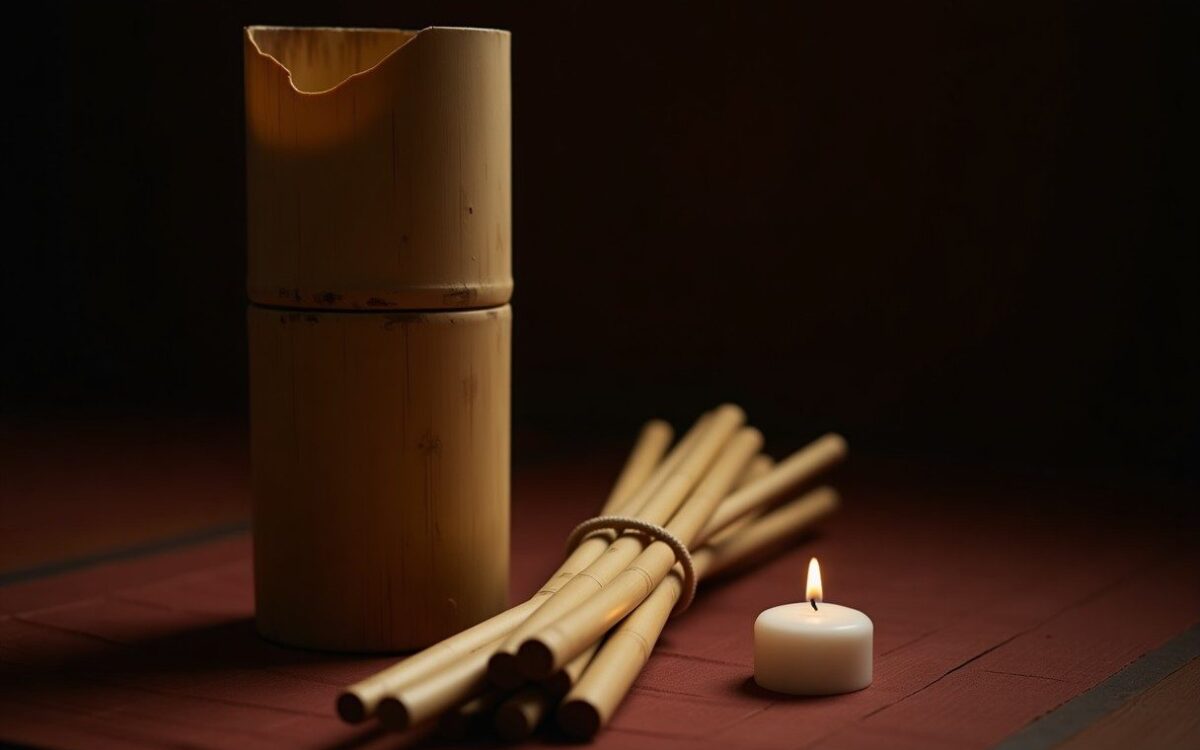
Kau cim, 求签 (qiú qiān in Mandarin), is the temple practice of asking a question and drawing a numbered stick for the answer. You kneel before the deity, shake a bamboo cylinder of sticks until one falls out, confirm it, and then read the short poem that matches its number. The name kau cim is Cantonese, and in English it is often called Chinese fortune sticks or the Chinese oracle.
In Singapore it is closely linked with Guan Yin, and the Guan Yin temple on Waterloo Street is where many people try it for the first time. Here is how it works, step by step.
How to do kau cim
- Prepare. Light incense and greet the deity. Then kneel, hold the cylinder of sticks (签筒) and silently state your name, your birth date and your address, followed by one clear question.
- Shake. Tilt the cylinder slightly forward and shake it gently and steadily until a single stick slides out and falls. If several fall at once, put them back and start again.
- Confirm with the moon blocks. Pick up the two crescent-shaped wooden blocks, 筊杯 (jiǎo bēi), and drop them on the floor. One flat side up and one round side up is a “yes” (圣杯), confirming the stick. Two round sides up is a “no”, and two flat sides up is read as laughter, meaning the question was unclear. If the answer is not “yes”, draw again.
- Read the number. Note the number on the confirmed stick and collect the matching slip, 签文, from the temple counter or the rack of drawers.
Reading the slip
Each slip carries a short classical poem, often alluding to a historical story, and a grade. The set at a Guan Yin temple usually has one hundred lots. Grades are commonly:
- 上上: the most favourable
- 上 and 中: favourable or mixed
- 下: unfavourable, calling for caution
Most slips also list brief notes for common topics such as family, travel, career, health and marriage. Because the poems are terse and allusive, many temples have interpreters, 解签 (jiě qiān), who explain the lot in the light of your question. They usually ask for a small donation.
Etiquette
- Ask one question at a time, and ask it sincerely. Asking the same question repeatedly until you get the answer you want is considered disrespectful.
- Be specific. “Will this job move go well if I take it this year?” gets a clearer reading than “What will happen to me?”
- Return the stick to the cylinder and the moon blocks to their place when you finish.
- An unfavourable lot is advice to be careful, not a curse. The usual counsel is patience, prudence and doing good.
Kau cim and the I Ching
Kau cim belongs to the same family of Chinese divination as the I Ching: you bring a question, a chance process selects a text, and the text is read against your situation. The I Ching is far older and more systematic, with sixty-four hexagrams and changing lines. If you would like to try that method, you can cast the I Ching online for free.
Both are ways of thinking through a question rather than of fixing the future. If your question is about the timing of a big decision, a reading of your birth chart looks at the years ahead in a way a single lot cannot. In a Ba Zi reading we spend an hour on your chart, with a written summary afterwards, and no fear-selling.