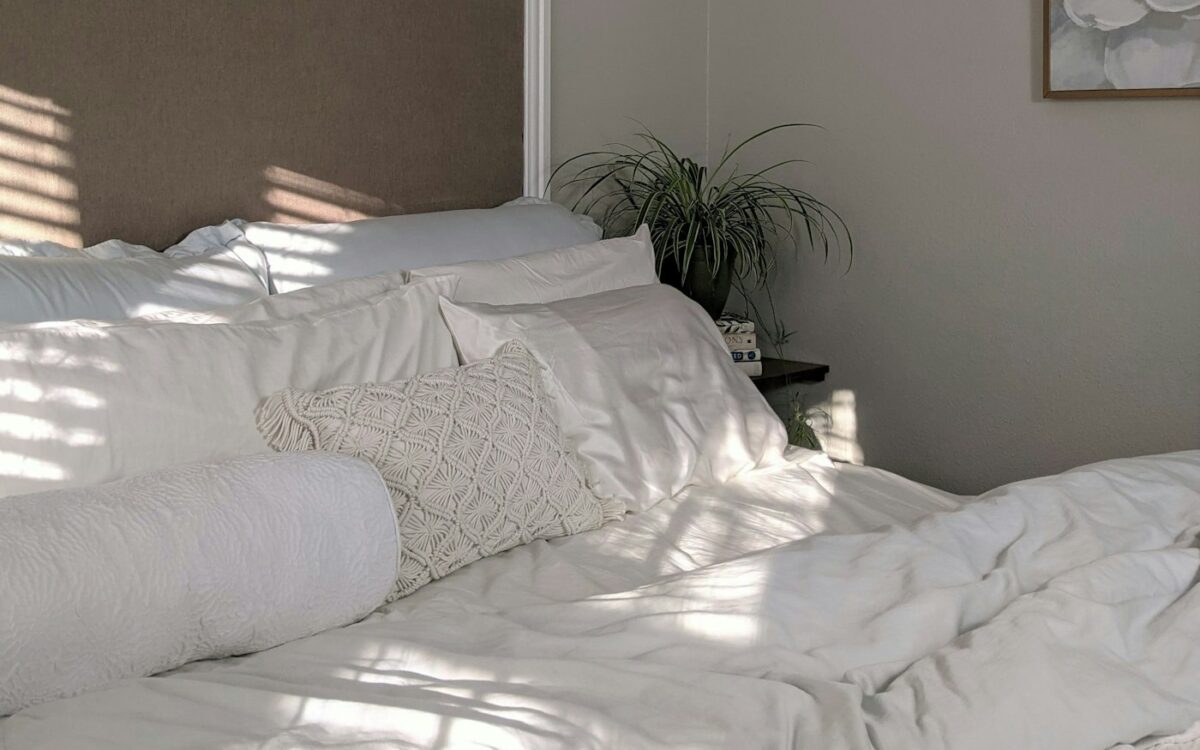
Most of what people call bad feng shui bedroom problems are not curses or bad luck. They are ordinary arrangement mistakes that leave you sleeping poorly, waking unsettled, or unable to relax in the one room meant for rest. Feng shui (风水 fēng shuǐ), literally “wind and water,” is the older Form School (峦头 luán tóu) art of arranging a space so qi (氣 qì) — the vital current of a room — moves smoothly rather than rushing, stalling, or pressing on you while you sleep. The good news is that the classic mistakes are the easy ones to see, and each has a fix you can do in an afternoon.
Here are the errors we flag most often, and what to do instead.
Mistake 1: The bed in line with the door
The single most common bad feng shui bedroom mistake is placing the bed so it lines up directly with the doorway — especially with your feet pointing straight out through the door. Classically this is called the “coffin position,” because the dead were carried out feet-first, and the deeper reason is practical: qi entering a doorway moves fastest in a straight line, so a bed in that path sits in a draught of rushing energy all night. You feel it as light, restless sleep.
The fix is the commanding position (命位 mìng wèi), the anchor of all Form School bedroom advice. Place the bed so you can see the door from your pillow without being directly in line with it — diagonally opposite the door is ideal, with a solid wall behind the headboard. You want a clear view of who enters while staying out of the rush of qi through the threshold. If the layout truly forces the bed into the door’s line, a footboard, a bench, or a low chest at the foot of the bed slows the current. We cover this arrangement in depth in our guide to feng shui bed placement and position.
风水 · Feng Shui
Find your lucky directions. Plot your chart free and see your feng shui Kua number and the directions that favour you — computed in your browser.
A headboard under a window is the second frequent error. A window is an opening, not a wall — it offers no solid support behind your head, and it lets qi (and draught, light, and street noise) pass over you as you sleep. In Form School terms you want a “mountain” behind you: something stable at your back. A pane of glass is the opposite.
Move the bed so the headboard meets a solid interior wall. When the room genuinely allows no other position — a common problem in compact Singapore flats — a tall, solid headboard plus a heavy curtain or blind closed at night restores some of the missing support. It is a compromise, not a cure, but it is a real improvement. For rooms where every wall seems spoken for, our notes on small bedroom feng shui work through the trade-offs.
Mistake 3: A beam, bulkhead, or sloped ceiling overhead
An exposed beam, an air-con bulkhead, or a sloped ceiling running directly over the bed creates what practitioners call “cutting” or oppressive qi. The heaviness overhead presses down on the part of the body beneath it — over the head is associated with poor sleep and headaches, over the chest or torso with a general sense of pressure. You do not need to believe in metaphysics to notice that sleeping under a low, heavy structure feels different from sleeping under an open ceiling.
The cleanest fix is to shift the bed out from under the beam entirely. Where that is impossible, a false ceiling or fabric canopy that hides the beam softens the effect by smoothing the line overhead. The point is to remove the sense of something bearing down while you rest.
Mistake 4: Clutter and storage under and around the bed
Clutter is bad feng shui in any room, but under the bed it matters most, because qi should be able to circulate freely around a sleeping body. Boxes, suitcases, and stacked objects crammed underneath trap stagnant energy right where you spend a third of your life. Old paperwork, sports gear, and anything with active or unresolved associations is the worst offender.
Ideally, keep the space under the bed open and clear. If storage is unavoidable — again, a reality in smaller homes — restrict it to soft, sleep-related items like spare bedding and linen, and keep it tidy and boxed rather than loose. Avoid storing anything sharp, mechanical, or emotionally charged there. The same discipline applies to the floor around the bed and the tops of nightstands: clear surfaces let the room breathe.
Mistake 5: Turning the bedroom into an office
A desk piled with work, a laptop glowing on the nightstand, and a corner of the room given over to deadlines all pull the bedroom away from its one job: rest. The yang (阳 yáng) activity of work fights the yin (阴 yīn) stillness a bedroom needs. When the last thing you see before sleep and the first thing you see on waking is your to-do list, the room never fully signals “rest” to the body.
Where possible, keep work out of the bedroom altogether. When a home office must share the room, screen the desk off — a room divider, a curtain, or even a cloth thrown over the desk at night creates a visual boundary between the two functions. Position the desk in its own commanding position where you can, and do not let it face the bed directly.
Mistake 6: Too many electronics and mirrors facing the bed
Two more offenders round out the list. Electronics — televisions, phones, chargers, and screens clustered around the bed — add restless yang energy, light, and a low hum of stimulation to a room that wants quiet. Keep them to a minimum, charge phones across the room rather than by the pillow, and cover or remove a bedroom TV where you can.
Mirrors are the other one. A mirror facing the bed is a classic bad feng shui bedroom fault: in the dark it reflects movement and light and can startle you awake, and traditionally a mirror doubling the bed is linked to unsettled relationships. The straightforward fix is to reposition the mirror so it does not reflect the sleeping body, or to cover a fixed wardrobe mirror at night. We go through the reasoning and the placements that actually help in our piece on mirrors in the bedroom.
Beyond the universal fixes: your personal directions
Everything above is Form School — universal, needing no calculation, and enough to correct the great majority of bedroom problems. There is also a personalised Compass School (理气 lǐ qì) layer. Each person has a Kua number (本命卦 běn mìng guà) from birth year and sex, which sorts everyone into an East group or a West group, each with four auspicious directions to favour when choosing which way the crown of the head points in sleep. These directions are deterministic and specific to you, so we will not guess them here — they should be computed, not recalled from memory.
The element logic behind feng shui cures follows the same five-element cycles that drive a Ba Zi (八字 bāzì) chart — Wood feeds Fire, Fire makes Earth, and so on — which is why the two systems are spatial and personal siblings. If you want to see how those cycles work, our primer on the five elements in Ba Zi is the place to start, and you can plot your own chart with the free Ba Zi calculator to find the elements and directions that support you. Fix the Form-School mistakes first; layer the personal directions on top once the room itself is sound.