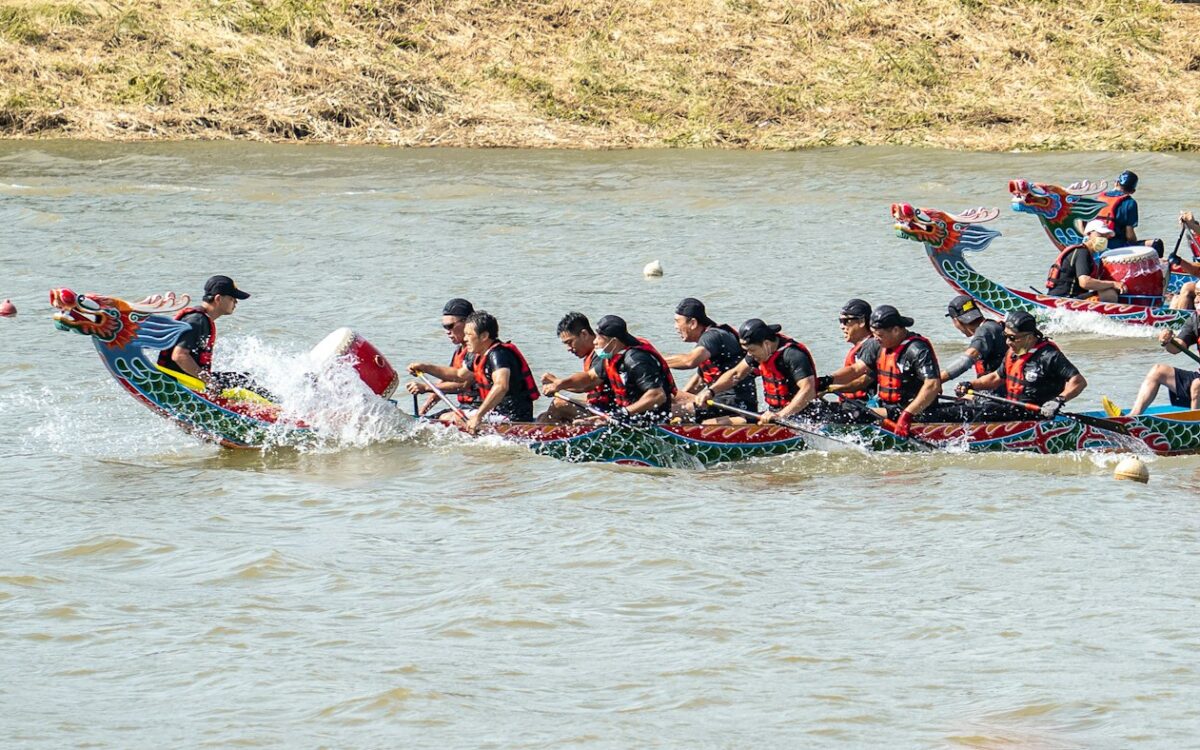
The dragon boat festival in 2027 falls on Wednesday 9 June 2027, the 5th day of the 5th lunar month (五月初五 wǔyuè chūwǔ). In 2026 it fell on Friday 19 June 2026. In Chinese it is 端午 (端午 Duānwǔ), and in Singapore it is as much a food festival as a river one, the day families eat bak chang and watch the boats.
Like every traditional festival, it follows the lunar calendar, so the solar date moves from year to year. The lunar date never changes.
Dragon Boat Festival 2027 and 2026 at a glance
| 2027 | 2026 | |
|---|---|---|
| Date | Wednesday 2027-06-09 | Friday 2026-06-19 |
| Lunar date | 五月初五 | 五月初五 |
| Day pillar | 己未 (Jǐ Wèi — Yin Earth over Earth Goat) | 甲子 (Jiǎ Zǐ — Yang Wood over Water Rat) |
| Month pillar | 丙午 | 甲午 |
| Day officer | 除 Remove | 破 Destruction |
| Clashes | Ox | Horse |
To see where the fifth lunar month sits in the year, our guide to the Chinese lunar calendar lays out each month and how its start is set by the new moon.
Qu Yuan and the meaning of the festival
The dragon boat festival commemorates the poet 屈原 (Qū Yuán). The story families tell is short. Qu Yuan drowned himself in the Miluo river. People raced out in boats to find him, and threw rice into the water.
Families tell those two actions as the roots of the day: the boats searching the river, and the rice given to the water. It is a festival of remembrance at heart, kept for a poet, which is part of why it has lasted. The story is simple enough for a child and still carries weight for an adult.
Dragon boat races
The races are the public face of the festival and the source of its English name. They recall the boats that went out after Qu Yuan, and for many people watching a race is the part of the day they remember first.
For most families, though, the festival happens at home. The races are something to watch; the food is something to share.
Zongzi, bak chang and the customs at home
The central food is zongzi (粽子 zòngzi), the rice dumpling of the day. In Singapore it is often called bak chang (肉粽), its Hokkien name. Recipes differ from family to family, and in many households the making of them is as much a part of the festival as the eating.
Two other customs survive in some homes:
- Hanging mugwort. Bundles of mugwort are hung at the door on the day, an old summer custom.
- Balancing an egg at noon. In some families, people try to stand a raw egg on its end at midday on the fifth day of the fifth month. It is a small game that children tend to enjoy.
The festival sits near the middle of the year’s festival calendar. Later in the year comes the Mid-Autumn Festival; our page on the mooncake festival covers that one.
The dragon boat festival in Ba Zi
In Ba Zi (八字 bāzì), months change at the solar terms, not at the new moon. The 丙午 month (Bǐng Wǔ — Yang Fire over Fire Horse) begins at 芒种 (Mángzhòng, Grain in Ear) on 2027-06-06 05:25, so the dragon boat festival in 2027 sits inside it. 端午 always falls in the 午 month, the height of Fire season, and the festival’s old associations with warding off summer illness come from that timing. Our guide to the 24 solar terms explains how these boundaries are set, and the five elements page explains what Fire season means.
The day itself is 己未 (Jǐ Wèi — Yin Earth over Earth Goat). Its day officer is 除 Chú, Remove, which the almanac reads as favouring cleaning house, ending bad habits and medical treatment, and as a day to avoid weddings and signing contracts. The day clashes with the Ox. You can check any day’s officer on the Chinese calendar today page or in our tong shu guide.
That is as far as a generic day goes. Everyone alive on 9 June 2027 shares this pillar, so it says little about any one person until it is set against an actual chart.
Noon on the fifth: the five poisons and old customs
The fifth day of the fifth month was traditionally treated as the height of the year’s yang energy, when heat, disease and pests were thought to be strongest. Many of the festival’s quieter customs were ways of warding these off:
- The five poisons (五毒): the centipede, snake, scorpion, lizard and toad were embroidered on children’s clothes and charms as protection.
- Mugwort and calamus (艾草, 菖蒲) were hung by the door, their strong scent believed to keep illness away.
- Realgar wine (雄黄酒) was once drunk or dabbed on children’s foreheads. Realgar is an arsenic compound, so the custom is now kept only as a story.
- Noon water (午时水): water drawn at noon on the day was kept for washing and was thought to be especially pure.
- Standing an egg at noon is a modern favourite, said to be easier on this one day. It is a fun challenge rather than physics.
In Ba Zi terms the festival usually falls in the Horse month (午), the Fire month of summer, which is why the customs focus on heat and its excesses. The month’s place in the year is shown in our guide to the 24 solar terms.
Keeping the festival
The dragon boat festival asks very little: a meal of bak chang, perhaps an afternoon by the water, and the story of a poet told once more. That is its strength.
Find the 丙午 month and the festival day against your own pillars: plot your chart free with the Ba Zi calculator.