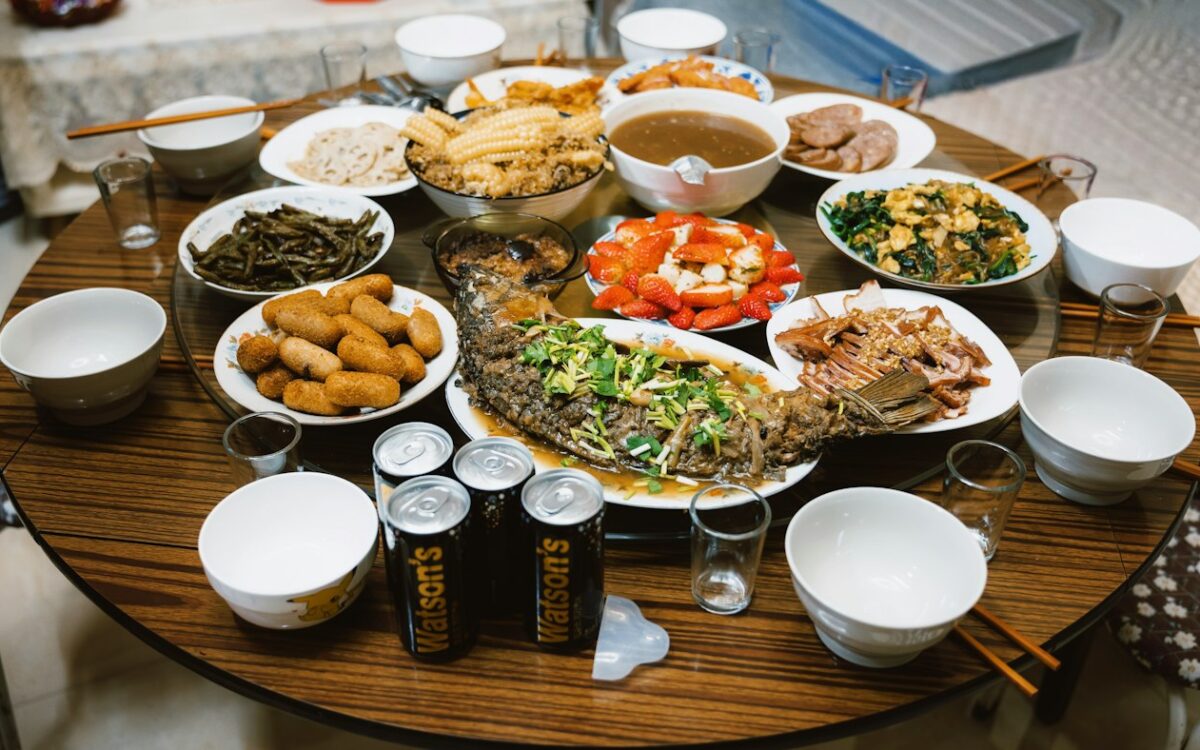
The reunion dinner in 2027 falls on Friday 5 February 2027, New Year’s Eve, which in 2027 is the 29th day of the twelfth lunar month (腊月廿九 làyuè niànjiǔ). Chinese New Year itself is Saturday 6 February 2027. For comparison, the 2026 reunion dinner was on Monday 16 February 2026, also a 廿九 eve.
Many people expect New Year’s Eve to be the 30th,. But lunar months run either 29 or 30 days, set by the new moon. The twelfth month of the outgoing year starts on 2027-01-08 and has only 29 days, so there is no 三十 in 2027. The eve is simply the last day of the month, whatever its number.
What the reunion dinner is
The meal is called 团圆饭 (团圆饭 tuányuán fàn), the “reunion meal”, or 年夜饭 (niányè fàn), the “year-night meal”. It is held on New Year’s Eve, 除夕 (chúxī), the last night of the lunar year. Families travel home to eat together, and for many households it is the one evening of the year when every generation sits at the same table.
团圆 means reunion, being complete. The image is round: a full table, nobody missing. That is why the dinner matters more than any single dish on it. For arranging the table and room where such meals happen, see our guide to the feng shui dining room, from table shape to seating.
Reunion dinner dishes and their meanings
Dishes are chosen as much for their names as their taste. These are examples, not a fixed menu; what lands on the table varies by family and by dialect group.
| Dish | Sounds like / stands for | Meaning at the table |
|---|---|---|
| Fish 鱼 (yú) | 余 (yú), surplus | Often some is left uneaten so the surplus carries over into the new year |
| 年糕 (niángāo) | 高 (gāo), high | Rising higher each year |
| Dumplings 饺子 (jiǎozi) | Shaped like old silver ingots | Common in northern families |
| 长年菜 / long greens | Long years | Long life |
| Prawns 虾 | Cantonese “ha”, the sound of laughter | A cheerful year |
| Hot pot / steamboat | Everyone cooking from one pot | Common in Singapore homes |
The pattern is worth noticing. None of these foods is meant to cause anything. They are a family speaking its hopes aloud through the menu, in a language everyone at the table already knows.
In Singapore, yusheng is also often tossed during the season, at the reunion dinner or in the days after. The phrases called out during the toss have their own page: see lo hei.
After the meal: 守岁 and red packets
After dinner some families stay up late, a custom called 守岁 (shǒusuì), “guarding the year”. The idea is to see the old year out together rather than sleep through its last hours. In practice it often means tea, snacks, television and long conversations that only happen once a year.
红包 (hóngbāo), red packets, are often given that evening or on New Year’s Day. The greetings that go with them are collected in our guide to Chinese New Year greetings.
The reunion dinner in Singapore
In Singapore, many families book a restaurant weeks ahead, while others cook at home, sometimes splitting the dishes between several households. Both are normal. The steamboat has become something of a local default because it suits a long, slow evening and a table of mixed ages.
The dinner opens a fifteen-day season. Our overview of Chinese New Year 2027 covers the days that follow, and the Chinese lunar calendar explains why the date moves each year.
The dinner opens a fifteen-day season. What goes up on the walls is in Chinese New Year decorations, the snacks and symbolic dishes of the days that follow are in Chinese New Year food, and the customs of each day, from 初一 to 十五, are in Chinese New Year traditions.
The Ba Zi angle on the eve
On the Ba Zi (八字 bāzì) calendar, read at 12:00 Singapore time, Friday 5 February 2027 is the day 乙卯 (Yǐ Mǎo — Yin Wood over Wood Rabbit), in the month 壬寅. Its day officer is 除 (Chú), Remove, which the almanac lists as favourable for cleaning house and ending bad habits. That fits a night of clearing out the old year, though it is a generic reading for everyone, not a statement about any one person. The day clashes with the Rooster. Officers for any date can be checked on our Chinese calendar today page.
One point catches people out. The lunar year turns at midnight into New Year’s Day, but the Ba Zi year does not follow the lunar calendar. It turns at Li Chun (立春 lìchūn), which in 2027 is 2027-02-04 09:45. So by the time the reunion dinner is served, the Ba Zi year has already been the 丁未 year for more than a day. The eve is not the boundary. Someone born during the dinner is a Goat in Ba Zi terms, even though the lunar calendar still reads 腊月. Our guide on how to read your Ba Zi chart explains why the solar terms, not the lunar months, set the pillars.
If someone in your family was born near the New Year and you have never been sure which year they belong to, the answer sits in the hour and minute. Enter the birth details into the free Ba Zi calculator and plot the chart free to see exactly where Li Chun falls.