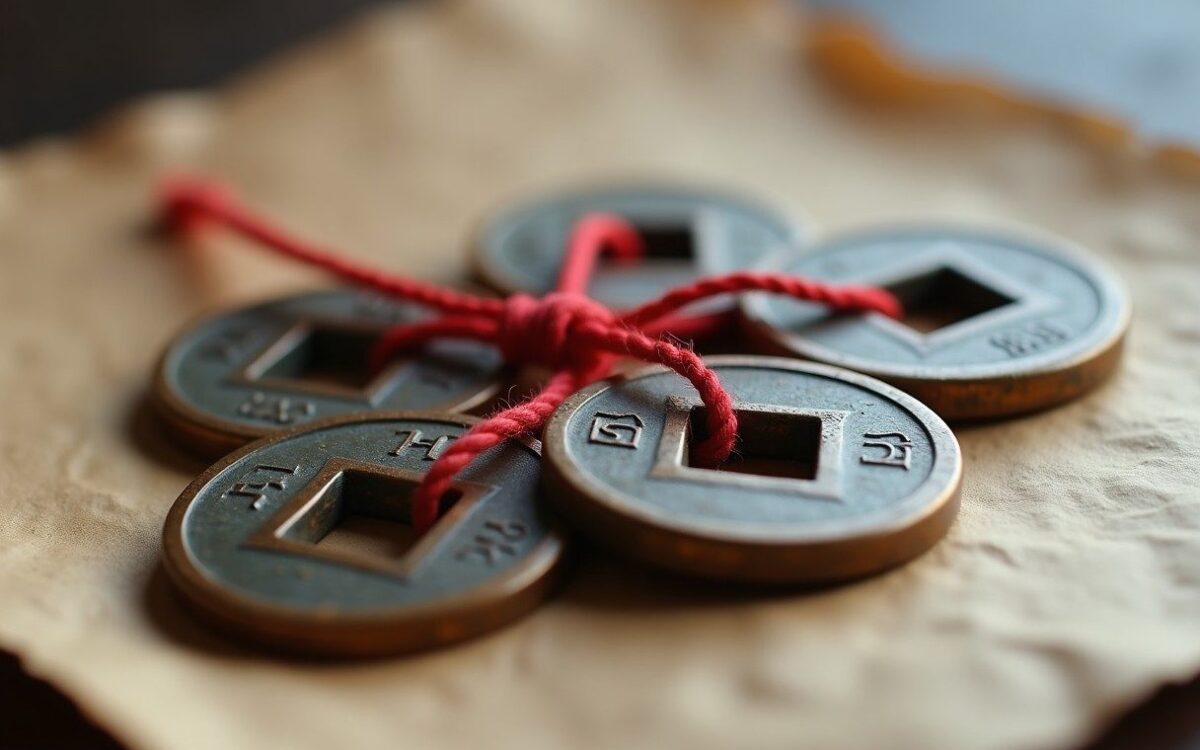
Feng shui coins are the old Chinese round coins with a square hole in the middle, usually tied together with red thread. The best-known set is the 五帝钱 (wǔdì qián, “Five Emperor coins”), drawn from five Qing dynasty reigns. This page explains what the coins symbolise, how households traditionally use them, and where they appear in Flying Star practice and I Ching casting.
As with every object on this site, we describe tradition, not effect. The coins carry a long history and a clear set of meanings. They are not a tool that changes outcomes by themselves.
The round coin with a square hole
For most of Chinese history, everyday coins were cast in copper alloy as a disc with a square hole punched through the centre. These are called 方孔钱 (fāngkǒng qián, “square-hole coins”). The hole was practical: coins were strung on cord in counted strings.
The shape also took on a symbolic reading. The round outer edge is read as heaven and the square hole as earth, an old pairing in Chinese cosmology. A single coin therefore holds heaven and earth together in the palm of a hand, which is a large part of why it became a lucky object long after it stopped being money.
The Five Emperors set
The “Five Emperors” set uses one coin from each of the reigns of five early Qing emperors. These reigns are remembered as a long, stable stretch of the dynasty, and the set gathers them together as a symbol of continuity and prosperity.
| Order | Reign | Hanzi |
|---|---|---|
| 1 | Shunzhi | 顺治 |
| 2 | Kangxi | 康熙 |
| 3 | Yongzheng | 雍正 |
| 4 | Qianlong | 乾隆 |
| 5 | Jiaqing | 嘉庆 |
An honest note: almost every Five Emperors set in circulation today is an antique-style reproduction, not coins that passed through Qing hands. That is fine. The reproductions carry the symbolism, which is what they were made for. They do not carry any certified power, and nobody can honestly certify one.
How feng shui coins are used traditionally
The coins are commonly tied with red thread in groups of three, five or six. Red is the colour of celebration and good fortune in Chinese custom, and the knotted thread turns a handful of loose coins into a single keepsake.
- Hung inside the main door. A common household custom, where the string marks the threshold.
- Placed under the doormat. Some families slip a set beneath the mat at the entrance.
- Carried. A small string kept in a wallet or bag as a personal token.
These are customs, and families vary in which they keep. None of them needs a particular date or ritual to be legitimate; the meaning is in the gesture of marking the home or carrying a reminder.
Coins in Flying Star practice
In Flying Star (玄空飞星 xuánkōng fēixīng) practice, coins appear for a different reason: they are metal. The annual 2 star (二黑 èrhēi) and 5 star (五黄 wǔhuáng) are both Earth stars and are read as difficult. In the five-element cycle Metal drains Earth, so metal objects are the traditional generic remedy for those two sectors. For 2027 the 5 star sits in the North and the 2 star in the West, changing at Li Chun (立春 lìchūn) on 4 February 2027. Our 2027 flying stars chart lays out the full year.
Coins are one metal option among several. The brass gourd is the classic object for the 2 star sector; our page on the wu lou explains why, and the wind chime is another metal object with its own placement lore. Keeping these sectors calm and uncluttered is part of the same tradition.
Coins in I Ching casting
The same kind of coin has a second life in divination. The three-coin method of casting the I Ching (易经 yìjīng) uses three such coins, tossed six times to build a hexagram line by line. You can try the method with our free I Ching online reading.
Common questions about feng shui coins
Which side faces up?
The side with four characters is traditionally treated as the yang side and is placed facing up or outward. The reverse, which often carries Manchu script or is plain, is the yin side.
How many coins?
Three coins tied with red string is the most common set, often linked to heaven, earth and humanity. Sets of five (the Five Emperors), six and eight are also popular. Sets of four are avoided, as with most gifts.
Are reproduction coins fine?
Almost every coin sold today is a reproduction, and that is how they are traditionally used. Genuine Qing coins are collectors’ items and are rarely used for feng shui.
Where do they go?
Common places are a purse or wallet, a cash register, the inside of a front door, or under a doormat. These are customs rather than rules; the coins carry a wish, not a mechanism. They are one of many objects gathered in our guide to Chinese good luck symbols.
The honest frame on feng shui coins
Feng shui coins are a compact piece of Chinese history: a currency shape read as heaven and earth, five reigns remembered as good years, red thread for celebration. Kept with that understanding, they are a pleasant tradition. Treated as a wealth device, they promise something no object can deliver.
Wealth and timing in a life are read from the chart, through the balance of the five elements in Ba Zi and the luck pillars that bring them forward.
Find your own Wealth element and the years that support it in your chart. Plot it free with the Ba Zi calculator.