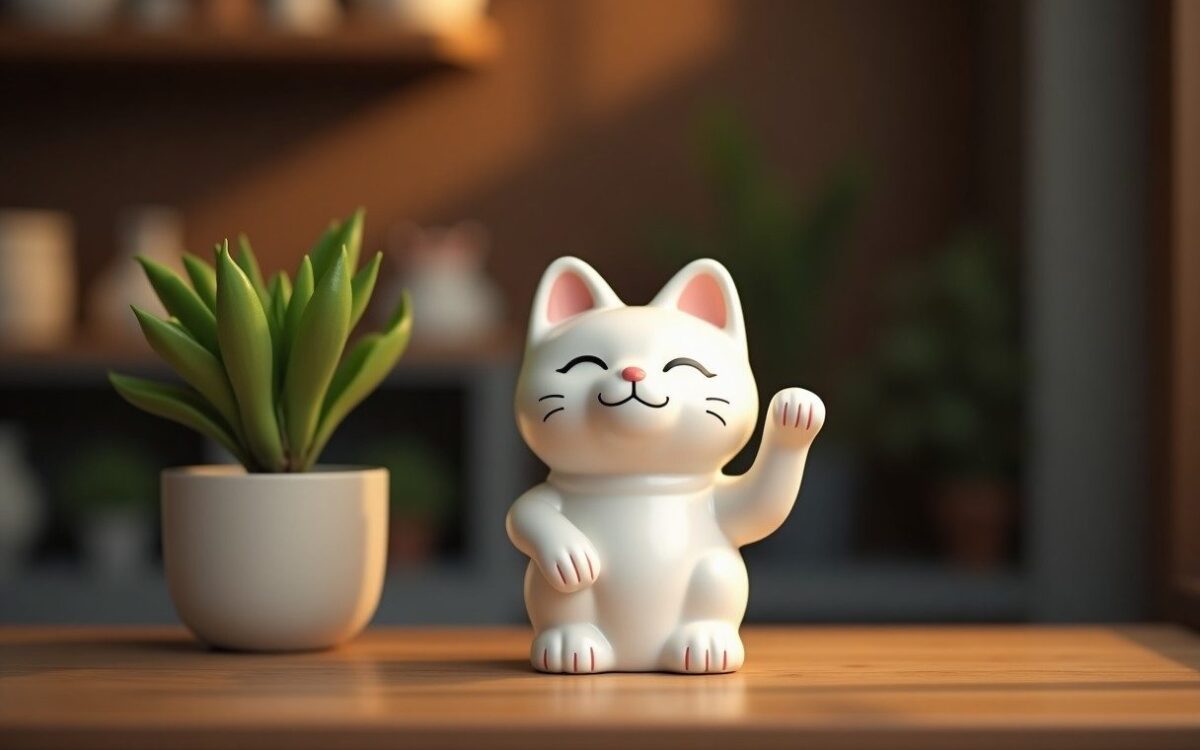
The fortune cat (招财猫 zhāocái māo, “the cat that beckons wealth”) waves from cashier counters across Singapore, from hawker stalls to jewellers. Many people assume it is an ancient piece of Chinese feng shui. It is not, and saying so plainly is the first step to understanding it well.
This page covers where the beckoning cat comes from, what its paws and colours mean in popular lore, where businesses traditionally place it, and the honest way to think about it beside a Ba Zi (八字 bāzì) chart.
Where the fortune cat comes from
The beckoning cat originates in Japanese folk custom, where it is known as the maneki-neko and dates to the Edo period. It was later taken up widely by Chinese-run businesses across Southeast Asia, including Singapore, and acquired its Chinese name along the way.
So the fortune cat is not part of classical Chinese feng shui (风水 fēngshuǐ). You will not find it in the old texts on landforms, compass directions or the flow of qi. It belongs to a different and newer layer: the shared commercial folk culture of Asian trading towns, where a friendly figure at the counter became a familiar part of doing business.
None of that makes it less charming. It simply puts it in its right category. A practitioner who tells you the fortune cat is a classical feng shui cure is mixing up two traditions.
What the paws mean in popular lore
The raised paw is the cat’s signature gesture: a beckoning motion, the way a person might wave someone over. Popular lore assigns a meaning to which paw is raised.
| Raised paw | Meaning in popular lore |
|---|---|
| Left paw | Invites customers |
| Right paw | Invites money |
| Both paws | Invites both |
These readings vary between regions and retellings, and you will meet people who swap them. Treat the table as the common version of a folk story, not as a rule with a classical source behind it.
Fortune cat colours
Colour carries meaning in popular lore too. The two you will see most often:
- Gold. Associated with wealth, which is why gold cats dominate cashier counters.
- White. Associated with general good luck, a broader and gentler wish.
Other colours circulate, each with its own story, but the lore around them is looser still. If a colour appeals to you, that is reason enough.
Where a fortune cat sits in a business
Traditionally the fortune cat is placed near the entrance of a business or by the cashier, facing the door. The logic is the logic of the gesture itself: a beckoning figure should face the people it is beckoning. Customers come through the door, so the cat looks toward them.
That placement says something useful even without any lore attached. An entrance that is clear, bright and visible from the street does real work for a business. A friendly figure at the counter is part of the welcome, much like a greeting from the person behind it. Our page on the feng shui wealth corner explains why the condition and use of a space count for more than what sits on a shelf.
The fortune cat is often confused with the pixiu, the wealth-keeping beast of Chinese lore. They belong to different traditions: the pixiu is a Chinese mythical creature with its own placement customs, while the fortune cat is a Japanese folk figure adopted into Chinese commerce. Many businesses keep both, and there is no conflict in that, as long as each is understood for what it is.
The honest frame on the fortune cat
The fortune cat is best understood as a welcome sign with a story. It is valued for what it signals: to customers, that they are wanted; to owners, that the day’s work is begun with goodwill. That is a real function, and it is enough.
What it cannot do is bring in trade on its own. Objects carry tradition and intention. The chart and the people decide outcomes. In Ba Zi, the questions that matter for a business are read from the owner’s chart and its timing: which element counts as Wealth for the Day Master, whether the person is strong enough to carry it, and whether the coming years favour expansion or consolidation. Our guide to the five elements in Ba Zi sets out the cycles that reasoning rests on.
Timing is the other half. Many owners in Singapore choose an opening day with care, and our guide to business opening dates in 2027 explains how that selection is traditionally made. A fortune cat on the counter and a well-chosen opening day belong to different traditions; the second is the one we can actually read.
If you are planning a new venture and want to see what your own chart says about wealth, partnerships and timing, that is the work of a reading. Our Ba Zi readings are one hour with your chart on the table, followed by a written summary. No fear-selling, nothing to acquire, just the map read plainly.