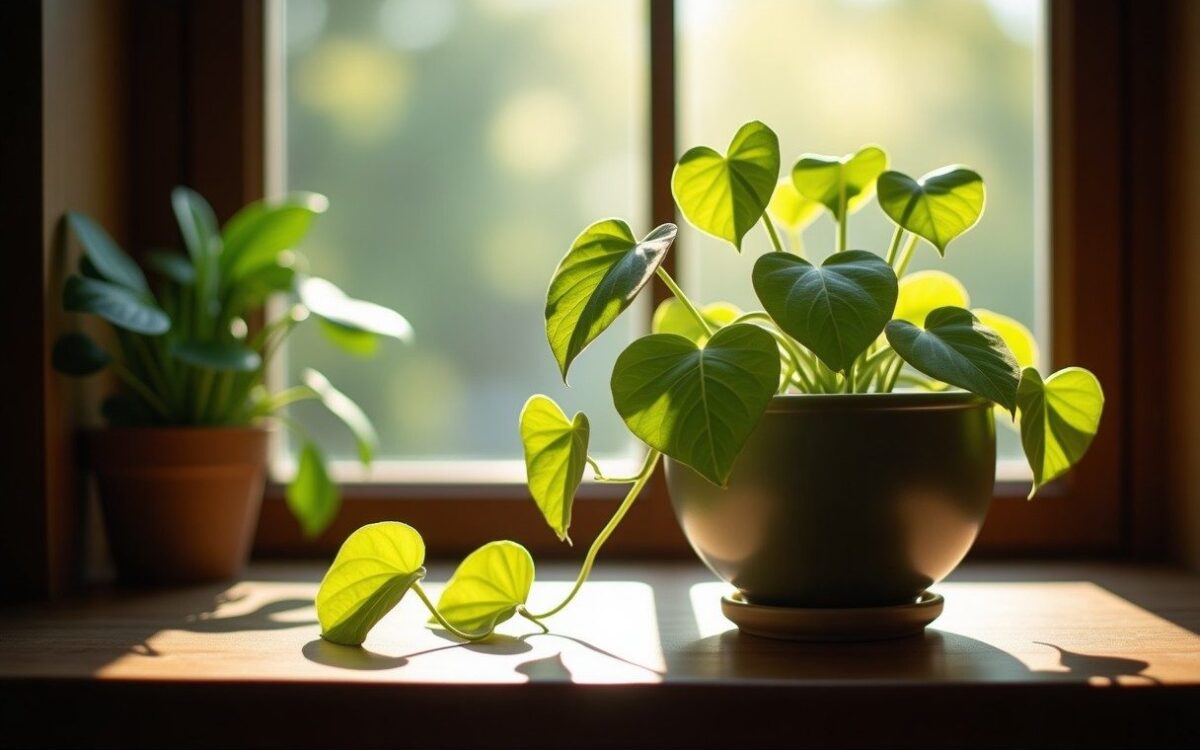
Money plant feng shui starts with a naming problem. Ask in Singapore, Malaysia or India and “money plant” almost always means the pothos, a trailing vine with heart-shaped leaves that grows happily on a shelf or in a jar of water. Ask in many Chinese households and you may be pointed to a different plant altogether. This page sorts out which is which, how feng shui (风水 fēngshuǐ) reads the pothos, where it is traditionally placed, and how to keep it healthy and safe in a home with pets.
Which plant is the money plant
The pothos, Epipremnum aureum, is known in Chinese as 黄金葛 (huángjīn gé) or 绿萝 (lǜluó). It is the plant most people in Southeast Asia mean when they say money plant: a climbing or trailing vine, glossy leaves, often variegated with yellow or cream.
The “money tree” in Chinese circles is something else. 发财树 (fācái shù) is Pachira, a small upright tree. It has its own page, feng shui money tree, and the two are easily confused because the English names are so close. Everything below refers to the pothos.
Money plant feng shui: the Wood reading
In feng shui terms the pothos is a Wood-element plant, like most living greenery indoors. The reading is about how it grows. Healthy leaves that are round rather than spiky, and growth that is steady, whether climbing upward or trailing down, are read as steady growth in the space. A plant that is yellowing, dusty or half dead is read the other way, which is why care matters more than position.
The name is part of its appeal. Many households like the idea of “money” growing in the home, and that is a perfectly good reason to keep one. But the honest frame is worth stating plainly: the money is a name. What matters in feng shui terms is a healthy plant in a well-used space. The plant does not bring income; work, timing and decisions do. If you want to understand how Wood sits among the other elements, the five elements page explains the producing and controlling cycles.
Whether extra Wood is helpful for you personally is a chart question, not a plant question. In Ba Zi some people benefit from Wood and some already have plenty. The idea of a personal element is covered on the feng shui birth element page.
Where the money plant is placed
Two placements are common in tradition:
- The Southeast. In Ba Gua placement, 八卦 (bāguà), the Southeast is the wealth corner, and it is also a Wood sector. A thriving Wood plant there is a natural fit. The feng shui wealth corner page explains how to find it in your home and how schools differ on locating it.
- A bright living area. Many households simply keep the pothos where people actually spend time, such as the living room. A plant that is seen and looked after every day tends to be a healthy plant, which is the point.
A few practical habits follow from the reading. Let a trailing pothos hang freely rather than pile up in a dark corner. Keep it away from a spot where it will be knocked or neglected. Choose one well-kept plant over several struggling ones. For a wider view of which plants suit which rooms, see feng shui plants.
Care: soil, water and light
Part of the pothos’s popularity is that it forgives a great deal. It tolerates low light, which suits flats where the brightest windows are taken. It grows in soil or simply in water, so a cutting in a clear glass jar is a common sight on Singapore desks and kitchen counters.
- Light: it copes with low light, though growth is fuller in bright, indirect light.
- Soil or water: either works. In water, keep the water clean; in soil, let the top dry a little between waterings.
- Trimming: remove yellow leaves as they appear. Trimming long vines also keeps the plant full rather than straggly.
From a feng shui point of view, this routine is the practice. A plant that is trimmed and tended reflects a space that is looked after.
A warning for homes with cats and dogs
Pothos is toxic to cats and dogs if chewed. The leaves and stems contain calcium oxalate, which irritates the mouth and throat. If you share your home with pets, keep the plant well out of their reach: on a high shelf, in a hanging pot, or in a room they do not use. If you cannot do that reliably, choose a different plant. No placement tradition is worth an unwell animal.
The same caution applies to any trailing vine that hangs low enough to be pulled at. A sensible home comes first; symbolism second.
Money plant or lucky bamboo
The pothos is often compared with lucky bamboo, another water-friendly Wood plant with its own lore about stalk counts. Both are easy to keep, and both are read the same basic way: healthy growth in a used, cared-for space. Neither replaces the reading of the people who live there.
Feng shui places a plant; Ba Zi shows whether Wood is the element your chart needs. See where Wood stands in your own Four Pillars with the free Ba Zi calculator.