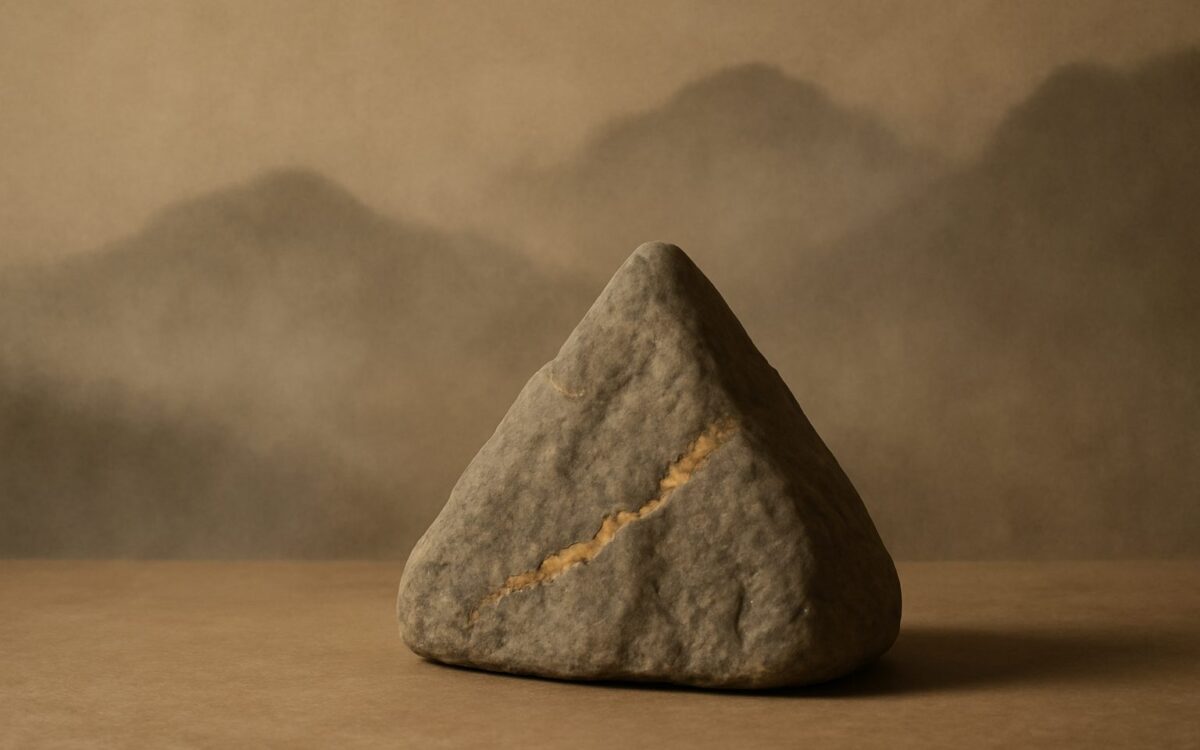
Hexagram 52, 艮 Gèn (pinyin gèn), is named Keeping Still, and its image is the Mountain. It is one of the eight doubled hexagrams: the trigram Gen (艮, Mountain, Earth element, whose attribute is stillness and keeping) sits over another Gen. Mountain over mountain — a range at rest, one summit behind another, nothing moving on the whole horizon.
When a trigram doubles, its quality is stated twice and so read at full strength. Here that quality is stopping. The mountain does not chase; it holds its place and lets weather pass over it. Hexagram 52 is therefore the classic figure for stillness that is chosen rather than forced — the discipline of not acting when the moment does not call for action.
The two trigrams and what they picture
Gen is the youngest son among the trigrams and the image of the mountain, the point where movement comes to rest. A single mountain already says “halt here.” Two mountains, back to back, close off both the way forward and the backward glance. The picture is not a wall built against you but a natural boundary: the terrain simply ends, and the sensible traveller stops walking.
In the older commentary the hexagram is read through the body. The lines, from bottom to top, move up a person — the feet, the calves, the hips, the trunk, the jaw — and each asks where stillness should begin. Keeping still is not numbness; it is knowing which part of you is straining to move when it should wait, and quieting that part first.
易经 · Book of Changes
Cast your own hexagram. Six throws build your hexagram and any changing lines, each linked to a plain reading. Free, in your browser.
The Judgment — overall counsel
The Judgment of hexagram 52 speaks of keeping the back still so that the self recedes — of being so settled that when you walk into the courtyard you no longer register the people there as things to react to. The counsel, in plain terms: stillness of the right kind removes the churn of wanting and fearing, and from that quiet a person can act cleanly or not act at all, without blame.
Read as practitioner advice, this is a hexagram about the gap between stimulus and response. The trouble it addresses is not the world but the restless self that grabs at every passing thing. When you can hold the back still — the part you cannot see and cannot admire — the front stops performing. Nothing here promises reward. It says only that composure is available, and that seeking it is not an error.
The Image — the mountains and the lesson
The Image sets mountains standing close together and draws from them a lesson about staying within your situation. The mountain does not think beyond its own ground. So the counsel is that the wise person does not let thoughts run past the matter actually in front of them — no borrowing tomorrow’s problem, no relitigating yesterday’s.
The practical shape of this is attention held to its place. A mind that keeps still in the right sense is not empty; it is present, resting where the body rests. That is the mountain’s teaching in 艮 Gèn: to stop the wandering not by strain but by returning, again and again, to the one thing that is here now.
Practical guidance — work, relationships, timing
As a tendency rather than a verdict, hexagram 52 favours pause over push. In work it reads as a season for consolidation, not expansion — finishing what is open, tightening what is loose, declining the new commitment that is really just restlessness in disguise. Waiting here is a position, not a failure of nerve.
In relationships the mountain counsels composure. It is the figure for not reacting to a provocation, for letting a heated exchange cool before you answer, for the kind of quiet that steadies the people around you. The risk to watch is stillness curdling into coldness or withdrawal; keeping still means staying present without grasping, not shutting the door.
On timing, the reading is plain: this is not the moment to force an outcome. The way ahead is blocked for now, and the honest response is to stop where you are and attend to your own ground until the terrain opens. The mountain is patient because it has nowhere else to be.
Changing lines — how it can shift
In a casting, lines that come up as 6 or 9 are changing lines, and they mark where the still situation is already beginning to move. In hexagram 52 they trace stillness up the body — from the feet that should not walk yet, to the jaw that should not speak too soon. Each shows a different place where holding back is either well-timed or overdone.
Flipping any changing line produces a second hexagram, the direction the moment is tending toward. Move the fifth line, for instance, and Gen shifts toward Hexagram 53, 漸 Jiàn (Development) — stillness giving way to slow, ordered progress once the pause has done its work. Read the primary hexagram as the present rest and the resulting one as what the stillness is preparing.
If you want to see how the same trigrams and five elements underpin your own chart, start with the I Ching hub, browse the full set on the 64-hexagram overview, or read the neighbouring figure of gradual movement in Hexagram 53, 漸 Jiàn. To ground all of this in your birth data, plot your Four Pillars free with the Ba Zi calculator.
Read in sequence · Previous: Hexagram 51, 震 Zhèn (The Arousing) · Next: Hexagram 53, 漸 Jiàn (Development)