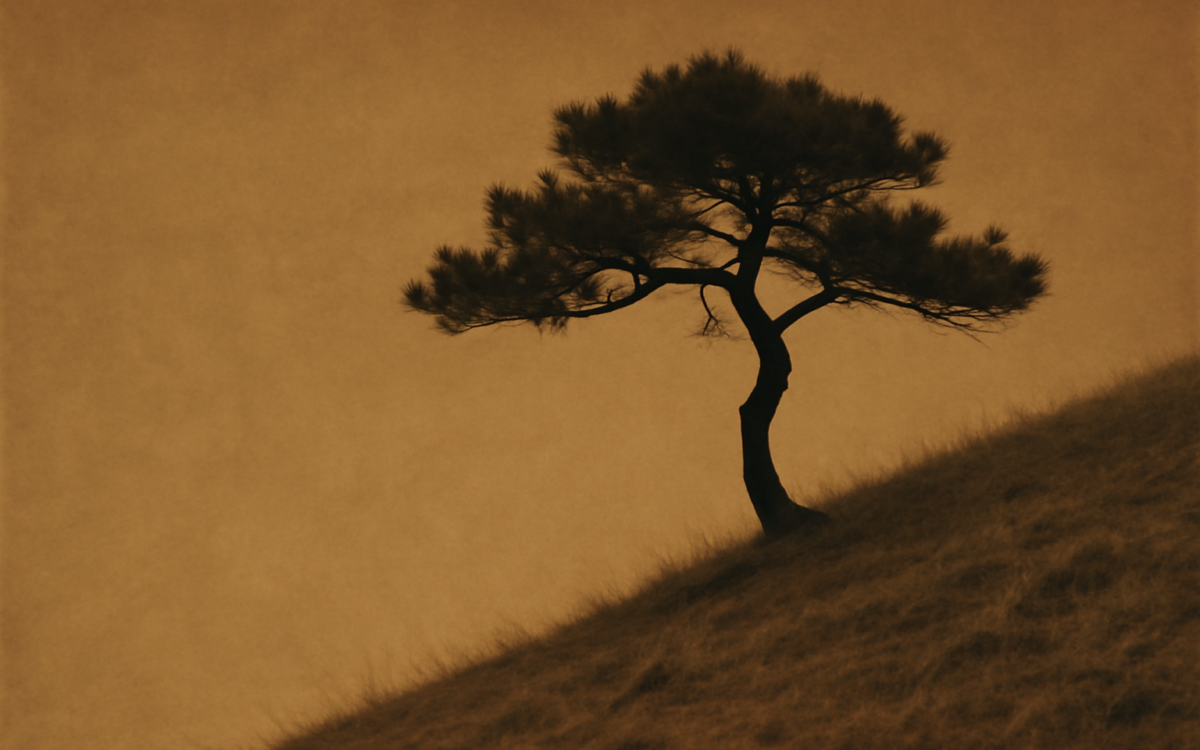
The Jia Xu day pillar (甲戌 jiǎ xū) places Jiǎ 甲, Yang Wood, on the Dog branch 戌, which is dry autumn Earth. Picture a mature tree rooted in a warm, well-drained slope rather than in a wet field. The soil here holds heat and mineral rather than moisture, so this is Wood standing on ground it must work to draw from, not ground that pampers it.
In Ba Zi (八字 bāzì), the day branch is what the Day Master sits on, and for Jia Xu that seat is Indirect Wealth. A tree over dry earth is a tree that has learned to send roots down and take what it needs. That single fact colours almost everything about how this pillar meets the world.
Personality of the Jia Xu day pillar
Jiǎ Wood is the pillar-and-beam of the ten stems: upright, principled, growth-minded, happiest with a direction to climb toward. On the Dog, that upward character gets a practical, acquisitive edge. The Day Master sits directly on Indirect Wealth (偏财 piāncái), the main qi being Wù 戊 Yang Earth, and Indirect Wealth reads as opportunity, enterprise and a wide, flexible relationship with resources.
So the Jia Xu person tends to be an operator as much as an idealist. There is the Jiǎ backbone, the sense of standards and long horizon, and there is a hands-on instinct for turning situations into value. They notice what a thing is worth and what it could become. Dog earth also carries loyalty and a guarding streak, so the ambition rarely feels grasping; it is more the steady drive of someone who wants to build something real and keep it.
Because the wealth they sit on is indirect rather than fixed, many Jia Xu natives are drawn to ventures, side projects and dealings that need improvisation. The classic caution is spreading roots too wide across too many pieces of dry ground. Focus is what turns this pillar’s natural enterprise into a lasting structure.
The spouse palace
The Dog branch is unusually full for a spouse palace. Its hidden stems, taken verbatim from the reference data, are: Wù 戊 (Yang Earth) = Indirect Wealth 偏财; Xīn 辛 (Yin Metal) = Direct Officer 正官; Dīng 丁 (Yin Fire) = Hurting Officer 伤官.
| Hidden stem in 戌 | Ten God (relative to Jiǎ) |
|---|---|
| Wù 戊 (Yang Earth) | Indirect Wealth 偏财 |
| Xīn 辛 (Yin Metal) | Direct Officer 正官 |
| Dīng 丁 (Yin Fire) | Hurting Officer 伤官 |
Three occupants means three currents inside one house. The Indirect Wealth main qi points to a partner tied up with the theme of resources, means and worldly matters. The Direct Officer (正官 zhèngguān) adds structure, duty and a respectable, orderly quality to the union. The Hurting Officer (伤官 shāngguān) brings expressiveness, spark and a willingness to speak plainly.
Read calmly, this is a marriage house with real texture rather than a smooth blank. Officer and Hurting Officer sharing the same seat classically suggests a relationship where order and candour both want airtime, so the dynamic rewards couples who can let strong opinions coexist with mutual respect. None of this is a verdict. It is a description of the raw material; how it plays out depends on the rest of the chart and on the two people involved.
The seat also responds to what reaches it. In the fixed relations, 戌 clashes with 辰 (辰↔戌) — the storehouse clash, which is read as instability signals whenever a Dragon sits in the natal branches or arrives by luck pillar or year — and combines with the Rabbit toward Fire (卯+戌→Fire), a binding influence that brightens the palace. With Tiger and Horse, the Dog also completes the Fire frame (寅午戌→Fire frame), turning the hidden Hurting Officer up considerably. The general method for weighing these touches is in our spouse palace guide.
Finding Jia Xu in a chart
If your day column shows 甲 over 戌, work outward in three steps. First weigh the trunk: dry Earth gives Jiǎ no root, so look to the month and hour for Water or more Wood before assuming strength. Second, unpack the seat: the three hidden stems above are live capacities — enterprise, propriety, candour — and whichever one is echoed by a visible stem elsewhere in the chart usually leads the personality. Third, scan the other branches for 辰 and 卯, the two that move this palace directly. The stem-by-stem reference for step two is the Ten Gods table for the Jia Wood Day Master.
Na Yin
The Na Yin (纳音 nàyīn) melodic element of Jia Xu is 山头火 Shāntóu Huǒ, Mountain-top Fire. It is an evocative image for a Wood-over-Earth pillar: a beacon burning on high ground, visible for a long way, warming the slope it sits on. Treat this as poetic colouring rather than mechanics. The five-element structure of stem and branch does the analytical work; Mountain-top Fire simply lends the pillar a note of far-seen, elevated warmth.
In a full chart
Everything above describes the pillar in isolation. In a real reading the Jia Xu day is only one of four pillars, and its meaning shifts with the company it keeps. The same Yang Wood over Dog earth behaves very differently in a chart flooded with more Earth and Fire than in one where Water and Wood keep the Day Master well supported.
That is why the first question is always whether the Day Master is supported or depleted. Our guide on the strong versus weak Day Master walks through that judgement, and the wider Jiǎ Wood Day Master profile covers how this stem behaves across seasons and companions. If you want to compare Jia Xu with a neighbouring Wood pillar, the Yi Hai day pillar makes an instructive contrast, since it sets Yin Wood on watery ground that nourishes rather than tests it. Within Jiǎ’s own family, Jia Chen is the mirror image — the same tree on the moist storehouse that clashes this dry one — and Jia Wu shows what happens when the buried Dog fire stands fully in the open.
Curious whether Jia Xu is your own day pillar? Plot your full four pillars free with the Ba Zi calculator and see exactly what your Day Master is sitting on.