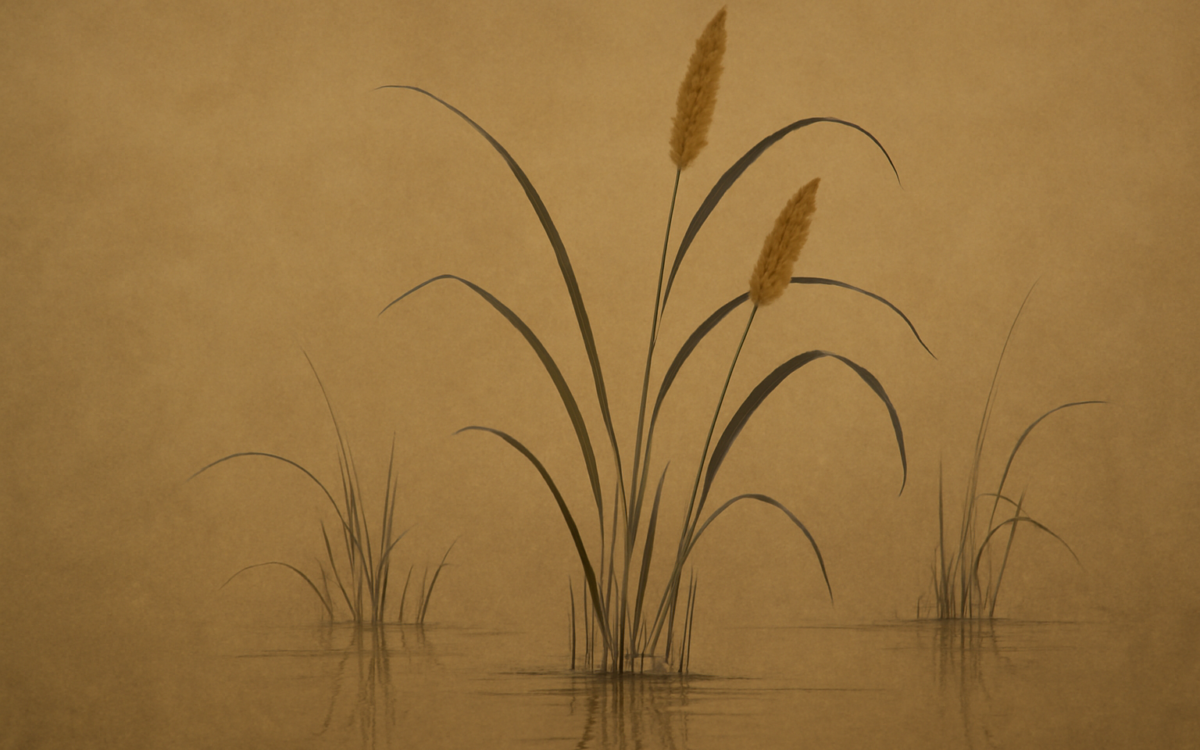
The Yi Hai day pillar (乙亥 yǐ hài) sets Yǐ 乙, Yin Wood, on the Pig branch 亥, which is Yang Water. The natural image writes itself: a soft, pliant plant growing beside deep, moving water, its roots always within reach of nourishment. Where some Wood pillars have to fight for moisture, Yi Hai floats on it.
In Ba Zi (八字 bāzì), the day branch is the ground the Day Master stands on, and for Yi Hai that ground is Direct Resource. Water feeds Wood, and here the branch’s main qi is Rén 壬 Yang Water, generating the Day Master directly. This is a pillar defined less by struggle than by support.
Personality of the Yi Hai day pillar
Yǐ Wood is the vine, the grass, the flowering stem of the ten stems: adaptable, quietly persistent, able to bend around obstacles and keep growing. Sitting on Direct Resource (正印 zhèngyìn) deepens that gentleness into something learned and well-rooted. Direct Resource is the study, the mentor, the sheltering influence, and its main qi Rén 壬 pours steadily into the Day Master.
The result is often a person who feels resourced from within. Yi Hai natives tend to be reflective, absorbent and cultured, drawn to knowledge and to caretaking roles. There is a natural patience to them, the patience of someone who trusts that support will be there. They read situations before acting and rarely force their way forward, preferring to grow around a problem than to break it.
The shadow side of so much Resource is a pull toward comfort and hesitation. A vine beside endless water can become languid, waiting to be watered rather than reaching. In practice this often shows up as excellent counsel given freely to others while their own decisions sit unmade, or as long preparation that never quite becomes a launch. The remedy is usually modest, structured output: small commitments, kept visibly. At its best, this pillar turns steady nourishment into genuine depth: it thinks things through, and it lasts.
The spouse palace
The Pig branch holds two hidden stems, listed here verbatim from the reference data: Rén 壬 (Yang Water) = Direct Resource 正印; Jiǎ 甲 (Yang Wood) = Rob Wealth 劫财.
The dominant note in this marriage house is Direct Resource, which colours the partner and the union with themes of care, protection and quiet nurture. Many Yi Hai natives experience the relationship as a source of support, almost parental in its steadiness. Alongside it sits Rob Wealth (劫财 jiécái), Jiǎ Wood, the assertive sibling energy that shares the Day Master’s own element.
Read without alarm, the pairing suggests a home where nurture is real but where a more competitive or independent streak also lives under the same roof. Rob Wealth in the spouse palace classically asks couples to be clear about resources, autonomy and who leans on whom. Handled openly, that clarity is a strength rather than a fault line. As always, the branch describes tendencies, not fate.
Note also what the seat does not hold: neither a wealth star nor an officer star, so the classical partner star must be found elsewhere in the chart — Earth stems for a Yǐ man’s wife star, Metal for a Yǐ woman’s husband star — while the Pig describes the atmosphere those people will live in. Separating those two layers cleanly is the core skill of reading the spouse palace. One further subtlety: the Jiǎ inside the Pig gives this soft Day Master a hidden root of kindred Wood, which quietly stiffens the vine — Yi Hai natives are rarely as yielding as they first appear.
The Pig in motion
By the fixed relations, Hai clashes with Si (巳↔亥 in the Six Clashes), is harmed by Shen (申↔亥 in the Six Harms), combines with Yin (寅+亥→Wood in the Six Combinations), and anchors the 亥卯未 Wood frame of the Three Harmonies. A Si year strikes this nurturing seat with the native’s own output Fire — support interrupted by expression, often literally a season of leaving the nest. Yin arrivals bind the palace toward Wood, converting nourishment into growth; Mao and Wei do the same through the harmony frame. For a pillar that risks over-comfort, these disturbances are frequently the making of it.
Na Yin
The Na Yin (纳音 nàyīn) of Yi Hai is 山头火 Shāntóu Huǒ, Mountain-top Fire, the same melodic element it shares with Jia Xu. There is a pleasing paradox in Water-fed Wood carrying a Fire song: growth beside the stream, yet a warm flame glimpsed on the ridge above. Take it as flavour only. The mechanics of Yin Wood on Yang Water carry the analysis; Mountain-top Fire simply adds a distant, hopeful glow to the picture.
In a full chart
All of this describes Yi Hai standing alone. In a working reading it is one pillar of four, and its heavy Resource can help or hinder depending on the whole. In a Day Master already drowning in Water, more nourishment is the last thing it needs; in a dry, demanding chart, the same Pig water is a lifeline.
So the reading always begins by asking whether the Day Master is strong or weak. Our explainer on the strong versus weak Day Master lays out that step, and the Yǐ Wood Day Master profile shows how this gentle stem behaves through the seasons; the underlying grammar — which stems nourish, drain or discipline this vine — is tabulated in the ten gods for Yi Wood. For contrast, the Jia Xu day pillar places Wood on dry, testing earth instead of nourishing water, which throws Yi Hai’s easy support into sharp relief. Within the Yǐ family, the Yi Si day pillar is this seat’s clash partner — the vine pouring itself out into Fire where Yi Hai drinks Water in — and the Yi Mao day pillar, its harmony-frame ally, shows what all that nourishment is for: Wood standing at last on its own root.
Frequently asked questions
Is Yi Hai a weak pillar because the stem is soft? No — softness is Yǐ’s method, not its measure. Seated on its Resource with a hidden Wood root beside it, Yi Hai is quietly well-supplied; the real question is whether the chart gives it something to do with the supply.
What kind of spouse does this palace suggest? A caring, steadying presence, with an independent streak sharing the home. The partner’s fuller character is read from the wealth or officer stars elsewhere in the chart.
Which years move this palace? Si years clash it, Shen years harm it, and Yin years combine with it. Take them as seasons when home and support structures are in motion, to be read with the whole chart.
Want to know whether Yi Hai is your day pillar? Draw your complete chart free with the Ba Zi calculator and see what your own Day Master rests upon.