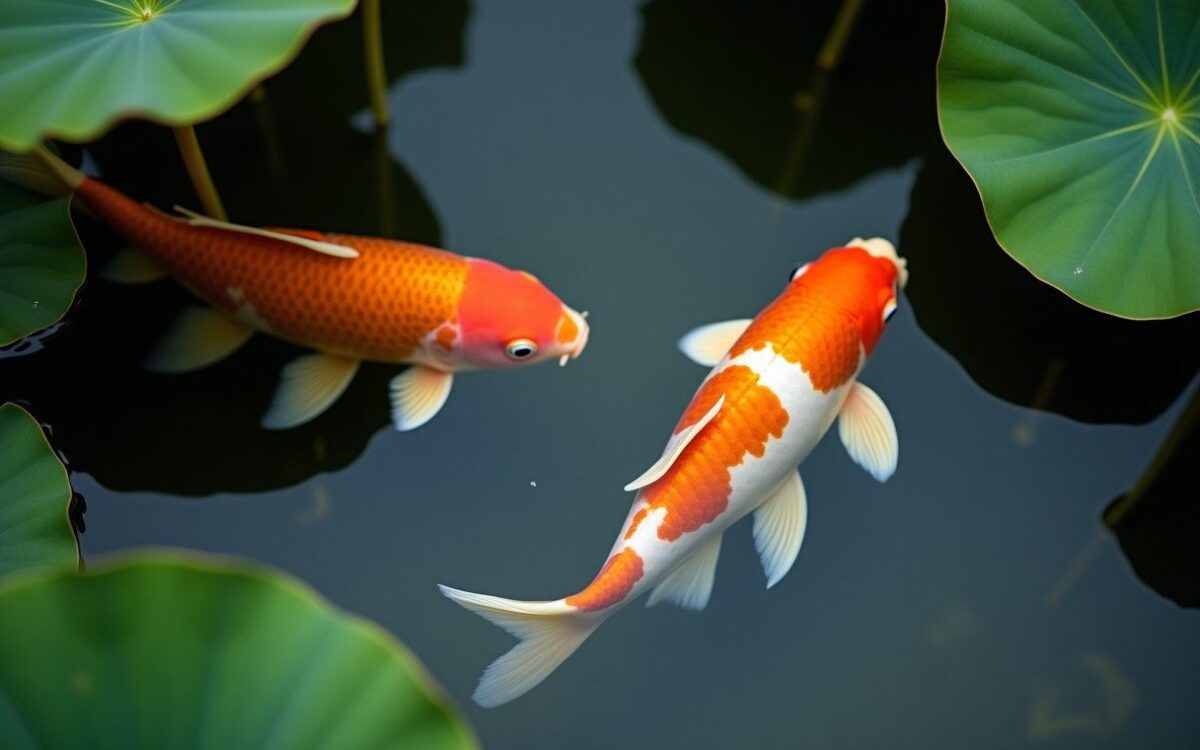
Koi fish, 锦鲤 (jǐnlǐ, “brocade carp”), are among the most loved symbols in Chinese art and feng shui. They stand for perseverance, success and abundance. Most of that meaning comes from one old legend and two puns, so that is where we begin.
The carp that leaps the Dragon Gate
The best-known story is 鲤鱼跃龙门, “the carp leaps over the Dragon Gate”. Carp swim up the Yellow River against the current to a great waterfall called the Dragon Gate. Most fail. The one that leaps over is transformed into a dragon.
For centuries the story described scholars who passed the imperial examinations and rose from ordinary life to high office. Today it is said to anyone facing a hard climb: an exam, a new business, a long project. A koi swimming upstream is a picture of effort that pays off.
Two lucky puns
- Carp is 鲤 (lǐ), which sounds like 利 (lì), profit or advantage. Koi are popular in businesses for this reason.
- Fish is 鱼 (yú), which sounds like 余 (yú), surplus. The New Year wish 年年有余 hopes for “a surplus every year”, which is why fish appear in New Year paintings and on the reunion table.
These belong to a whole family of lucky puns, gathered in our guide to Chinese good luck symbols.
Koi colours
Popular meanings are attached to koi colours, though they are modern and vary between sources. Red and orange koi are linked with love, energy and good fortune; gold with wealth; black with overcoming difficulty; and white with purity or career. Pairs of koi, one red and one black or swimming together, are a common wedding and anniversary motif for harmony between two people.
The ornamental koi with bright patterns were developed as pond fish in Japan from carp, and the Japanese tradition has its own meanings. The Chinese symbolism above comes from the carp itself.
Koi in feng shui
In feng shui, fish belong to the Water element of the five elements, and moving water is associated with the flow of wealth. That is why fish tanks and koi ponds are a popular feature near entrances and in living areas. How a tank is placed and kept, and the old lore about the number of fish, is covered in our guide to the feng shui fish tank.
Koi paintings carry the same meaning. A painting of koi swimming towards the inside of the room, rather than out of the door, is the usual preference, so the fortune swims in rather than away. Nine koi together are a common choice, since nine sounds like “long-lasting”. Our page on choosing art for feng shui covers how water paintings and other imagery are usually placed, and what is best avoided.
Koi and lotus in Chinese art
A favourite pairing in paintings and embroidery is fish swimming among lotus. Lotus is 莲 (lián), which sounds like 连 (lián), continuous, so fish and lotus together read as 连年有余, “surplus year after year”. You will see the motif on New Year prints, porcelain bowls and wedding gifts.
Keeping it in proportion
A koi pond is a lovely thing to sit beside, and the Dragon Gate story is a good one to remember on a hard day. What it cannot do is change the timing of your career or finances; those depend on the work and on the years ahead. If you want to know when your own chart favours a big step, a Ba Zi reading looks at exactly that, with a written summary afterwards and no fear-selling.