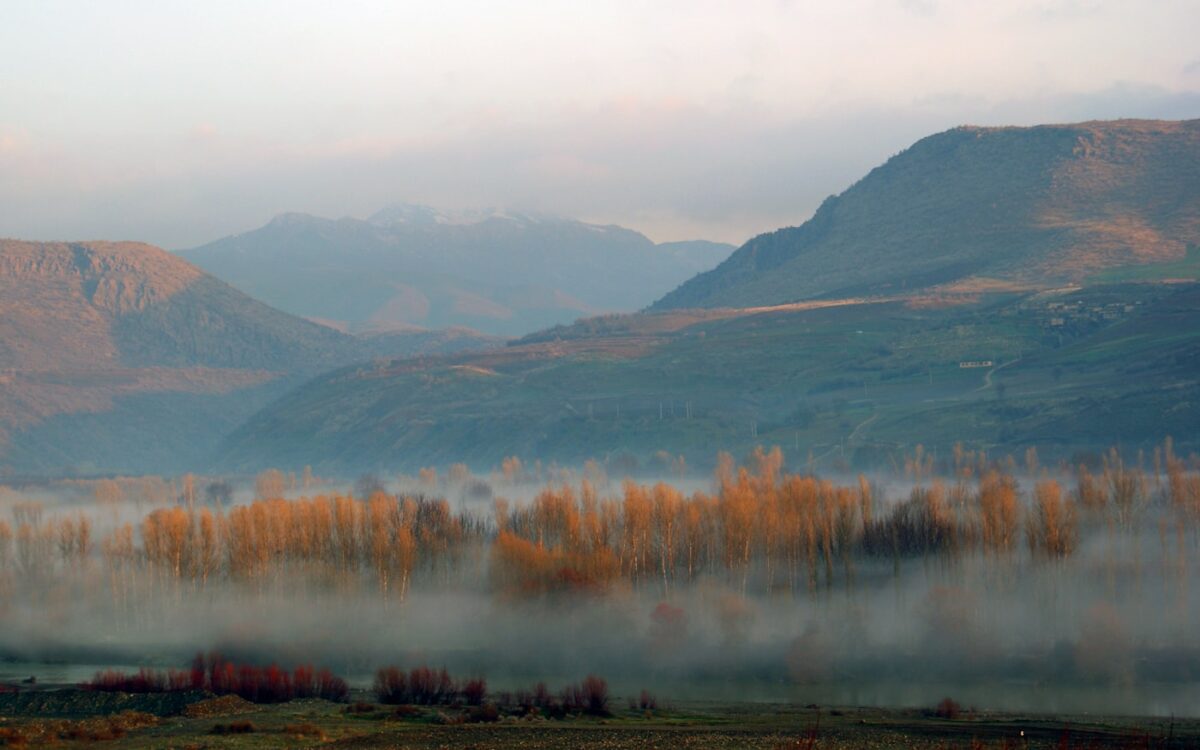
A Wu Earth born in spring is the mountain standing while the forest presses in around it. Wù Earth (戊 wù) is the Day Master (日主 rìzhǔ) of high ground — the ridge, the wall, the broad dyke that holds a landscape in place. Spring is the Wood season, branches 寅卯辰, running Feb 4 – May 4 (from Li Chun 立春 to before Li Xia 立夏). Those are solar-term (節氣 jiéqì) boundaries, not calendar months: the season begins the moment the sun reaches Li Chun, so a late-January or early-February birthday can land on either side. Settle which side you were born on with the Butcher Boy calculator before reading anything into the season.
Spring is the quarter when Wood is at its peak, and Wood is the element that controls Earth. For the Wu mountain, that makes spring the season of steady pressure — roots working into the slope from every side.
Dormant (死 sǐ): the season controls your element
The classical state here is 死 sǐ — Dormant — the season controls your element: weakest baseline; support and timing matter more than effort. For Wu Earth specifically, this is the mountainside gripped by spreading roots. The mountain does not move — Wu is the most immovable of the ten stems — but its energy is committed to bearing the load, not to building or expanding. It holds; it does not grow.
Read against the yin Ji Earth, the difference matters. Ji is the garden soil that Wood happily grows in, so it feels the spring differently. Wu is bedrock and ridge, and Wood on bedrock is pressure without much give. A Wu born in spring is not a collapsing chart — it is a strong shape carrying a heavy season, which is a very particular kind of tired.
The three spring months from the mountain’s side
Which of the three branches holds your month pillar changes how much of the pressure actually lands. The Tiger month (寅 yín) opens the season; its hidden stems (藏干 cánggān) are Jiǎ 甲, Bǐng 丙 and Wù 戊. That is a remarkable branch for this Day Master: the controlling Wood is the main qi, but the same branch carries Bǐng — the Fire resource that warms Earth — and a Wù root of the mountain’s own. Pressure, remedy and footing arrive in one character. The Rabbit month (卯 mǎo) hides Yǐ 乙 alone: pure Wood, no Fire, no Earth, and therefore the heaviest month of the quarter for a Wu — the roots grip the slope with nothing softening them. The Dragon month (辰 chén) closes spring hiding Wù 戊, Yǐ 乙 and Guǐ 癸. As one of the four Earth-storage months, it gives the mountain a true root under a fading Wood sky; a 辰-month Wu is the most settled of the three, dormant on paper but standing on its own ground.
What this season asks of you
Spring is Earth’s power and pressure season — Wood controls Earth — so a Wu Earth born in spring is a weak-season chart by default, and the priorities are the weak-state ones: resource, allies, and timing rather than raw output. Resource for Wu means Fire (火 huǒ): sunlight warms the mountain, hardens the ground, and turns pressure into something the slope can bear. A well-placed Bing or Ding, or a Fire branch, is the warmth that steadies the whole picture. Allies mean other Earth — a Wu ridge or Ji field beside you to share the weight of the controlling Wood.
That is the weak-side application of the general favorable-elements rule: resource and companions favorable, output, wealth and power unfavorable — always with the caveat that season and chart structure can override the rule of thumb. The Earth-specific version is worked through on the favorable elements for Earth Day Masters page.
The move to avoid is meeting the season head-on, trying to out-muscle the Wood. A mountain does not win a shoving match with a forest; it endures one. The Wu strategy is to gather Fire and Earth, then let the calendar turn — a summer luck pillar, a Fire hour, a cycle that brings resource — so that expression comes when the climate finally backs it. For a weak Day Master, timing outperforms effort every time.
The caveats that change everything
Season is only half the strength verdict. Earth carries a nuance the other elements do not: classical doctrine gives Earth its own prosperity in the four transitional months (土旺四季 tǔ wàng sìjì), strongest in late summer (未 wèi) — so the dormant reading above is the season-core judgement, and a chart weighted toward those Earth-storage branches can sit heavier than the spring alone suggests. On top of that, rooting decides the rest: a Wu backed by Fire, sitting on an Earth branch, with supportive hidden stems reads far sturdier than a bare stem exposed to Wood. Roots, the surrounding stems, clashes and combinations all finish what the season starts.
So never stop at the month branch. Walk through the full weighing in our guide to a strong versus weak Day Master, and read the temperament of the mountain itself on the Wu Earth Day Master profile. For the contrast, see the same mountain in its resource season at Wu Earth born in summer, where Fire feeds Earth instead of Wood pressing on it — then complete the year with Wu Earth born in autumn, the mountain spending itself into ore, and Wu Earth born in winter, the dyke straining to hold the flood. Spring is the only quarter of the four where the season stands directly on the mountain, which is why its remedies are the most defensive.
Two questions spring-born Wu charts ask
Is a dormant Wu still a “strong” personality?
Often, yes. The seasonal state measures elemental backing, not character. Wu’s immovable temperament survives a weak season intact; what changes is how expensive it is to act on. A dormant mountain still refuses to move — it simply pays more for the refusal.
Does the 土旺四季 rule cancel the dormant reading?
No. It qualifies it. The season-core state for spring remains 死, but a chart carrying 辰, 戌, 丑 or 未 branches holds more native Earth than the label suggests. Both facts go into the same weighing rather than one erasing the other.
Spring is the pressured quarter for the mountain, but pressure in a chart is a set of instructions, not a sentence. To see whether your own Wu is a strained slope or a well-warmed one, confirm both your Day Master and your birth season with the Butcher Boy calculator, then weigh the roots around it.