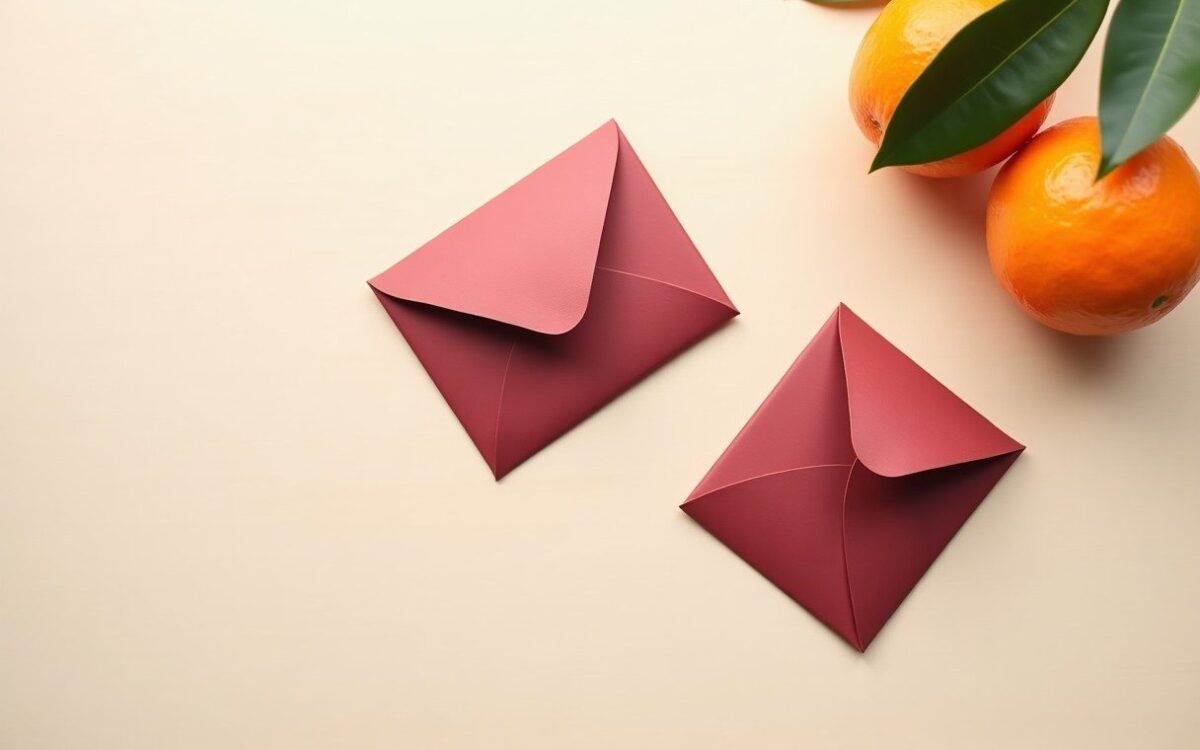
An ang bao, 红包, is a red packet with money inside, given at Chinese New Year, weddings, birthdays and other happy occasions. The red stands for good fortune and the money for a good start. You will see the name spelled ang bao, ang pao and ang pow, all from Hokkien and Teochew; in Mandarin it is hóngbāo, and Cantonese speakers call it 利是 (lai see).
This guide covers the Chinese New Year customs most Singapore families follow. For weddings, where the rules are different, see our guide to wedding ang bao.
Who gives ang bao to whom
The basic rule is that those who are married give to those who are not.
- Married couples give to children and to unmarried younger relatives, including many unmarried adults. In most families a couple gives one packet together.
- Working adults give to their parents and often grandparents, as thanks and respect.
- Employers give to staff, usually a small token at the first working day of the year.
- Visitors give to the host’s children when visiting during the fifteen days of the New Year.
Unmarried adults usually receive rather than give, though many who are working choose to give to their parents.
How much to give
There is no fixed rate, and it varies with family habits and income. These are common ranges in Singapore, not rules:
| Recipient | Common range |
|---|---|
| Children of friends, neighbours, colleagues | S$6 to S$10 |
| Nephews, nieces and close family children | S$10 to S$50 |
| Your own parents and grandparents | S$100 and up |
| Staff, from an employer | A small token, often S$8 to S$20 |
What matters more than the amount is consistency. Give the same to children of the same household, and to families who give to yours, a similar amount in return.
Lucky and unlucky amounts
- Even numbers are preferred, because good things come in pairs.
- Avoid four (S$4, S$40, S$44), since 四 sounds like death.
- Eight is favoured, because 八 sounds like prosper. S$8, S$18 and S$88 are popular. More on number meanings is in our guide to feng shui numbers.
New notes and e-ang pao
Crisp new notes are traditional, a fresh start for the year, and Singaporeans queue at banks for them before the New Year. To reduce waste, banks also offer lightly used “good-as-new” notes, and many families now send e-ang pao through banking and payment apps, especially to relatives overseas. Both are perfectly acceptable.
Giving and receiving with good manners
- Give and receive with both hands, with a greeting such as 新年快乐 or 恭喜发财. Our page of Chinese New Year greetings has more.
- Do not open a packet in front of the giver.
- Do not reuse a packet with someone else’s name on it.
- Packets are usually given during the first fifteen days of the New Year. The 2027 New Year begins on Saturday 6 February 2027; the season’s other customs are in our guide to Chinese New Year traditions.
Ang bao at other occasions
Red packets are not only for the New Year. They are given at an elder’s birthday, especially a milestone such as sixty or eighty; at a baby’s full-month celebration; when a friend opens a new business; and to helpers on a moving day. The same customs apply: red packet, even amount, no fours, and both hands.
The red packet in a wider sense
The ang bao is a small, generous custom: a wish for good fortune, handed over in person. It sits alongside the other New Year symbols of luck, from mandarin oranges to the upside-down 福, which are explained in our guide to Chinese good luck symbols.