Chinese New Year 2027 falls on Saturday 6 February 2027 (正月初一), and the season runs sixteen days, from the eve on Friday 5 February to the Lantern Festival on Saturday 20 February. Chinese New Year traditions are not one ritual but a sequence, each day carrying its own custom. Practice varies by dialect group and by family, so read what follows as what many households do, not a rulebook. For the wider picture of the year itself, start with Chinese New Year 2027.
The sixteen days at a glance
The table gives each date with its lunar date, the occasion, the day pillar (日柱 rìzhù) and the day officer (建除十二神 jiànchú shí’èr shén) from the almanac, computed for 12:00 Singapore time. The officers are a separate almanac layer and are listed for reference only; they say nothing about whether a custom is well or badly timed. For what the officers are, see the Tong Shu guide.
| date | day | lunar | occasion | day pillar | officer |
|---|---|---|---|---|---|
| 2027-02-05 | Fri | 腊月廿九 | 除夕 New Year’s Eve (reunion dinner) | 乙卯 | 除 Remove |
| 2027-02-06 | Sat | 正月初一 | 初一 New Year’s Day | 丙辰 | 满 Full |
| 2027-02-07 | Sun | 正月初二 | 初二 | 丁巳 | 平 Balance |
| 2027-02-08 | Mon | 正月初三 | 初三 | 戊午 | 定 Stable |
| 2027-02-09 | Tue | 正月初四 | 初四 | 己未 | 执 Initiate |
| 2027-02-10 | Wed | 正月初五 | 初五 | 庚申 | 破 Destruction |
| 2027-02-11 | Thu | 正月初六 | 初六 | 辛酉 | 危 Danger |
| 2027-02-12 | Fri | 正月初七 | 初七 人日 Renri | 壬戌 | 成 Success |
| 2027-02-13 | Sat | 正月初八 | 初八 | 癸亥 | 收 Receive |
| 2027-02-14 | Sun | 正月初九 | 初九 天公诞 Jade Emperor’s birthday | 甲子 | 开 Open |
| 2027-02-15 | Mon | 正月初十 | 初十 | 乙丑 | 闭 Close |
| 2027-02-16 | Tue | 正月十一 | 十一 | 丙寅 | 建 Establish |
| 2027-02-17 | Wed | 正月十二 | 十二 | 丁卯 | 除 Remove |
| 2027-02-18 | Thu | 正月十三 | 十三 | 戊辰 | 满 Full |
| 2027-02-19 | Fri | 正月十四 | 十四 | 己巳 | 平 Balance |
| 2027-02-20 | Sat | 正月十五 | 十五 元宵 Lantern Festival / Chap Goh Mei | 庚午 | 定 Stable |
One structural note from the Ba Zi side. The Ba Zi year does not turn on New Year’s Day but at Li Chun (立春 lìchūn), which in 2027 falls on 2027-02-04 at 09:45, two days before 初一. The festival follows the lunar calendar; the chart follows the solar terms.
New Year’s Eve and New Year’s Day
除夕 chúxī: the reunion dinner
The eve, Friday 5 February 2027, is the night the family gathers for the reunion dinner, often the one meal of the year everyone makes the effort to attend. Many families then keep 守岁 (shǒusuì), staying up late to see the old year out, and red packets are often given that evening. Houses are cleaned before this night, and decorations go up before the eve; the Chinese New Year decorations guide covers what goes where.
初一 chūyī: visiting and greeting
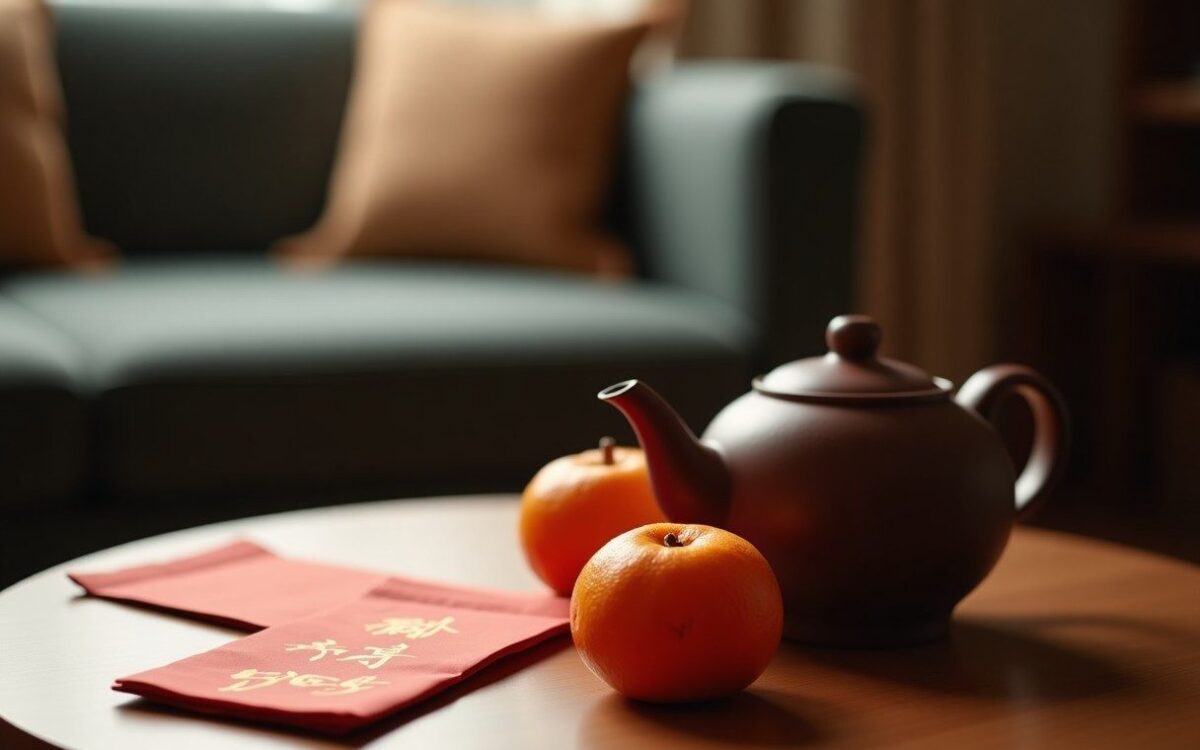
New Year’s Day is for 拜年 (bàinián), visiting elders and relatives. Visitors exchange Chinese New Year greetings, and married couples give red packets, 红包 (hóngbāo) or ang pow, to the unmarried.
初一 also carries the best-known folk beliefs of the season, which many families observe. They do not sweep the floor, so as not to sweep away the year’s luck. Many do not wash their hair that day. Words about death or illness are avoided, and people take care not to break things. These are folk beliefs, kept out of habit and respect as much as conviction, and households differ in which ones they keep.
Chinese new year traditions of the first week
初二: returning to the parental home
On Sunday 7 February, married daughters traditionally return to visit their own parents, 回娘家 (huí niángjiā). For many families it is the second great gathering of the season.
初三: 赤口, the “red mouth” day
Monday 8 February is 赤口 (chìkǒu), “red mouth”, traditionally a day prone to quarrels. Many families stay home rather than visit, treating it as a quiet day between the rounds of calls.
初五: 破五 and the God of Wealth
Wednesday 10 February is 破五 (pòwǔ), the end of several New Year restrictions. Many families welcome the God of Wealth, 迎财神 (yíng cáishén), and many businesses traditionally reopen around this day. The 破 in the table on this date is the day officer, a separate almanac layer, and has no connection to the name 破五.
初七: 人日, everyone’s birthday
Friday 12 February is 人日 (Rénrì), “everyone’s birthday”. In Singapore and Malaysia, lo hei is traditionally tossed on this day, though in practice the yusheng toss happens at many gatherings across the season.
初九 and the Jade Emperor
初九 is 天公诞 (Tiāngōng dàn), the Jade Emperor’s birthday, a day of particular weight for Hokkien families. Prayers to 天公 (Bai Ti Kong) begin on the night of 初八 and carry into 初九, with offerings that traditionally include sugarcane. A Hokkien legend tells of the community hiding in a sugarcane field, which is why the stalks appear on the altar.
In 2027, 初九 falls on Sunday 14 February, the same day as Valentine’s Day. Some households will be keeping a late-night prayer on the eve and a dinner for two the next evening; the two calendars simply overlap in 2027.
十五 and the close of the season
The fifteenth day, Saturday 20 February 2027, is 元宵 (Yuánxiāo), the Lantern Festival, known in Singapore by its Hokkien name Chap Goh Mei. It closes the New Year season. Decorations traditionally come down after this day, and 汤圆 (tāngyuán) are eaten for reunion; the Chinese New Year food page covers the symbolic dishes.
Red runs through all fifteen days, from couplets to packets. Some people extend it to what they wear, such as a red string bracelet, particularly in a year when their animal sits under Tai Sui 2027.
The fifth day belongs to the God of Wealth; who he is and how he is welcomed is covered separately.
Who gives red packets to whom, and how much is usual, is covered in our guide to ang bao etiquette.
Wondering about clothes and colours? See what to wear for Chinese New Year.
Where Ba Zi fits
These Chinese New Year traditions belong to families and communities; Ba Zi (八字 bāzì) reads something narrower. Each day in the table has a pillar, but a pillar that applies to everyone in Singapore says very little about any one person until it meets an individual chart. What matters for you is how the new year pillar and the coming months interact with your own four pillars.
See how the 2027 year meets your own chart: plot your Four Pillars free with the Ba Zi calculator.