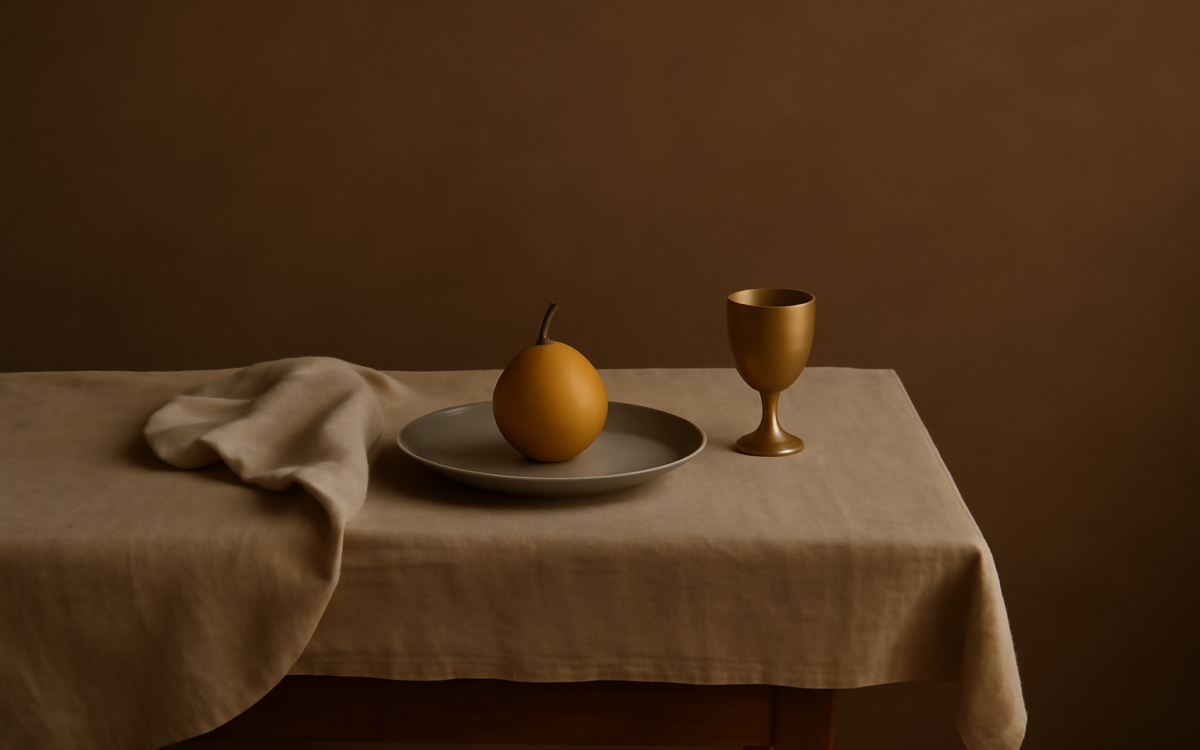
Where the kitchen is the source, the dining room is where nourishment is shared. Classical practice reads the table as a small gathering point for the household’s qi (气 qì) and, by old association, its wealth — a place where the family sits together, faces one another, and eats. That is why a considered feng shui dining room matters more than its size suggests: it is not a grand room, but it is a frequent one, and the quality of attention people give each other across the table sets a tone the rest of the home borrows.
Almost everything worth doing here is Form School (峦头 luán tóu) — the older, placement-and-flow branch that needs no compass and no birth data. You are reading how people sit, where the qi settles, and how a shared meal is made calm rather than rushed. Start there and the room does most of its work before you reach any finer layer.
The table as shared nourishment and wealth
In the classical view the dining table (餐桌 cānzhuō) is one of the home’s gathering places — somewhere qi pools rather than passes through. The reasoning is plain rather than mystical. A table that is used, laid, and sat at is a household that eats together, and that steadiness is what the tradition ties to abundance. A table that has become a dumping ground for post, keys and laundry has stopped being a place of nourishment, and no cure fixes that faster than clearing it and eating at it.
Two conditions do most of the work. The table should sit in a settled part of the room, not marooned in a through-route between the front door and the kitchen where people and qi rush past it. And it should have a sense of enclosure — a solid wall or two nearby rather than four exposed sides in the middle of an open-plan floor. A table with support behind it holds the meal; a table adrift in traffic scatters it.
风水 · Feng Shui
Find your lucky directions. Plot your chart free and see your feng shui Kua number and the directions that favour you — computed in your browser.
Shape carries an element, and each shape suits a slightly different room. This is the same five-element (五行 wǔxíng) logic that runs through the whole practice, so choose for the household rather than the trend.
Round or oval (Metal). The classic dining shape. No hard corners point at anyone, qi circulates evenly, and everyone sits an equal distance from the centre — which reads as fairness and easy conversation. Round tables are the gentle default, especially for families that want to feel level with each other.
Rectangular (Wood). The most practical for most homes and the easiest to seat. It carries a mild head-of-table hierarchy, which suits a household that likes a clear host. Soften it by choosing rounded rather than sharp corners.
Square (Earth). Stable and grounding for four, though it seats larger groups awkwardly and its corners point outward. Good for a small, steady household.
Whatever the shape, aim for an even number of seats where you can — pairs read as balance and companionship, the same instinct behind pairing nightstands in a bedroom. Leave enough room to pull every chair out without knocking a wall, and avoid seating anyone with a table corner aimed straight at their midsection or with their back squarely to the door. A cramped table where two seats are unusable is worse than a smaller one everybody can reach.
The commanding seat
The dining room has its own version of the principle that governs the bed and the desk: the commanding position (命位 mìng wèi). At least the main seats — and ideally the host’s — should let a diner see the entrance to the room without sitting directly in line with it. Someone whose back is to the doorway eats with a low, background unease, and a tense diner is the opposite of a nourished one.
In practice this rarely needs a full rearrangement. Angle the table so the principal chairs face the room and its opening. Give the host a seat with a solid wall behind it rather than a window or a passage. If the layout forces the best seats to face away from the door, a mirror or reflective surface placed so a diner can catch the entrance restores the sense of command — the same reflected-view fix that appears throughout the home, which we set out in the guide to feng shui mirror placement.
Mirrors reflecting the table — the abundance placement
The dining room is the one room where a large mirror is not just allowed but traditionally encouraged. A mirror positioned to reflect the dining table is said to double the food on it — an image of abundance, the meal multiplied. It is a rare case, because in most rooms a mirror facing the wrong thing is a problem; in the bedroom a mirror facing the bed is actively discouraged. Here the symbolism runs the other way, and a mirror that shows a laid, well-lit table reads as plenty.
A few honest cautions keep this from becoming clumsy. The mirror should reflect the table and the room, not the front door directly (which is read as pushing arriving qi and, by association, money straight back out), and not a cluttered sideboard or a bathroom door — a mirror doubles whatever it sees, so give it something worth doubling. Keep it clean and unbroken. This gentle wealth symbolism sits alongside the more deliberate placements in our guide to the feng shui wealth corner, where the same instinct — abundance made visible — is put to work more directly.
Lighting and clutter
Light is the finishing layer and the dining room asks for a particular quality of it: warm, adjustable, and gathered over the table rather than flat across the ceiling. A pendant or a dimmable fixture that pools light onto the meal draws people in and holds the qi where the eating happens. Harsh overhead glare pushes a room to feel like a canteen; candlelight and low warm light make the same table feel like an occasion. Where a beam or a sharp light fitting hangs directly over a diner’s head, shift the seat or soften the fixture — nobody dines well under a blade of shadow.
Clutter undoes all of it. A dining table buried under paperwork has quietly changed its job, and a room used for everything except dining loses the gathering quality the tradition prizes. Clear the surface, store the odds and ends elsewhere, and let the table return to what it is for. Colour can stay simple: warm, earthy, appetising tones — cream, terracotta, soft timber and gentle greens — nourish the room, while an all-over cold or stark scheme leaves a dining space feeling unwelcoming. Where the dining area falls within the wider plan matters too, and that sits in the broader picture at our feng shui hub.
Work from the room outward: settle the table in a supported spot, choose a shape that suits the household, seat the host in command of the door, add a mirror to double the meal, then warm the light and clear the clutter. That is the whole of a good dining room, and none of it needs your birth data. The personalised layer — which of the five elements genuinely nourish you, rather than the room — lives in your chart. Plot your Ba Zi (八字 bāzì) free with the calculator, read how the cycles work in our guide to the five elements in Ba Zi, and let your own elements guide the finishing touches at the table.