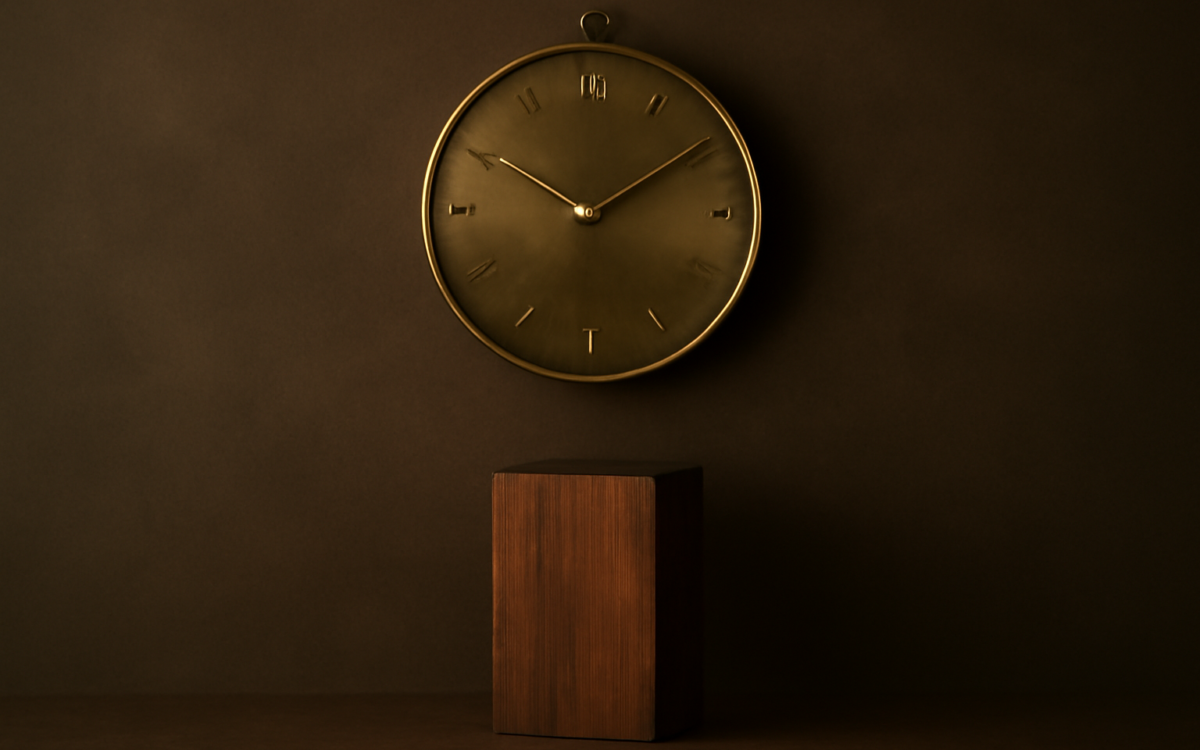
A clock is one of the few objects in a home that never stops moving. Its hands turn, a pendulum swings, a second hand ticks — and in feng shui, sustained motion is a form of active energy. That is the whole idea behind feng shui clock placement: a clock is not a neutral decoration but a small engine of activity, and where you put it decides whether that activity steadies a room or agitates it. The principle is Form School (峦头 luán tóu) — it reads how qi (氣 qì), the vital current, moves through a space — so no compass or birth chart is needed to apply most of what follows.
Clocks earn their reputation for being tricky because they carry two associations at once. On one hand they bring liveliness, rhythm and forward momentum to a stagnant corner. On the other they are quiet reminders of time passing, which is why the wrong placement — over the bed, or the first thing you see through the front door — can leave a room subtly unsettled. The craft is knowing the difference.
Where a clock helps
A clock does its best work in the active, public parts of the home. Living rooms, dining rooms, kitchens, home offices and hallways all benefit from a measured pulse of movement. In a room that feels flat or under-used, a wall clock reintroduces a sense of life and keeps qi circulating rather than pooling.
By the classical Bagua (八卦 bāguà) map, the east and southeast sectors are the natural homes for a clock. East governs family and health, southeast governs wealth and abundance, and both belong to the Wood (木 mù) element — which a clock’s steady, growing rhythm supports well. A clock on an east or southeast wall of the living room is one of the safest placements there is. Our broader feng shui living room guide covers how this sits alongside seating and the commanding position.
The north sector is a gentler option. North is the Water (水 shuǐ) area of career and path, and a metal-cased clock suits it, since in the productive cycle Metal (金 jīn) feeds Water. A small desk clock in a home office can help you keep to your hours without dominating the room. For the wider logic of which element belongs where, our note on the feng shui wealth corner is a useful companion, since a clock placed there needs a light touch — enough movement to keep wealth energy active, never so large that it dominates the sector.
风水 · Feng Shui
Find your lucky directions. Plot your chart free and see your feng shui Kua number and the directions that favour you — computed in your browser.
A short list of placements to avoid does most of the work here. These are Form-School cautions, universal and needing no computation.
Facing the front door head-on. A large clock that is the first thing you meet on entering reads as a countdown greeting the household and its guests. The front door is the mouth of qi (气口 qì kǒu); let it invite energy in, not confront it with ticking time.
Over or facing the bed. The bedroom is meant to be restful and slow. A ticking clock directly above the headboard, or on the wall the bed faces, keeps a low current of activity running over people who are trying to wind down. If you need a bedside clock, a small silent one on a nightstand is far kinder than a large wall piece. Our feng shui bedroom guide explains why the room’s whole job is to quieten qi.
Directly above where you habitually sit or work. A clock hanging over your own head in the commanding position adds a subtle pressure of passing time to a spot that should feel stable and supported.
A stopped or broken clock left on display. A clock frozen at one time reads as stalled energy. Keep the clocks you display running and accurate, or store the ones you do not use.
None of this means a bedroom or entry must be clock-free. It means the clock should be small, quiet, and out of the direct sightline of the bed or the door.
Size and material by element
A clock carries whichever element its material and shape express, and that is what lets you match it to a sector. This is the same five-element logic that governs colours and objects throughout the home, drawn straight from the productive and controlling cycles; if the cycles are new to you, our primer on the five elements in Ba Zi lays them out.
Clock material / shape
Element
Sits well in
Round metal case, brass or steel
Metal (金 jīn)
West, northwest, north
Wooden frame, tall or rectangular
Wood (木 mù)
East, southeast
Red tones, triangular or pointed
Fire (火 huǒ)
South (use sparingly)
Earthenware, square, beige or ochre
Earth (土 tǔ)
Southwest, northeast, centre
Dark, wavy or glass-fronted
Water (水 shuǐ)
North
Size follows the room. A large statement clock belongs in a generous living or dining space where its movement has room to circulate; in a small bedroom or a tight study it becomes overbearing. When in doubt, choose the quieter, smaller piece — a clock should keep a room’s rhythm, not set its mood. Match the case to the sector rather than fighting it: a bright red, fiery clock on a south wall reinforces an already-warm Fire zone and is best kept modest, while a round brass clock suits the metal-governed west.
The note on gifting a clock
One cultural point is worth naming plainly, because it comes up often and is easy to get wrong. In Chinese custom, giving a clock as a gift is traditionally avoided. The phrase for “to give a clock,” 送钟 (sòng zhōng), sounds identical to 送终 (sòng zhōng), which means to attend a dying person’s final moments or see them to the end. The homophone makes a clock read as an unlucky present, particularly for an elder or on an auspicious occasion such as a wedding or a new home.
This is a matter of language and courtesy rather than qi flow, and you will find families who observe it strictly and families who pay it no mind — schools and households differ. If you do want to give a timepiece, a common workaround is to let the recipient hand you a token coin in return, which reframes the clock as a purchase rather than a gift. A watch, framed differently in speech, tends not to carry the same association.
Clock placement is Form School at its most approachable: give an active room a measured pulse, keep the ticking away from the bed and off the front-door axis, and match the case to the sector it sits in. Feng shui reads the room the way Ba Zi (八字 bāzì) reads the person. If you would like to see how the same Metal, Wood and Fire at work in a room show up in your own chart, plot it free on the Ba Zi calculator, or browse the wider feng shui guide for the rest of the home.