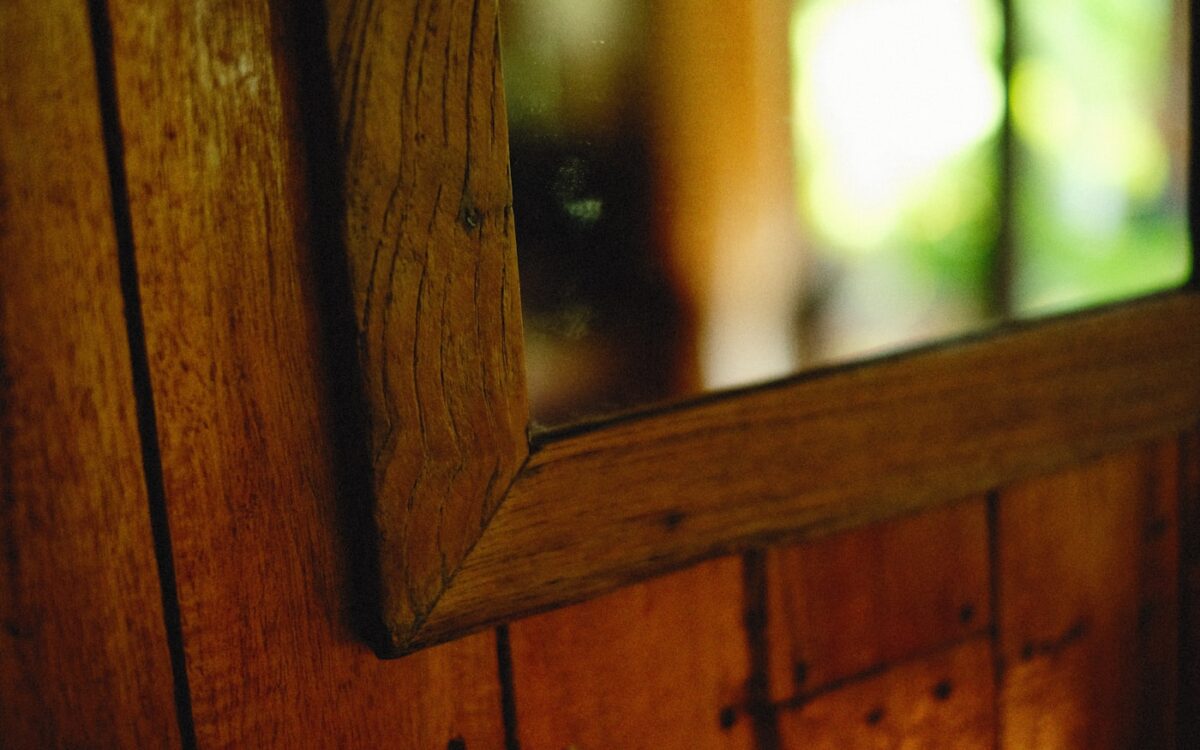
Of all the objects we move around a home, the mirror is the one that repays attention the most. It doubles whatever it faces — light, space, a view, or a problem. Good feng shui mirror placement is really just the discipline of deciding, on purpose, what you want doubled. A mirror is a Water (水 shuǐ) object in the five-element reading: reflective, cooling, expansive. Placed with intention it opens a cramped room and draws light deeper inside. Placed carelessly it can bounce qi (氣 qì) — the vital current — straight back out the way it came.
Most mirror advice you meet online concerns the bedroom, and there are real reasons for that, which we cover on our companion piece on mirrors in the bedroom. This guide is about everywhere else: the entry, the living and dining rooms, hallways and the areas that hold your household’s wealth. The underlying logic is Form School (峦头 luán tóu) — how qi moves through a space — so no compass or birth data is needed to apply it.
Feng shui mirror placement and the front door
The most common question in feng shui mirror placement is whether a mirror should hang directly opposite the front door. In most cases the answer is no. The front door is the mouth of qi (气口 qì kǒu), the main way nourishing energy enters the home. A mirror hung squarely facing it acts like a return valve: qi arrives, meets its own reflection, and is pushed back out before it can circulate and settle. You want the entry to invite and hold energy, not repel it. For more on why the entrance matters so much, see our guide to the feng shui front door.
This does not mean the entryway should have no mirror at all. A mirror on a side wall of the foyer — perpendicular to the door rather than opposite it — is often excellent. It widens a tight entrance, lets you check yourself before leaving, and reflects the interior warmth rather than the doorway. The rule is about the axis, not the object: keep the reflective surface off the direct line of the incoming door.
Schools differ on one point worth naming. Some Western and BTB practitioners deliberately use a small mirror to “expand” a very poky entry, judging that the benefit of more apparent space outweighs the return-flow concern. Classical Form School is stricter about the door axis. When traditions disagree, the practical test is honest observation: does the space feel welcoming and easy to move through, or does it feel like energy stalls at the threshold?
风水 · Feng Shui
Find your lucky directions. Plot your chart free and see your feng shui Kua number and the directions that favour you — computed in your browser.
A mirror amplifies whatever sits in front of it, so the second principle of good placement is to point it at things you want more of. This is where mirrors and household prosperity meet. A mirror that reflects your dining table — traditionally a symbol of the family’s abundance and nourishment — is considered auspicious, because it visually doubles the food on the table. A dining-room mirror is one of the few placements nearly every school agrees is beneficial.
The opposite case is the classic mistake. A mirror positioned so it reflects a toilet, an open bathroom, a cluttered corner, or a bin doubles a draining feature. In the five-element cycle, Water governs the flow of wealth, and a bathroom is where household Water literally exits; reflecting it multiplies the drain. The same caution applies to a mirror that faces a staircase running down toward the front door, which reads as energy — and by extension money — pouring out of the home. If you are mapping the money zones of your home, our note on the feng shui wealth corner pairs naturally with this: a mirror can gently enlarge and brighten a wealth area, provided what it reflects is worth doubling.
A short way to hold the whole idea: before you hang a mirror, stand where it will be and look at exactly what fills the glass. Whatever you see is what you are asking the home to give you twice.
Entryways, hallways and dining rooms
Away from the door axis, mirrors are among the most useful cures a home has. Long, narrow corridors move qi too fast, almost like a wind tunnel; a mirror on the side wall slows and softens that rush by drawing the eye outward and giving the passage apparent width. In a dim stairwell or windowless hall, a mirror placed to catch and relay daylight from a nearby window keeps qi from going stagnant in the dark.
In the living room, use a mirror to reflect something genuinely pleasant — a garden view, a bright window, an area of open, uncluttered space. This borrows the good feature and spreads it through the room. Our broader feng shui living room guide covers how this fits alongside seating and the commanding position. The discipline is consistent everywhere: reflect openness, light and life; avoid reflecting clutter, sharp corners, exposed beams, or a knife block in the kitchen.
What a mirror should never reflect
It helps to keep a short list of things to keep out of the glass. These are Form-School cautions, universal and needing no computation.
The front door head-on — pushes incoming qi straight back out.
A toilet or open bathroom — doubles a draining, Water-loss feature.
The bed — the main reason mirror talk centres on the bedroom; covered in the bedroom mirror guide.
The stove or a busy, sharp kitchen scene — Fire (火 huǒ) reflected and multiplied unsettles the heart of nourishment; see the feng shui kitchen notes.
Clutter, bins, or a downward staircase — amplifies mess and outward flow.
Two mirrors facing each other — the infinite bounce agitates qi and unsettles a room.
Two practical housekeeping points round this out. Keep mirrors clean and whole; a cracked, foggy or spotted mirror reflects a fractured image and is best replaced. And favour a single generous mirror over a mosaic of small tiles, which chops any reflection — including of the people in the room — into fragments.
Mirrors as one element among five
Because a mirror carries Water energy, it also belongs to the wider element balance of a room. In a space that already feels cold or over-watery — a north-facing room, say, or one dominated by blues and blacks — a large mirror may tip the balance further and is worth using sparingly. In a stuffy, over-warm room it can help. This is the same five-element logic that governs colours, materials and shapes throughout the home; if it is new to you, our primer on the five elements in Ba Zi explains the productive and controlling cycles that feng shui borrows wholesale. Feng shui reads the room the way Ba Zi (八字 bāzì) reads the person.
None of this asks you to compute anything. Mirror placement is Form School at its most accessible: decide what deserves doubling, keep the glass off the front-door axis, and never let a mirror multiply a drain. If you would like to see how these spatial ideas connect to the elements in your own chart — the same Water, Fire and Wood at work in a room — start with a free reading on the Ba Zi calculator, or browse the wider feng shui guide for the rest of the home.