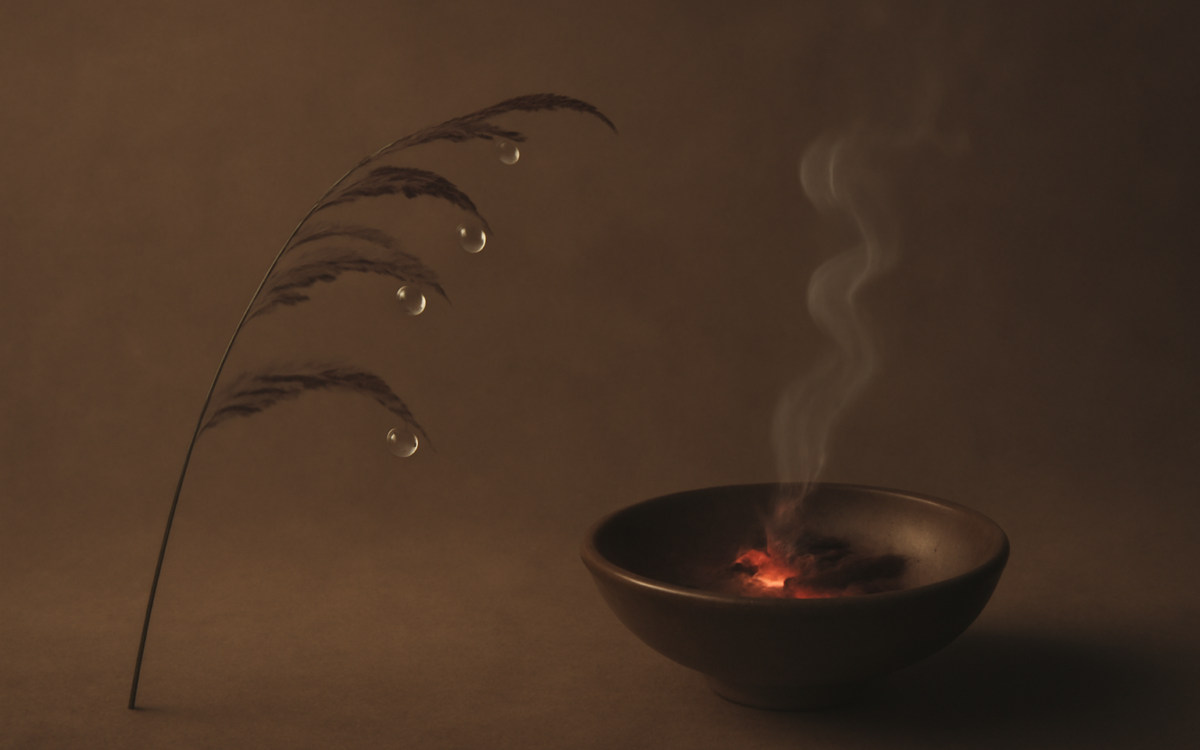
The Gui Si day pillar (癸巳 guǐ sì) sets Guǐ 癸 (Yin Water) over the branch of the Snake, which is Fire in its bright, active phase, holding Metal and Earth within it. In a Ba Zi (八字 bāzì) chart the day pillar seats your Day Master (日主 rìzhǔ) on its home ground. Here the finest Water — mist, dew, rain — rests directly over Fire. Water controls Fire, yet Gui is delicate and the Snake’s flame is strong, so the image is not domination but exchange: dew above a warm hearth, the water drawn toward the wealth held in the heat below.
Guǐ is the softest Water, quiet and pervasive, reaching everywhere without force. The Snake is warmth, intelligence and hidden treasure. The pairing gives a person who is gentle on the surface and quietly acquisitive underneath.
Personality
Gui Si sits on Direct Wealth (正财 zhèngcái), because the Snake’s main hidden qi is Bǐng Fire, which for Yin Water reads as the orthodox Wealth star. This is the steady, earned kind of money-sense — not the gambler’s flair of Indirect Wealth but the diligent, reliable relationship with resources. Gui Si people tend to be practical about value in a soft-spoken way, working patiently toward security rather than chasing the big score.
Where Gui Water on its own can drift and daydream, sitting on Direct Wealth gives it a purpose to flow toward. These people are often quietly capable, good with detail and money, and warmer than the cool Gui stem alone would suggest — the Fire beneath keeps them engaged with the tangible world. There is ambition here, but it is understated and methodical.
The classic note is that Direct Wealth this close can make Gui Si careful, even a touch anxious about stability. At its best, though, this is the pillar of the dependable earner with a gentle manner and a shrewd sense of worth.
The spouse palace
The day branch is the spouse palace (夫妻宫 fūqīgōng). The Snake 巳 carries three hidden stems: Bǐng 丙 (Yang Fire) = Direct Wealth 正财; Wù 戊 (Yang Earth) = Direct Officer 正官; Gēng 庚 (Yang Metal) = Direct Resource 正印.
| Hidden stem in 巳 | Ten God (relative to Guǐ) |
|---|---|
| Bǐng 丙 (Yang Fire) | Direct Wealth 正财 |
| Wù 戊 (Yang Earth) | Direct Officer 正官 |
| Gēng 庚 (Yang Metal) | Direct Resource 正印 |
This is a notably well-ordered palace — three “direct” gods together, the orthodox trio. Direct Wealth as main qi puts steady resources and, in a male chart, a supportive partner at the centre. The Direct Officer (正官 zhèngguān) brings structure, respectability and mutual responsibility — and for a female chart that hidden Wù is the classical husband star, so the marriage significator sits in the marriage seat for either sex. The Direct Resource (正印 zhèngyìn) adds care, protection and learning.
Classically this is one of the more harmonious marriage seats: wealth, proper commitment and nurturing all present in their upright forms, with no killings or hurting stars muddying them. It reads as a partnership built on reliability and shared standards. As always this is a tendency rather than a promise — the rest of the chart still has its say, and our spouse palace guide shows how the seat is weighed against clashes, combinations and the visible stars.
Reading the orthodox trio in practice
Work the seat in three passes. First, note which of the three hidden stems is echoed by a visible stem in the year, month or hour — an exposed Bǐng leads the life toward provision and enterprise, an exposed Wù toward duty and career, an exposed Gēng toward study and quiet backing. Second, check the movers of the branch: 巳 clashes with 亥 (巳↔亥), so Pig branches and Pig years send instability signals through this otherwise settled palace, while 巳 combines with 申 toward Water (巳+申→Water), a binding influence that turns the seat toward Guǐ’s own element; with Rooster and Ox the Snake also completes the Metal frame (巳酉丑→Metal frame), swelling the hidden Resource. Third, come back to strength: three upright gods are still three drains and supports to balance. The full mapping for the first pass is on the Ten Gods page for the Gui Water Day Master.
Na Yin
The Na Yin (纳音 nàyīn) of Gui Si is 长流水 Chángliú Shuǐ, Long-flowing Water. There is quiet charm in the softest, most delicate Water pillar carrying the melody of the great long river — as if the dew remembers it belongs to something that flows to the sea. It suggests persistence beneath the gentleness. Take the Na Yin as poetic flavour layered over the element mechanics, not as a replacement for them.
In a full chart
One pillar gives a temperament and a marriage axis, not the whole verdict. Gui Si’s fine Water standing on strong Fire is easily overheated; whether it thrives depends on whether the rest of the chart brings Metal and Water to keep the Day Master from evaporating, or piles on Fire and Earth and dries it out. That balance is exactly what the strong versus weak Day Master judgement exists to weigh.
For the stem in full, read the Gui Water Day Master profile. Siblings sharpen the contrast: Ren Chen is the yang-Water pillar with a very different, Officer-driven temperament, while Gui Mao shows the same Gui stem sitting on Wood output instead of Fire wealth, and Gui Hai sits on the very Pig that clashes this Snake — reading that pair together is the quickest way to feel what the 巳↔亥 axis means.
Think the Gui Si day pillar might be yours? Plot your four pillars free with the Butcher Boy calculator and check whether this is your day pillar before you build any reading on top of it.