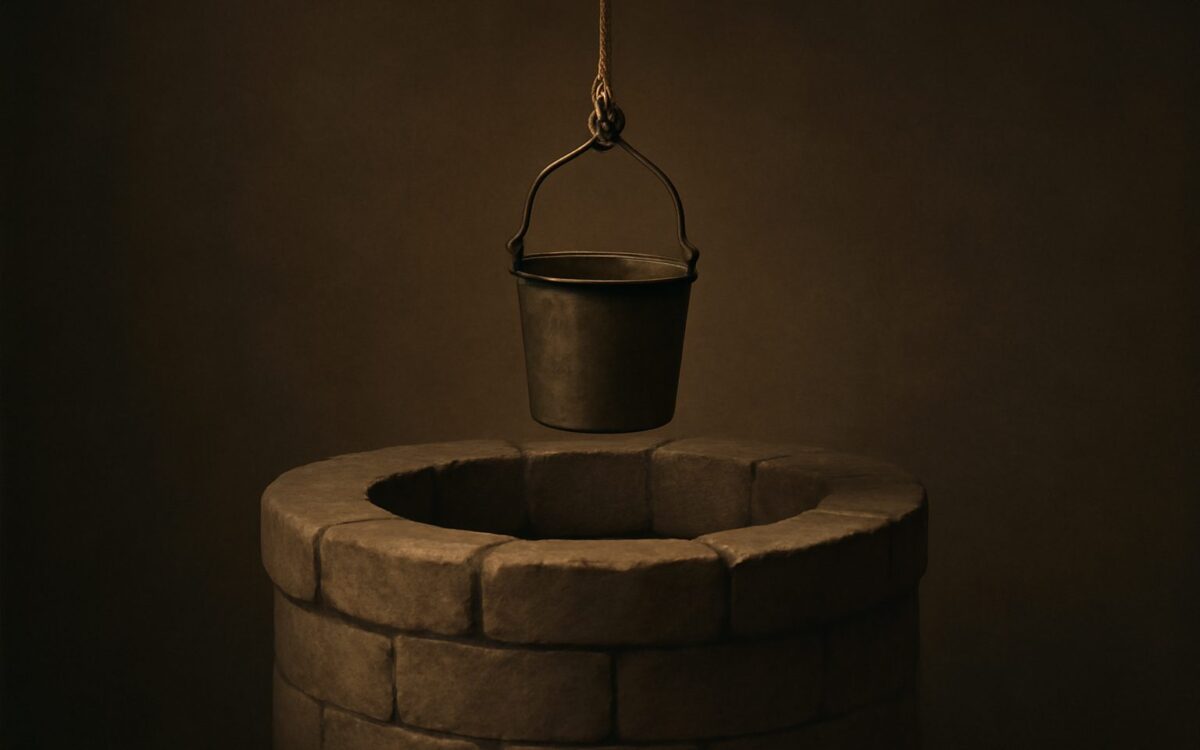
Hexagram 48 is 井 (jǐng), The Well. It is built from Kan (坎 kǎn), Water, in the upper position over Xun (巽 xùn), Wind or Wood, below. The lower trigram here reads as wood reaching down, and the picture is old and exact: a wooden mechanism sunk into the earth, drawing water up from a deep source. Read the two trigrams together and you get the image of a well — water lifted from below the ground by something patient and penetrating.
A well is one of the steadiest symbols in the whole book. Towns rise and fall, families move, the walls above the water change hands for centuries, but the well itself stays where it is and gives the same water to whoever lowers a bucket. That constancy is the heart of hexagram 48: a source that does not run dry and does not play favourites.
The trigrams and what the combination pictures
Water (Kan) above sits over Wood or Wind (Xun) below. The wood is the bucket and the pole, the reaching-down instrument; the water is what is drawn up. Nothing in this pairing is dramatic. There is no thunder, no fire, no clash — only the slow, reliable act of bringing something nourishing up from the depths so that people can be fed.
What the combination teaches is that the source is fixed but the access is not. The water is always there. Whether anyone actually drinks depends on the rope, the bucket, and the care taken not to let the jug break at the very end. So the hexagram is quietly about maintenance, structure, and follow-through as much as it is about the source itself.
易经 · Book of Changes
Cast your own hexagram. Six throws build your hexagram and any changing lines, each linked to a plain reading. Free, in your browser.
The Judgment, in plain voice
The overall counsel of hexagram 48 runs like this. The town can be moved, but the well cannot be moved. The water neither drains away nor overflows; people come and go and draw from it freely. The warning attached is sharp: if the rope does not reach the bottom, or if the bucket breaks before the water is raised, there is misfortune.
The lesson is not about the source failing — the source is sound. It is about completion and access. You can have real depth, real substance, a genuine gift to offer, and still come away with nothing if the delivery is short or the effort is abandoned near the end. Reach all the way down. Bring the jug up whole.
The Image and its lesson
The natural picture is water over wood: the well. The traditional reading of the Image turns this outward toward people. Just as the well feeds the community without being used up, the person who understands this hexagram works to nourish others and to encourage them to help one another. The well does not hoard and does not choose; it simply gives.
The practical instruction inside the Image is about being a dependable resource. A person, a team, or an institution becomes a well when what it offers is clean, constant, and available to all who come. The quiet ambition of 井 is not to be admired but to be reliable.
Practical guidance
In work, hexagram 48 tends to favour tending your foundations over chasing new ground. This is a moment to deepen the source you already have — skills, systems, relationships that others draw on — and to make sure people can actually reach it. If a process is nine-tenths built, the counsel is to finish it; a bucket that breaks near the surface wastes the whole descent.
In relationships, the hexagram points toward being a steady presence rather than a shifting one. It leans against grand gestures and toward simply being there, clean and available, the way a well is. Care shown consistently over time is the register it rewards.
On timing, this is patient rather than urgent. The well does not hurry the water, and it does not advertise. Progress here is measured by depth reached and by whether what you offer is genuinely getting through, not by speed. Treat all of this as tendency, not verdict — the hexagram describes the grain of the moment, not a fixed outcome.
Changing lines and where it shifts
The lines of 井 move from a neglected, silted well at the bottom toward a clear, cool spring that people can safely draw from near the top. Reading bottom to top, they trace repair: the well that no one tends, the water that is clean but undrawn, the source finally reliable and open. When a line changes, the hexagram shifts into another figure, and that second hexagram shows where the situation is tending.
A common neighbour to hold in mind is Hexagram 49, 革 (gé), Revolution — the well that must eventually be cleaned out or overturned when the old structure no longer serves. Where 井 maintains the source, 革 renews it. To trace these lines properly, begin with the two trigrams and the overall Judgment before reading any single moving line.
For the wider map, see the I Ching hub and the full 64-hexagram overview. The same trigrams and five-element logic that shape this hexagram also run through your birth chart — plot yours free with the Ba Zi calculator and see which elements form your own steady source.
Read in sequence · Previous: Hexagram 47, 困 Kùn (Oppression) · Next: Hexagram 49, 革 Gé (Revolution)