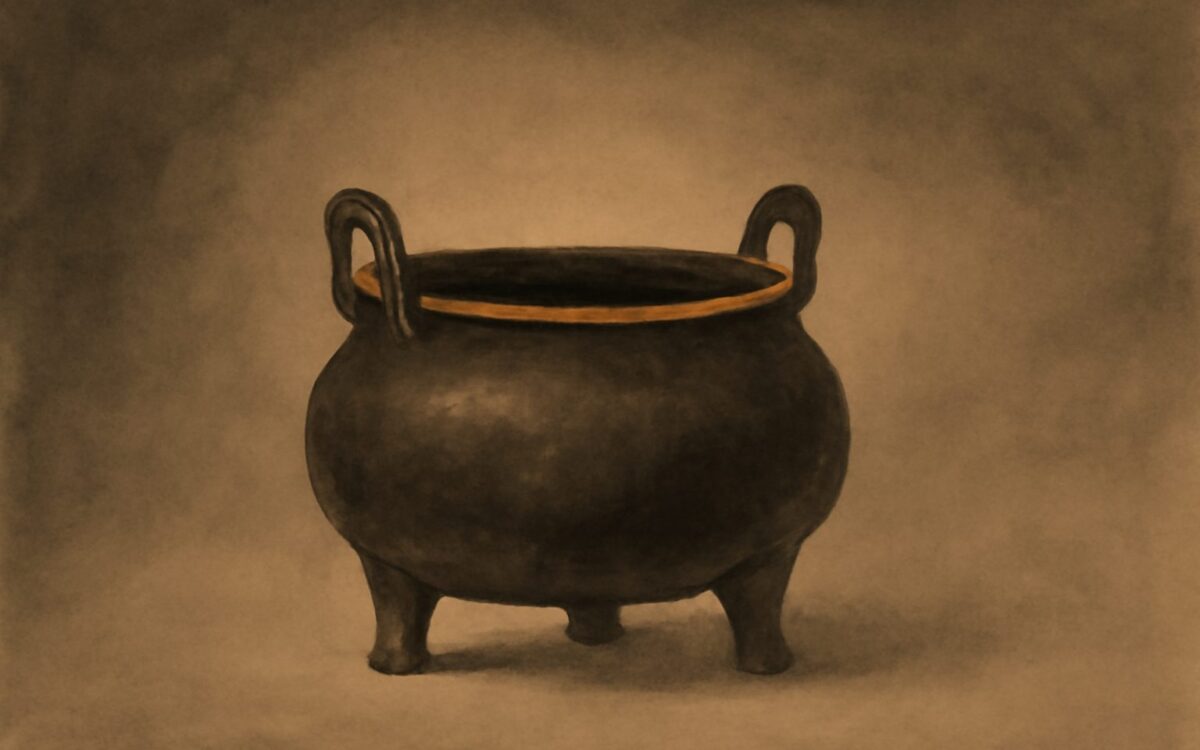
Hexagram 50, 鼎 dǐng, is usually called The Cauldron. Its structure is the trigram Li (離 lí, Fire) over Xun (巽 xùn, Wind, Wood). Wood feeds a fire above it, and the whole figure is read as the ancient bronze ritual vessel standing over its flame — legs below, a body that holds, handles and a carrying-ring at the top. Where the previous hexagram, 革 gé (Revolution), tears down the old, hexagram 50 is what comes after: the vessel in which raw material is cooked into something nourishing and refined.
The picture is deliberately domestic and civilised. A cauldron is not a weapon or a tool of struggle; it is how a household or a state transforms grain and meat into a shared meal, and how offerings are prepared. So 鼎 dǐng carries a sense of culture, cultivation, and the honouring of worth — raw stuff being turned, by patient heat, into something that feeds people.
The two trigrams and what they picture
Read from the bottom, Wind and Wood provide the fuel and the draught; Fire clings and burns above. Wood entering fire is the exact image of cooking: something is placed into a process and changed by it. The Cauldron also reads the six lines as the vessel itself — the solid line at the base as the legs, the firm lines in the middle as the full belly, the yielding line above as the ears, and the top line as the carrying-ring of jade. It is one of the few hexagrams that describes a single object part by part.
The lesson embedded in that object is refinement through containment. Nothing useful happens if the ingredients are scattered or the fire has nothing to hold it. The cauldron works because it gathers, contains, and applies steady heat. In hexagram 50 the message is that the moment favours building and nourishing, not scattering.
易经 · Book of Changes
Cast your own hexagram. Six throws build your hexagram and any changing lines, each linked to a plain reading. Free, in your browser.
The Judgment — overall counsel
Paraphrased in plain terms, the Judgment on 鼎 dǐng points to supreme good fortune and success. This is one of the more openly favourable figures in the sequence. The counsel is that when a person has prepared the vessel — built something orderly that can hold and transform — good things follow, and worthy people are drawn to be fed by it.
The undertone is one of service and right placement. A cauldron earns its standing by nourishing others, not by hoarding. So the fortune here is tied to using your position to sustain people around you: feeding the capable, honouring the wise, keeping the vessel clean and well-set. Good fortune is available, but it is the fortune of the host, not the conqueror.
The Image — the natural picture and its lesson
The Image sees Fire over Wood and reads it as the cauldron at work. The traditional lesson drawn from it is that the thoughtful person steadies their position and consolidates their calling — literally, sets their seat firm and correct, the way a heavy tripod stands stable on its three legs.
The practical reading is about being properly grounded so that you can transform things well. A cauldron that wobbles spills its contents; a fire without a vessel scorches without feeding anyone. The lesson is to make your base correct and stable first, then the cooking — the real work of turning effort into nourishment — can proceed. Solidity below, radiance above.
Practical guidance
In work, hexagram 50 tends to favour cultivation over conquest. It suits building an institution, refining a craft, mentoring, or turning rough material — raw talent, raw data, raw produce — into something finished and shareable. The tendency is that recognition comes through what you nourish and elevate, so honouring capable people and giving them a place tends to serve you well.
In relationships, the Cauldron leans toward mutual sustenance and shared table rather than drama. It reads as a season for feeding a bond steadily, making a home solid, and drawing worth toward you by being someone others can rely on to nourish rather than deplete. As always this is tendency, not verdict: the vessel still has to be tended, and a cauldron left unclean or unbalanced simply does not cook well.
On timing, the transformation takes heat and patience. This is a slow, contained process, not a lightning moment. Set your footing correctly, gather the right people, and let the steady flame do its work rather than lifting the pot off the fire early.
Changing lines — how it can shift
The changing lines of 鼎 dǐng track the life of a vessel: an overturned cauldron that clears out old refuse, a broken leg that spills the meal, handles that get too hot to lift, and the jade ring at the top that makes it worthy to carry. Where lines move, the counsel narrows — sometimes to a fault in the base, sometimes to the fine finish at the top.
Because Fire and Wood are so mobile, small changes here can turn the picture toward neighbouring hexagrams. A single moving line can point back toward 革 gé (Revolution) — the tearing-down that precedes the rebuilding — or forward into the shaking energy of the next figure, 震 zhèn. Read any changing line as the active edge of the situation: the part of the cauldron that is being tested right now.
If you would like to see how the trigrams and five elements of a hexagram like this echo in your own chart, start with the I Ching hub, browse the full 64-hexagram overview, and then plot your elements free with the Ba Zi calculator.
Read in sequence · Previous: Hexagram 49, 革 Gé (Revolution) · Next: Hexagram 51, 震 Zhèn (The Arousing)