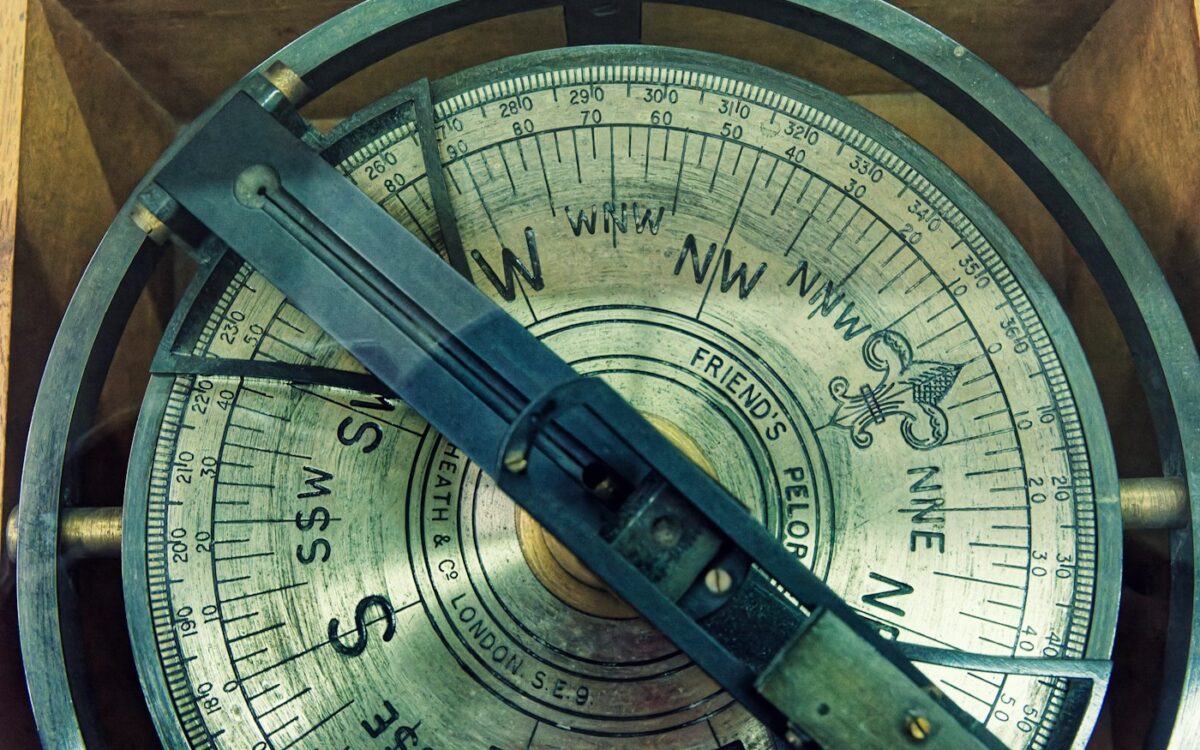
The luo pan (罗盘 luó pán) is the feng shui compass. Where an ordinary compass gives you north and a number, the luo pan gives you a direction already written in the language of the practice: a stem, a branch or a trigram. It is a measuring instrument, not a charm, and the way to understand it is to look at what it measures and how a practitioner reads it on site.
Anatomy of a luo pan
At the centre sits a magnetic needle in a small well called the heaven pool (天池 tiānchí). Around it run concentric rings, each one a different reference table printed in a circle. The round dial sits on a square base plate with a red cross-hair thread stretched across it. Names for the dial and base vary by school.
The rings vary by school: which ones appear depends on the tradition the pan was made for. Two rings, however, are on every luo pan: the 24 mountains and the eight trigrams. If you know those two, you can read the part of any pan that matters most for a house.
The 24 mountains (二十四山)
The 24 mountains (二十四山 èrshísì shān) divide the full circle into 24 equal sectors of 15° each, with 子 centred on due North. Each sector is named by a character: eight of the ten Heavenly Stems, all twelve Earthly Branches, and four of the eight trigrams. The stems and branches are the same 22-character alphabet used in Ba Zi, covered on our page on Heavenly Stems and Earthly Branches.
| mountain | span | centre |
|---|---|---|
| 壬 | 337.5°–352.5° | 345° |
| 子 | 352.5°–7.5° | 0° |
| 癸 | 7.5°–22.5° | 15° |
| 丑 | 22.5°–37.5° | 30° |
| 艮 | 37.5°–52.5° | 45° |
| 寅 | 52.5°–67.5° | 60° |
| 甲 | 67.5°–82.5° | 75° |
| 卯 | 82.5°–97.5° | 90° |
| 乙 | 97.5°–112.5° | 105° |
| 辰 | 112.5°–127.5° | 120° |
| 巽 | 127.5°–142.5° | 135° |
| 巳 | 142.5°–157.5° | 150° |
| 丙 | 157.5°–172.5° | 165° |
| 午 | 172.5°–187.5° | 180° |
| 丁 | 187.5°–202.5° | 195° |
| 未 | 202.5°–217.5° | 210° |
| 坤 | 217.5°–232.5° | 225° |
| 申 | 232.5°–247.5° | 240° |
| 庚 | 247.5°–262.5° | 255° |
| 酉 | 262.5°–277.5° | 270° |
| 辛 | 277.5°–292.5° | 285° |
| 戌 | 292.5°–307.5° | 300° |
| 乾 | 307.5°–322.5° | 315° |
| 亥 | 322.5°–337.5° | 330° |
The mountains fall into groups of three, one group for each of the eight directions and its trigram:
- 壬子癸 = North, 坎 kǎn
- 丑艮寅 = Northeast, 艮 gèn
- 甲卯乙 = East, 震 zhèn
- 辰巽巳 = Southeast, 巽 xùn
- 丙午丁 = South, 离 lí
- 未坤申 = Southwest, 坤 kūn
- 庚酉辛 = West, 兑 duì
- 戌乾亥 = Northwest, 乾 qián
Two stems are missing from the ring: 戊 and 己. Both are Earth, and Earth belongs to the centre, so they have no direction of their own. Their places are taken by the four trigrams 乾, 坤, 艮 and 巽, which sit on the diagonals. If the trigram names are new to you, our guide to the eight trigrams sets them out, and the bagua mirror page shows the same trigrams in a very different object.
San He, San Yuan and combined pans
Luo pans are made for schools, and the rings follow the school. The common families are the 三合 sān hé pan, the 三元 sān yuán pan, and the combined pan (综合 zōnghé), which carries rings from both. The differences lie in the outer rings and how they are used, and schools differ on which is the better tool. For reading a house’s direction, all three share the 24 mountains and the eight trigrams, so the facing you take is the same on any of them.
How a facing reading is taken with a luo pan
A reading has two halves. The facing (向 xiàng) is the direction the building looks out toward, usually the side with the main frontage. The sitting (坐 zuò) is the opposite direction, the side the building rests its back against.
In practice the steps are simple and the care is in the details. Hold the luo pan level, so the needle swings freely. Set the square base square to the building, its edge parallel to the frontage. Let the needle settle, then read where the red thread crosses the 24 mountains ring on the facing side. The sitting is the mountain directly opposite, 180° away.
A worked example using the table: a facing of 165° falls in 丙 (157.5°–172.5°), a South mountain. The sitting is 345°, which falls in 壬, a North mountain. The house is described as sitting 壬, facing 丙.
That description is where a flying-star house chart begins. The chart is built from the facing and the period in which the building was completed, which is why flying star feng shui needs an on-site reading rather than a guess from a map. A 15° sector is narrow, so a few degrees of error near a boundary can change the mountain, and with it the chart.
Phone compass or luo pan
For most everyday questions a phone compass is fine. Finding your favourable directions from your Kua number, or checking which way your headboard points for bed direction, works in eight broad directions of 45° each. A rough bearing is enough there.
A facing reading for a house chart is different, because it works in 15° mountains. Any magnetic needle, in a phone or in a luo pan, is pulled by metal nearby: cars in the car park, steel window frames, the reinforced concrete of a block, a gate or a railing. Near the edge of a mountain, that pull is enough to move a reading into the next sector. The value of the luo pan is less in the needle than in the discipline of reading it slowly and in the rings that turn a bearing straight into a mountain.
A compass reading tells you how a house sits. It does not tell you how the people in it are placed, which is a separate map. If you want your home’s facing read alongside your own chart, a private reading puts both on the table: one hour, a written summary afterwards, and no fear-selling.