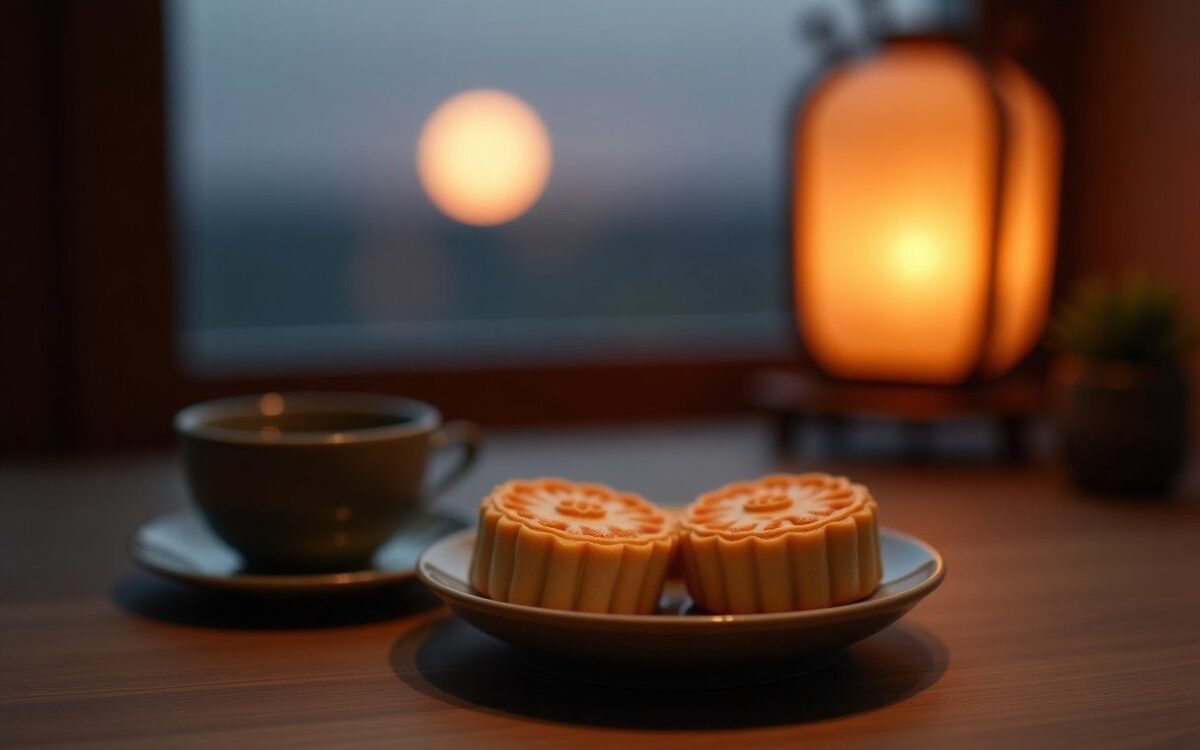
The Mid-Autumn Festival falls on Wednesday 15 September 2027, the fifteenth day of the eighth lunar month (八月十五), when the moon is full. For comparison, the 2026 festival fell on Friday 25 September 2026. The wishes below are the ones you will hear and read in Singapore in the weeks around it, with the hanzi, the pinyin, what each one means and who it suits.
Every Mid-Autumn greeting turns on one idea: the full moon is round and complete, and so should the family be. The word to know is 团圆 (tuányuán), reunion. Once you have it, most of the phrases explain themselves.
Everyday Mid-Autumn greetings
- 中秋快乐 (zhōngqiū kuàilè): “Happy Mid-Autumn.” The standard greeting for anyone, in person or in a message. 中秋节快乐 (zhōngqiū jié kuàilè) adds the word for festival and means the same.
- 月圆人团圆 (yuè yuán rén tuányuán): “The moon is full and the family is together.” Warm and simple, ideal for relatives.
- 阖家团圆 (hé jiā tuányuán): “The whole family reunited.” Often written on cards and mooncake boxes.
- 花好月圆 (huā hǎo yuè yuán): “Flowers in bloom, the moon full.” A picture of perfect happiness, used especially for couples and newlyweds.
- 人月两团圆 (rén yuè liǎng tuányuán): “Both the moon and the people are whole.” A favourite in Cantonese-speaking families.
- 事事圆满 (shìshì yuánmǎn): “May everything be complete.” The round-moon idea applied to plans and work.
Classic lines for someone far away
For family overseas, or anyone spending the festival apart, two lines of Tang and Song poetry are quoted every year. Both are about looking at the same moon from different places.
- 但愿人长久,千里共婵娟 (dàn yuàn rén chángjiǔ, qiān lǐ gòng chánjuān): “I only wish we may live long, and share this lovely moon across a thousand miles.” From Su Shi’s poem 《水调歌头》, written at Mid-Autumn while he was apart from his brother. It is the most quoted Mid-Autumn line of all.
- 海上生明月,天涯共此时 (hǎi shàng shēng míng yuè, tiānyá gòng cǐ shí): “A bright moon rises over the sea; at the ends of the earth we share this moment.” From Zhang Jiuling’s Tang poem 《望月怀远》.
Either line, sent with a photo of the moon from where you are, makes a thoughtful message.
Wishes in English, and for clients
In English, keep it short and keep the moon in it. A few that read naturally:
- “Wishing you and your family a happy Mid-Autumn Festival, and a full moon to match.”
- “May your home be as full and bright as tonight’s moon.”
- “Thinking of you under the same moon tonight. Happy Mid-Autumn.”
For clients and colleagues, pair the standard greeting with a wish for the business. 祝您中秋快乐,阖家幸福 (zhù nín zhōngqiū kuàilè, hé jiā xìngfú), “Happy Mid-Autumn, and happiness to your whole family”, is polite and safe on a card that comes with a box of mooncakes.
Dialect forms
Many Singapore families still greet each other in dialect. In Cantonese, 中秋快乐 sounds roughly like “jung chau faai lok”. In Hokkien it sounds roughly like “tiong chiu khuai lok”. These are rough guides, not formal romanisations, and an elder will happily correct your tones.
Lanterns, mooncakes and etiquette
Children carry lanterns after dark, and in Singapore the weeks before the festival bring lantern displays in Chinatown and mooncake gifting between families, friends and companies. Mooncakes are round like the full moon, so a box of them carries the reunion wish without a word being said. The customs, the date and the moon lore behind them are covered in our guide to the Mid-Autumn Festival.
A few small courtesies:
- Send greetings in the days before the festival or on the night itself, not long after.
- When you receive mooncakes from a family friend, a box in return or a visit is the usual reply.
- For a family that has lost someone this year, a quiet 中秋安康 (zhōngqiū ānkāng), “peace and health this Mid-Autumn”, is gentler than “happy”.
The same habits of set phrases and careful choice apply at New Year; our page of Chinese New Year greetings covers that season.
The festival in the calendar
In the Chinese calendar, the 2027 festival day is 丁酉 (Dīng Yǒu), Yin Fire over the Metal Rooster, inside the 己酉 month. Its day officer is 建, Establish, and the day clashes the Rabbit. None of this changes how the festival is kept, but it is the kind of detail the Chinese calendar records for every day of the year.
If the reunion theme has you thinking about family timing, such as a wedding, a move or a new venture in the coming year, that is a question for your chart. In a Ba Zi reading we look at the years ahead together, for one hour with the chart on the table, and send a written summary afterwards. No fear-selling.