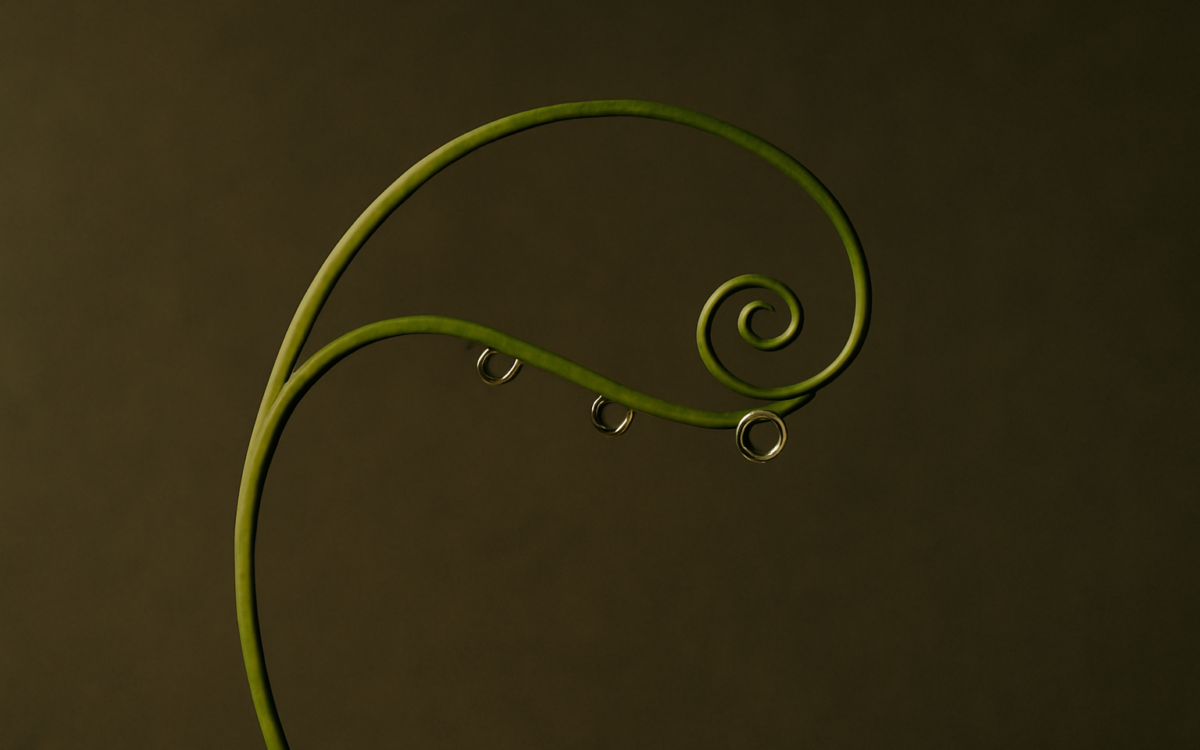
When Yǐ Wood (乙 yǐ) is the Day Master (日主 rìzhǔ), the chart carries not the great trunk but the vine and the flowering grass of the sixty-pillar system — supple, adaptive, quick to fill whatever space it finds. Yi Wood born in spring places that soft growth in its own Wood season (寅卯辰), the stretch running Feb 4 – May 4, from Li Chun (立春 lìchūn) to just before Li Xia (立夏 lìxià). This is the season the vine was made for. One thing to fix first: seasons run on solar terms, not calendar months, so a late-January or early-February birthday can land on either side of the boundary. Confirm the exact term with the Butcher Boy calculator before reading anything into the season.
Spring tilts the whole climate toward Wood, and for a plant that already is Wood, that is native ground.
Prosperous (旺 wàng): the season is yours
The seasonal state is 旺 wàng — Prosperous — the season is your own element: maximum native strength. This is the strongest of the five seasonal footings, and the same word that describes the towering Jiǎ tree in spring also describes the Yǐ vine. But it reads differently on soft growth than on hard timber.
A prosperous Jia is a trunk gaining height; a prosperous Yǐ is a vine spreading everywhere it can reach. Yin Wood in its own season is not about standing tall so much as covering ground — flowering, multiplying, threading through every available gap. The strength is real but lateral. And the standard caution on 旺 still holds: maximum native strength usually means the chart needs outlets, not more support. A garden in full spring does not want more seed and more rain; it wants somewhere for all that fresh growth to go before it tangles on itself.
Where to look in your own chart
Confirming this combination takes two glances at a plotted chart. The day stem — the upper character of the day pillar, third column from the right — must be 乙. The month branch — the lower character of the month pillar — must be one of 寅 (Tiger), 卯 (Mǎo, Rabbit) or 辰 (Chén, Dragon). If both hold, this page is your seasonal reading. Note which of the three branches you have, because the quarter is not uniform.
The Tiger month (寅 yín) opens spring with hidden stems (藏干 cánggān) Jiǎ 甲, Bǐng 丙 and Wù 戊 — plenty of Wood authority in the air, though the root it offers Yǐ is a Jiǎ root, the elder sibling’s rather than its own. The Rabbit month (卯 mǎo) is Yǐ’s home ground in the purest sense: the branch hides Yǐ 乙 alone, so a Rabbit-month Yi Day Master stands on its exact own qi — the cleanest prosperous footing this stem can have. The Dragon month (辰 chén) closes the quarter, hiding Wù 戊, Yǐ 乙 and Guǐ 癸; it is one of the four transitional Earth months (辰未戌丑) where Earth strengthens at each season’s end, so a 辰-month Yi is spring-born but already standing on thickening ground, with its Wood root reduced to a minor stem inside the branch.
What this season asks of you
Spring is a same-element season — Wood relative to Wood: same element (companions) — so the climate adds to your own side of the ledger rather than feeding or draining it. That is precisely why a prosperous Yi Wood born in spring should be read as strength looking for employment.
The useful elements are the ones that give abundant growth a purpose. Fire is output: it lets the vine flower and express, turning soft energy into visible color. Earth is wealth, the ground the plant spreads across and lays claim to. A touch of Metal prunes back growth that would otherwise sprawl into a thicket. A chart like this tends to flourish when those outlets are present and to knot up when the other pillars simply add more Wood and Water. For Yǐ especially, the failure mode is not weakness but overgrowth — energy with nowhere to resolve. The growth edge is direction and shape, not more vitality.
That is the strong-side reading of the general rule: a strong Day Master favors output, wealth and power, and is burdened by further resource and companions — always subject to the caveat that season and chart structure can override the rule of thumb. The full breakdown for this stem sits on the favorable elements for Wood Day Masters page.
The caveats that change everything
Season is only half of the strength verdict. The month gives the vine its prosperous footing; the roots, the hidden stems inside the branches, and the balance of the other pillars finish the judgement. A Yǐ born in spring but sitting on Metal branches, drained by strong Fire and cut off from Water, can read closer to balanced than the word “prosperous” implies on its own.
So a single strong season never settles the chart. Yin Wood in particular takes its final character from what surrounds it, since a vine leans on whatever it grows against. Work the full judgement through our guide to a strong versus weak Day Master, read the temperament on the Yi Wood Day Master profile, and see where it fits in the five elements in Ba Zi. To feel how much the season moves the same stem, compare Yi Wood born in summer, where the vine turns from ruling the season to spending itself on the heat — then the harder and softer poles of the year, Yi Wood born in autumn under the blade and Yi Wood born in winter fed by the water table. The four readings together show how one stem wears four entirely different climates.
A last practical note: prosperous charts are the ones most often misjudged by their owners. Strength feels like proof that nothing needs adjusting, when the chart is actually asking where the surplus should go. In readings, the productive question for a spring Yǐ is rarely “how do I get stronger” and almost always “which outlet — expression, ground or discipline — is mine to use”.
Before you decide your Yi Wood is prosperous, confirm both anchors: that Yǐ is truly your Day Master, and that your birth sits inside the spring solar terms rather than beside them. Plot both for free with the Butcher Boy calculator, then read the season against the rest of your four pillars rather than in isolation.