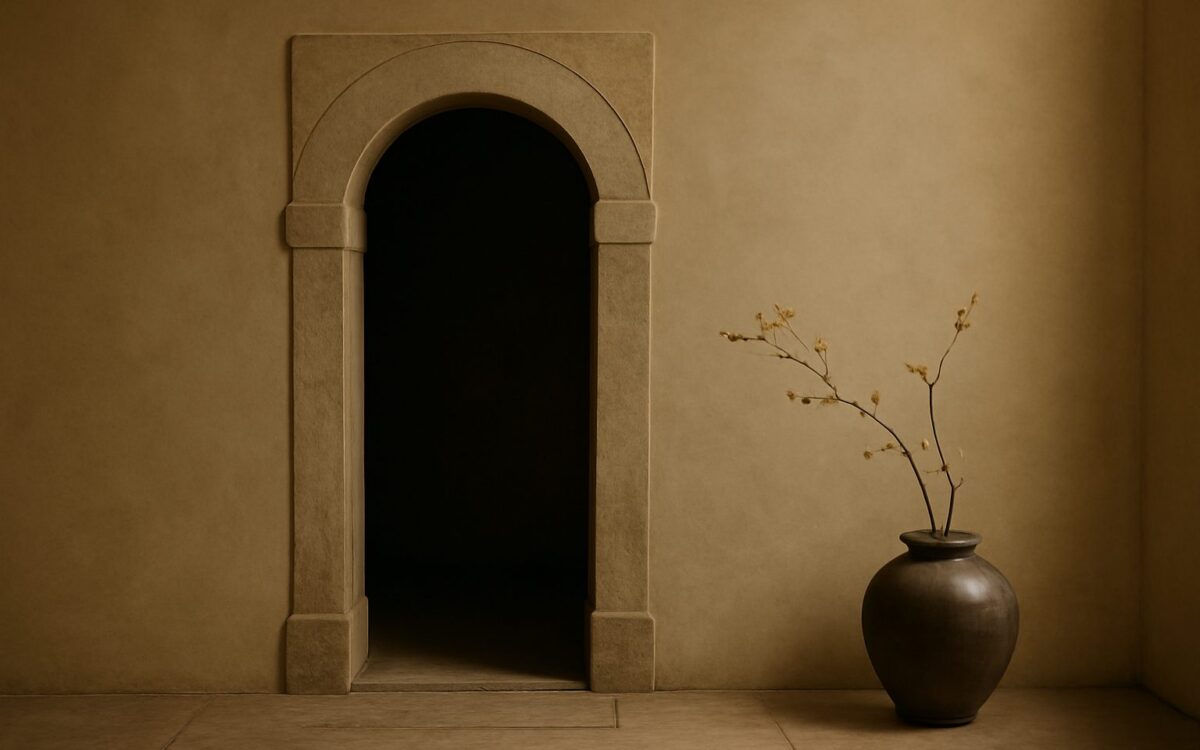
If the front door is the mouth of qi, the entryway is its first breath inside the home. This is the foyer, the landing, the few steps of floor just past the threshold where the vital current (气 qì) arrives before it decides where to go. In classical practice the feng shui entryway is treated as a small but decisive room: get it clear and bright, and qi enters generously and circulates. Let it clog with shoes, bags and gloom, and even a good door delivers a tired, choked flow into the rest of the house.
Almost everything here is Form School (峦头 luán tóu) — the older, landform-and-flow branch of feng shui that needs no compass and no birth data. You are simply reading how qi arrives and giving it a good place to land. Start there, and the entryway does most of its work before you reach direction or colour.
The entryway as where qi arrives
Qi behaves a little like air and a little like water. It wants to enter, slow, circulate, and settle — not to rush straight through a corridor or stall in a dark corner. The entryway is where that first settling happens, so its job is to feel open and cared-for. Think of it as a landing, not a passage. A guest crossing your threshold should sense a small, welcoming pause before the home opens up, and qi reads the space the same way.
Two qualities matter most, and they are both physical. The first is light: a bright entry draws qi in, while a dim one lets it stall. A working ceiling fixture, a lamp on a console, or borrowed daylight all help. The second is space to arrive — a patch of clear floor and a little breathing room, rather than a wall of storage two steps from the door. Where the entry leads next sets the tone for the whole home, which is why we treat it as the opening move in the feng shui house layout guide, and it feeds directly into how the living room receives that qi.
风水 · Feng Shui
Find your lucky directions. Plot your chart free and see your feng shui Kua number and the directions that favour you — computed in your browser.
Clear, bright, uncluttered — the working checklist
The classic entryway problems are all about qi arriving and then being obstructed or drained. Most fixes are simple, physical, and worth doing first. A working checklist:
- The floor is clear. The door should swing fully into the home against a clear wall, not bump a shoe rack or a stack of parcels. A door that opens halfway lets in half the qi.
- The light works. Replace the dead bulb, add a lamp, keep the fixture clean. Brightness at the entry is the single most reliable cure in the whole space.
- The air is fresh. Stale or smelly entries — often from damp shoes — sour the first breath of qi. Ventilate, and keep the area dry.
- One healthy plant, if there is room. A living plant near the entry lifts and softens incoming qi. Choose rounded leaves over spiky ones, and keep it genuinely healthy; a dying plant does the opposite of its job. Our guide to feng shui plants covers which ones suit an entry.
- Nothing broken. A wobbly console, a cracked tile, a coat hook hanging by one screw — each reads as friction where qi arrives. These small repairs are the ones to make first.
None of this is mystical. A bright, clear, well-tended entrance simply lets qi enter and settle, exactly as it lets a person breathe out and set down their bag. A staircase that faces the entrance is a common case, which our page on staircase feng shui treats with calm, practical fixes.
Shoes and storage
Shoes are the practical heart of most entryways, and the most common source of clutter. In this reading, shoes carry the dust and heaviness of the outside world — the last thing you want scattered across the point where fresh qi arrives. The remedy is ordinary tidiness given a little intention.
- Contain them. A closed shoe cabinet or a low bench with storage keeps footwear off the open floor. Closed storage beats an open rack, which keeps the outdoor heaviness on display.
- Keep it low, near the door. Store shoes at floor level rather than up high — shoes belong to the ground. A low bench doubles as a place to sit, which quietly signals a welcoming pause.
- Do not let storage crowd the arrival. Storage should line the entry, not fill it. If a cabinet stops the door opening fully or squeezes the walkway, it is working against the flow it is meant to tidy.
- Edit, don’t hoard. Only everyday shoes need to live at the door; the rest can move to a wardrobe. A slim, curated entry moves qi far better than a bulging one.
What should face the door — and the mirror question
Stand just inside your entrance and check the sightline. What qi meets first shapes how it flows on. A few things are best kept out of that direct line:
- A staircase running straight at the door funnels qi too fast between floors. Soften it with a runner or a plant at the foot; the fuller logic is in our front door guide.
- A back door or large window in a straight line lets qi flow in and leave without nourishing the home. Break the line with a console, a screen, or a rug so the flow has to slow and turn.
- A bathroom door meets incoming qi with a drain. Keep it shut and the lid down.
The mirror deserves its own note, because it is the most misunderstood entry object. A mirror placed to face the front door directly pushes fresh qi straight back out — the classic mistake. But a mirror hung on a side wall of the entry, so it sits beside the door rather than opposite it, is genuinely useful: it widens a narrow hall, bounces light into a dim landing, and lets you check yourself on the way out. The rule of thumb is a mirror by the door, never facing it. The room-by-room detail is in our guide to feng shui mirror placement.
As for what should greet the eye instead: something calm and uplifting. A piece of art you like, a healthy plant, a clean console with one considered object. The entry sets the emotional register of the whole home, so let it read as settled and generous rather than busy. If you hang a chime near the entrance, our guide to wind chime feng shui covers metal versus wooden rods and when to keep one quiet.
A short order of work
Work from the physical to the decorative. First, clear the floor and fix the light so qi has a bright place to arrive. Second, contain the shoes and slim down the storage so the entry breathes. Third, walk the sightline and soften anything that drains or reflects the flow — a straight-through window, a facing bathroom, a mirror squared off against the door. Only then reach for art and colour. An entryway treated in this order becomes what it is meant to be: a generous, well-tended first breath of qi.
The entryway is where a whole-home reading begins, and the rest of the house follows its lead. For the wider picture, start at our feng shui hub. And if you want the personalised layer — which elements and directions genuinely support you rather than the building — that answer lives in your Ba Zi (八字 bāzì) chart. Plot yours free with the Ba Zi calculator and let your own elements guide the finishing touches at the door.