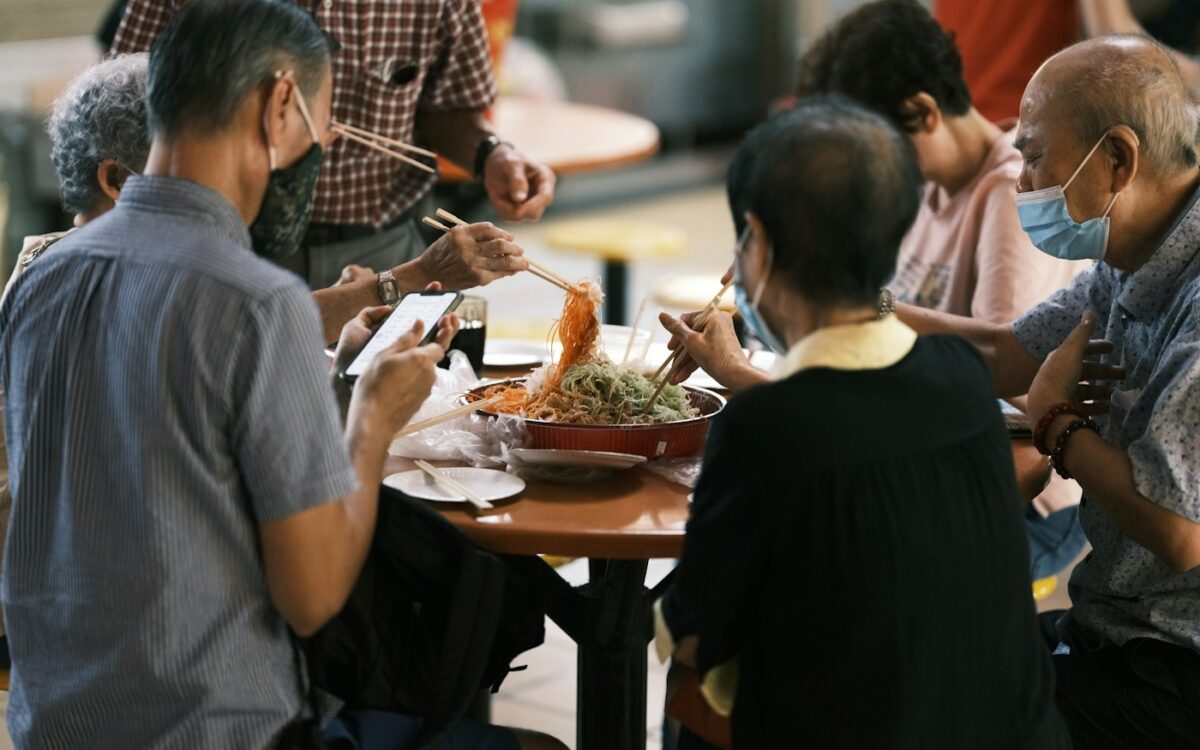
Lo hei (捞起 lāoqǐ, Cantonese for “toss up”) is the yusheng toss that opens many Chinese New Year meals in Singapore. In 2027 its traditional day, 人日 (Rénrì), falls on Friday 12 February 2027, the seventh day of the first lunar month (正月初七 zhēngyuè chūqī). The season itself opens on Saturday 6 February 2027, and in practice families and offices toss yusheng on any day of the fifteen days of New Year.
This page covers what yusheng is, how the toss is done, the phrases that go with it, and where the custom comes from.
What yusheng is
Yusheng (鱼生 yúshēng) is a raw fish salad served on one large plate in the middle of the table. The name works on two levels, which is a large part of its appeal at New Year. 鱼 (yú, fish) sounds like 余 (yú, surplus), the same pun behind the greeting 年年有余, “surplus every year”. And 生 (shēng) means raw, but it also means life and growth.
So a plate of yusheng is, in its name alone, a wish for abundance and growth. The dish is assembled at the table rather than served finished, and the assembling is the point.
How the lo hei toss works
The ingredients go onto the plate one at a time. As each is added, someone at the table calls out an auspicious phrase that goes with it. When everything is on the plate, everyone picks up their chopsticks and tosses the salad together, lifting it high while calling out wishes for the year.
Tradition says that tossing higher brings more good fortune, which is why a lo hei table tends to get loud and a little messy. That is part of the occasion, not a lapse in manners.
A few practical points families keep in mind:
- Everyone at the table joins in, from the eldest to the youngest.
- Wishes are called out together, so it is fine to repeat what others say.
The lo hei phrases
Each ingredient is paired with a phrase, and the pairings are not fixed. Exact ingredient and phrase pairings vary by restaurant and by family, so treat the examples below as typical rather than a script.
| Ingredient (example) | Phrase called out | Meaning |
|---|---|---|
| Raw fish | 年年有余 niánnián yǒuyú | Surplus every year |
| Plum sauce, oil, crackers | Wishes for wealth and sweetness | Prosperity and a sweet year |
Alongside these, people call out general New Year phrases during the toss itself: 恭喜发财 (gōngxǐ fācái, wishing you prosperity), 万事如意 (wànshì rúyì, may all go as you wish), 步步高升 (bùbù gāoshēng, rising step by step) for colleagues, and 身体健康 (shēntǐ jiànkāng, good health) for the elders at the table. The full list, with when each one fits, is in our guide to Chinese New Year greetings.
When to do lo hei: Renri, the seventh day
Lo hei is traditionally associated with 人日 Rénrì, the seventh day of the new year, known as “everyone’s birthday”. In 2027 that is Friday 12 February 2027. Today the custom is no longer tied to that one day. Yusheng is tossed on any day of the season, often at company dinners and family gatherings, and the season itself closes at the Lantern Festival.
The Ba Zi view of Renri 2027
In Ba Zi (八字 bāzì), Renri 2027 is a 壬戌 day (Rén Xū, Yang Water over Earth Dog) in the 壬寅 month (Rén Yín, Yang Water over Wood Tiger). Its day officer is 成 (Chéng, Success), and the day clashes the Dragon. You can check the officer for any day on the Chinese calendar today page.
Keep this in proportion. A day pillar is shared by everyone in Singapore that Friday, so on its own it says little about any one person. Whether a 壬戌 day sits well with you depends on your own chart.
Lo hei etiquette at dinners
Lo hei is noisy and cheerful, but a few habits keep it smooth, especially at company or family dinners with many people around one plate:
- Let someone lead. Usually the host, the most senior person or a confident volunteer calls out the phrases as each ingredient is added. Everyone answers or repeats.
- Toss high, but land it on the plate. The higher the toss, the higher the fortunes, the saying goes. Food on the table is part of the fun; food on a guest is not.
- Wait for the last ingredient. The tossing together comes after the sauce, oil and crackers are added, not before.
- Ask about diets. Vegetarian and salmon-free versions are common, and many restaurants offer abalone or fruit variations.
- Eat it. After the toss, the yusheng is served and eaten. Leaving it untouched misses half the point.
The phrases themselves, and when in the New Year to toss, are explained above. For the other customs of the season, see our guide to Chinese New Year traditions.
Where lo hei comes from
The modern restaurant version of lo hei is strongly associated with Singapore, where it was popularised in the 1960s. Malaysia also claims an origin for the dish. Both places claim it, and this page does not try to settle the question. Whichever account a family prefers, the toss itself is the same: one plate, many hands, wishes said out loud.
For the full 2027 season, including the New Year date, the year pillar and the turn of the Ba Zi year at Li Chun, see the Chinese New Year 2027 guide.
Lo hei is a wish called out together; your chart shows the year you are actually stepping into. Find how the 丁未 Fire Goat year and its months meet your own pillars: plot your chart free with the Ba Zi calculator.