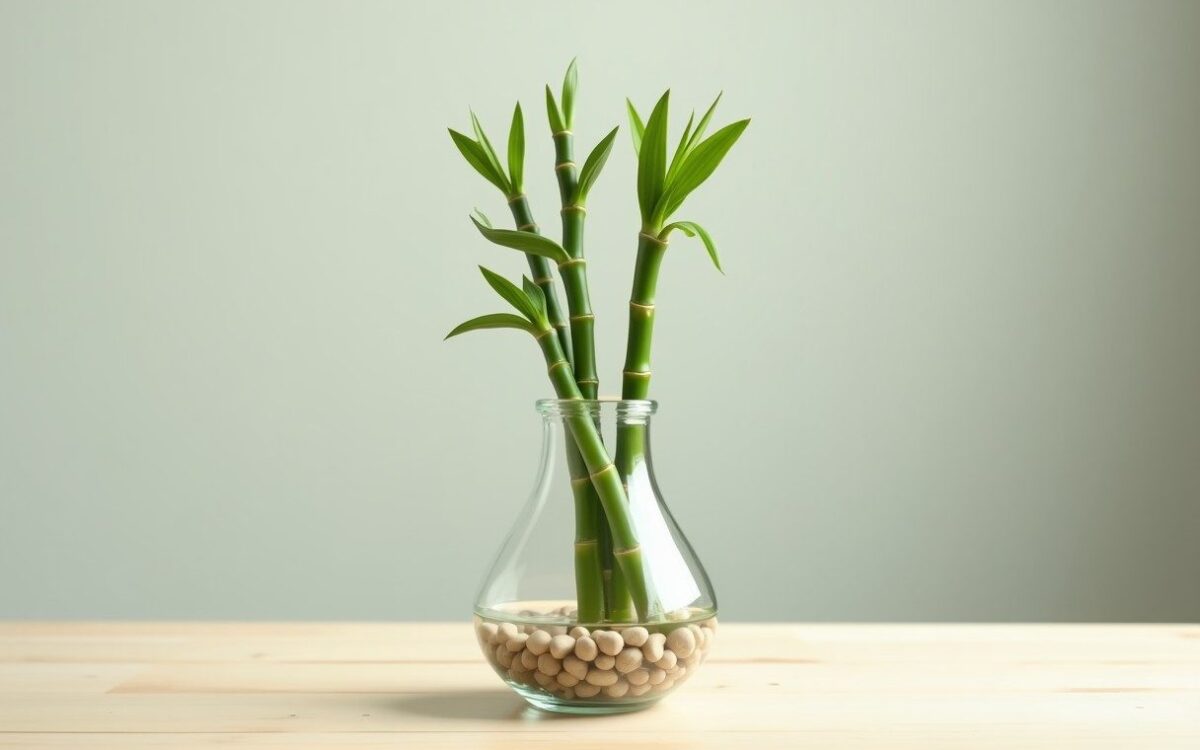
Lucky bamboo, 富贵竹 (fùguì zhú, literally “wealth and honour bamboo”), is one of the most common gift plants in Chinese homes and offices. It is easy to keep, grows in a glass of water and comes with a small vocabulary of meanings attached to the number of stalks. This page covers what the plant actually is, the stalk-count lore and the wordplay behind it, how feng shui (风水 fēngshuǐ) reads it in element terms, where it is traditionally placed and how to keep it green.
Lucky bamboo is not a true bamboo
Despite the name and the jointed look, lucky bamboo is not bamboo at all. It is a Dracaena, Dracaena sanderiana, a different plant family entirely. It can be grown in soil, but in Singapore it is most often seen standing in water, in a vase or shallow dish, sometimes with pebbles to hold the stalks upright.
The distinction matters for care more than for symbolism. True bamboo is a fast-growing grass that wants soil and space; lucky bamboo is a slow, tidy houseplant that wants clean water and gentle light.
Stalk counts and what they mean
The best-known part of lucky bamboo tradition is the number of stalks. Much of it rests on homophones, words that sound alike in Chinese. This is popular lore and it varies between families and regions; treat the list below as the common version, not a rule.
| Stalks | Meaning in popular lore | Why |
|---|---|---|
| 2 | Love | A pair |
| 3 | Happiness, wealth and long life | The three stars 福禄寿 (fú lù shòu) |
| 5 | The five elements, or health | Five as a complete set |
| 8 | Wealth | 八 (bā) sounds like 发 (fā), to prosper |
| 9 | Long life | 九 (jiǔ) sounds like 久 (jiǔ), long-lasting |
| 4 | Avoided | 四 (sì) sounds like 死 (sǐ), death |
The avoidance of four is a matter of sound and courtesy, which is why four stalks are rarely given as a gift. For more on how numbers are read in Chinese custom, see feng shui numbers.
None of these counts makes anything happen. They are wishes in a form people can see on a table, and they are best understood that way.
Wood growing in Water: the element reading
In five-element terms lucky bamboo is a neat picture: a Wood plant standing in Water. In the producing cycle, Water feeds Wood, so the arrangement shows one element nourishing another in plain sight. The cycles themselves are set out on the five elements in Ba Zi page.
That image is why lucky bamboo sits comfortably in feng shui practice. It is not a charm; it is a small, living demonstration of an element relationship. Whether more Wood suits you is a different question, and it belongs to your chart rather than to the plant.
Where lucky bamboo is placed
Three placements are common in tradition:
- The East. The East is a Wood sector and is associated with family, so a Wood plant there fits the reading.
- The Southeast. Also a Wood sector, and the wealth area in Ba Gua placement, 八卦 (bāguà).
- On a desk. A small vase on a work desk is probably the most common placement of all, especially as a gift for a new job or a new office.
Wherever it goes, the plant should be seen and tended. A vase of stale water behind a monitor reads poorly in any school. For how it compares with other indoor greenery, see feng shui plants, and for the trailing vine often kept beside it, money plant feng shui.
Keeping lucky bamboo healthy
Lucky bamboo is forgiving if you follow a few habits:
- Water level: keep the roots covered with clean water.
- Change the water weekly. Stale water is the usual cause of a tired-looking plant.
- Light: bright, indirect light. Keep it out of strong direct sun.
- Yellowing: usually means too much sun or water that has gone stale. Move it out of direct light and refresh the water.
A yellowing stalk is not an omen. It is a plant asking for fresher water or a little shade. Remove a stalk that has gone soft, and the rest will usually carry on.
Common questions about lucky bamboo
Why are the leaves turning yellow?
The usual causes are too much direct sun, chlorinated or stale water, or too much fertiliser. Move it to bright indirect light, use filtered or rested tap water, and trim the yellow leaves.
How often should the water be changed?
Once a week is a good habit, rinsing the container and pebbles at the same time. Keep the roots covered with water.
Water or soil?
Both work. In water it is easy to keep and fits the Wood-in-Water reading above. In soil it often grows stronger over time; keep the soil moist but not soaked.
How many stalks make a good gift?
Two (for love), three (happiness, wealth and long life), five, eight and nine are popular. Avoid four, as with most gifts. The full list of counts is above, and other lucky plants are in our guide to the money plant.
The honest frame
Lucky bamboo carries tradition and intention: a wish for love, prosperity or long life, given in a form that stays green on the table. It is a pleasant thing to keep and a thoughtful thing to give. What it does not do is decide outcomes. The people in the room and the timing in their charts do that.
If you are curious whether Wood and Water are the elements your own chart leans on, plot your Four Pillars with the free Ba Zi calculator and see where they stand.