Flowers are one of the gentlest feng shui adjustments you can make. They carry living Wood (木 mù) qi (氣 qì) — the upward, growing current — into a room, and unlike heavier cures they ask nothing of you but a little attention. The question of what makes good feng shui flowers has two halves: which blooms carry an auspicious meaning, and where you place them so that meaning lands. Both matter, and both are simpler than the folklore suggests.
A note before the list. In feng shui a flower is first a living thing and only second a symbol. A wilting stem in the “wealth corner” does more harm than an empty vase, because the message a space sends is the message it actually shows. Lead with vitality; let symbolism follow.
The classic auspicious flowers and what they mean
Four flowers appear again and again in the tradition, each tied to a quality worth inviting into a home.
Peony (牡丹 mǔdān) is the flower of romance and honour — long associated with love, beauty, and social standing. Its full, layered bloom reads as abundance. Peonies are the classic choice for relationship and marriage intentions, which is why you will see them recommended for the bedroom and for the Love corner of a space.
Orchid (兰花 lánhuā) stands for refinement, fertility, and quiet strength. Among the “Four Gentlemen” of Chinese painting, the orchid represents integrity that holds without display. A living orchid is a graceful desk or living-room presence; it suits fertility and new-beginnings intentions, and its slow, steady flowering rewards patience.
Lotus (莲花 liánhuā) is the emblem of purity — it rises clean from muddy water, so it stands for clarity emerging from difficulty, and for spiritual calm. Lotus imagery suits a study, an entry, or any zone where you want composure over ambition.
Chrysanthemum (菊花 júhuā) carries ease, longevity, and a settled life. Another of the Four Gentlemen, it blooms late in the year and so signals resilience. Yellow and white chrysanthemums bring a warm, grounding note to a living space. One caveat worth naming plainly: in Chinese custom white chrysanthemums are strongly linked to funerals and mourning, so many households keep them for remembrance rather than daily display. Schools and families differ on how strict this is.
Beyond these four, plum blossom (梅花 méihuā) speaks to perseverance through winter, and narcissus (水仙 shuǐxiān) to good fortune in the new year. You do not need a botanical checklist. Choose a flower whose meaning matches what you actually want more of.
风水 · Feng Shui
Find your lucky directions. Plot your chart free and see your feng shui Kua number and the directions that favour you — computed in your browser.
The single most useful rule for good feng shui flowers is about condition, not species. Fresh, healthy flowers carry active Wood qi — they are alive, drinking water, opening. That living energy is the whole point of bringing a plant indoors.
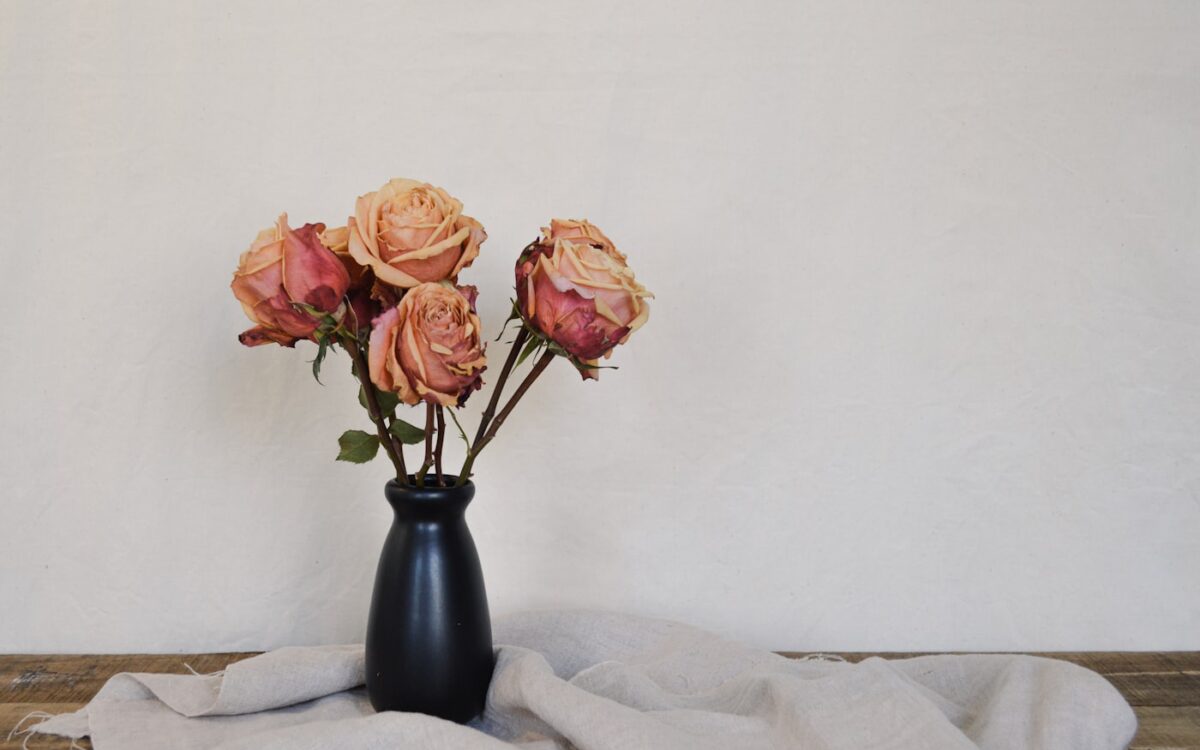
Dried flowers are the opposite case in most schools: they have finished their life cycle, hold no moisture, and are read as stagnant or “dead” Wood. A single arrangement will not curse a room, but dried bouquets kept for years — especially in a bedroom or a wealth zone — work against the vitality you are trying to build. If you love a dried arrangement, keep it somewhere low-stakes and refresh it.
High-quality silk or artificial flowers sit in between. They carry no living qi, but because they never wilt they also never send a decaying message. Practitioners tend to accept good artificial flowers as a stable, symbolic stand-in where fresh blooms are impractical — a dim hallway, a rarely-visited room — provided they are kept clean and dust-free. Cheap, faded fakes read as neglect and are best avoided. As always, this echoes the same living-qi logic behind healthy houseplants; our guide to feng shui plants for the home covers the wider principle.
Placement by intention using the Bagua
Where you set flowers decides what they support. The Bagua (八卦 bāguà) map assigns each area of a home to a life domain, and flowers — being Wood — feed some zones naturally.
For wealth, the southeast is the abundance zone, and its element is Wood. Living flowers or a healthy flowering plant here reinforce that Wood energy directly, which is why blooms are a light-touch alternative to the classic money plants. If wealth is your aim, read this alongside the feng shui wealth corner and the feng shui money tree and wealth plants, which explain the same Wood-in-the-southeast logic for larger cures.
For love and relationships, the southwest is the marriage zone. A pair of peonies here — or in the bedroom — supports partnership; pairs, rather than a lone stem, echo the symmetry the tradition favours for couples. Pink and red tones suit this intention.
For reputation, the south is the fame zone, and its element is Fire. In the productive cycle Wood feeds Fire (Wood → Fire), so flowers, and warm red or orange blooms in particular, nourish this area. For family and health, the east is a Wood zone, so flowers belong there comfortably too.
A few universal cautions. Keep flowers out of direct alignment where they crowd a doorway; refresh water and trim stems so nothing decays; and in the bedroom favour a small, calm arrangement over a large fragrant one, since too much active energy can disturb rest. Colour choices interact with the room’s element balance — our note on feng shui bedroom colors pairs well with flower selection there. For the full Wood-Fire-Earth-Metal-Water logic behind these zones, the feng shui hub and our Ba Zi primer on the five elements give the underlying cycle.
Choosing flowers that fit you
Feng shui works best when a general principle meets a personal chart. The element a room needs, and the element you personally lack or favour, are not always the same — a home heavy on Fire may want cooling rather than more Wood. Knowing your own five-element balance turns “good feng shui flowers” from a generic list into a targeted choice.
You can find your element balance in minutes — plot your chart free with the Ba Zi calculator, see which of the five elements your chart leans toward, then choose flowers and placement that support it rather than crowd it.