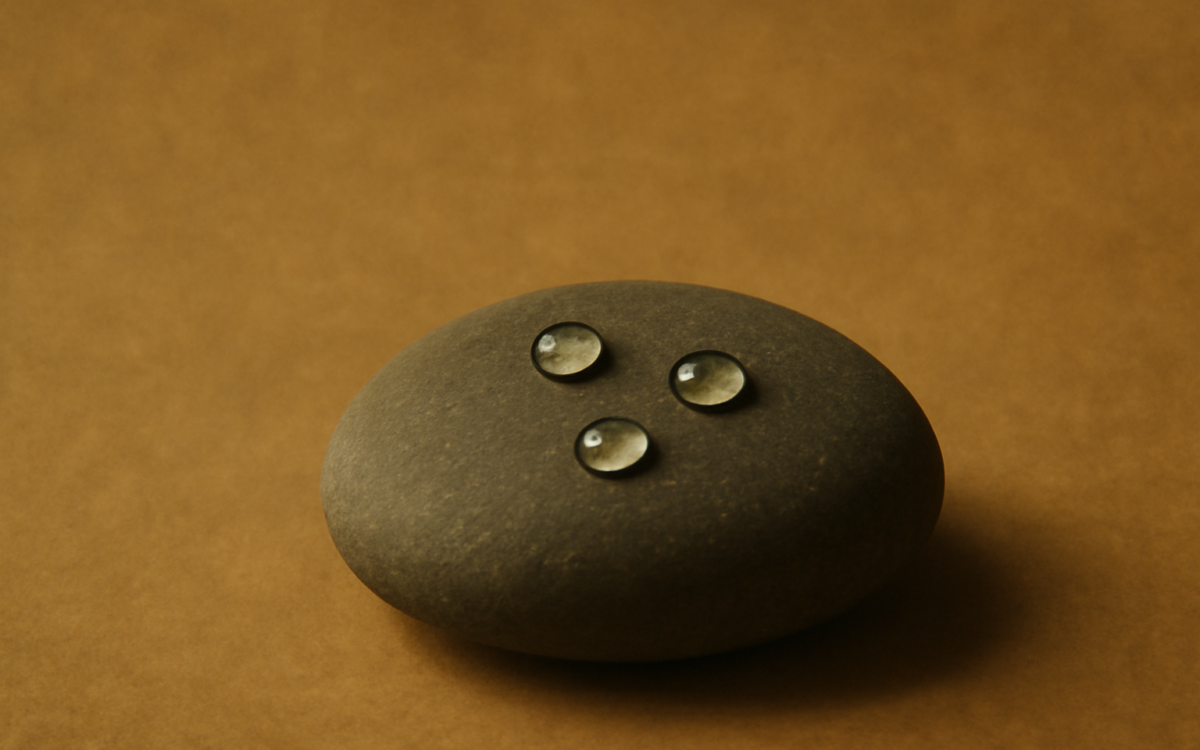
The Gui You day pillar (癸酉 guǐ yǒu) sets Yin Water over the Rooster branch, which belongs to pure Metal. In Ba Zi (八字 bāzì), Guǐ 癸 is soft water — mist, dew, quiet rain, the gentlest of the ten stems. Yǒu 酉 is clean, finished Metal, and Metal is the source of Water. The image is dew forming on polished stone: clear water drawn quietly from a bright, pure source.
Everything about this pillar is fine-grained rather than forceful. The Water is small but well-supplied, and the clarity of that source runs through the character.
Personality of the Gui You day pillar
A Guǐ Day Master is perceptive, imaginative and unobtrusive, attuned to feeling and quick to sense the mood of a room. What defines this pillar is that the Water sits on Indirect Resource (偏印 piānyìn), through the main-qi Metal Xīn 辛 in the branch. Among the Ten Gods (十神 shíshén), Indirect Resource is intuitive, unconventional support — a mind that learns obliquely, keeps its own counsel, and trusts its instincts.
Sitting on such clean Indirect Resource, a Gui You person often has an unusually clear, discerning mind. They tend to be private, thoughtful and self-reliant, drawn to specialised knowledge and to depth over breadth. The pure Metal beneath lends real sharpness of judgement, sometimes a cool, exacting streak. The risk is over-withdrawal — so much inner supply that they retreat into their own world and overthink. At their best they combine gentleness of manner with a quietly precise intelligence.
In practice, Gui You people do their finest work in quiet rooms: research, analysis, editing, design, the kinds of trades where accuracy is the product. Colleagues often underestimate them for a year and then quietly start routing the hard questions their way. The pattern worth watching in this pillar is input without output — endless reading, note-taking and refining with nothing shipped, because the Resource beneath keeps feeding and nothing in the seat pushes outward. When a Gui You chart carries a healthy outlet elsewhere, the combination of clean source and fine instrument is genuinely formidable; the water finds its channel and runs clear.
The spouse palace
The day branch is the spouse palace. For Gui You the Rooster holds a single hidden stem: Xīn 辛 (Yin Metal) = Indirect Resource 偏印. A clean, single-stem palace like this classically suggests a marriage with one clear tone rather than a tangle of competing pulls.
| Hidden stem in 酉 | Ten God (relative to Guǐ) |
|---|---|
| Xīn 辛 (Yin Metal) | Indirect Resource 偏印 |
Indirect Resource in the spouse palace often describes a partner who is supportive in a quiet, capable, mentor-like way — someone who nourishes the Day Master’s mind more than they fuss over the household. The gentle caution is that this form of resource can carry a note of detachment: a partner who is private and self-sufficient, or a bond that is more companionable than demonstrative. Read whole, it is a settled and intellectually compatible seat, at its best when both people put warmth into words as well as into understanding. Because no wealth or officer star sits in the branch, the spouse star proper is read from the rest of the chart — the division of labour our spouse palace guide explains in full.
A worked example
Set this pillar beside two different month stems and watch it change. With a visible Yǐ Wood in the month — Eating God for Guǐ — the seat’s endless intake finally has a spout: the researcher publishes, the analyst ships, and the classic input-without-output trap never forms. With a visible Jǐ Earth instead — Seven Killings — the quiet mind is put under command pressure, and the clean Resource beneath becomes the classical answer to it, converting demand into competence. Same day pillar, two distinct lives. The mapping behind both readings is on the Ten Gods page for the Gui Water Day Master.
The branch relations complete the picture. 酉 clashes with 卯 (卯↔酉), so Rabbit branches and Rabbit years send instability signals through this marriage seat — for Guǐ, the Rabbit carries the output element, so the disturbance often arrives as competing claims between work-of-the-hands and the quiet bond at home. 酉 combines with 辰 toward Metal (辰+酉→Metal), a binding influence that deepens the supply, and with Snake and Ox the Rooster completes the Metal frame (巳酉丑→Metal frame), which can turn a well of resource into a flood of it.
Na Yin
The Na Yin (纳音 nàyīn) of Gui You is 剑锋金 Jiànfēng Jīn, Sword-edge Metal — the honed edge of a finished blade. It is a keen image to lay over dew on stone: precision and decisiveness beneath all that softness. Take it as poetry rather than mechanism. It lends the pillar an incisive, discerning edge, while the working analysis stays with the Water, the Metal and the Indirect Resource beneath.
In a full chart
A day pillar is one line of four. Two people born on a Gui You day can differ completely once the month of birth, the other stems and the luck pillars are added. The same clean Resource that clarifies one chart may over-cool another that already lacks warmth and fire. Whether this footing helps or hinders turns first on strength, so read our guide to a strong versus weak Day Master before drawing conclusions.
For the stem itself, see the full Gui Water Day Master profile. It is also worth comparing neighbours: the Ren Shen day pillar shows the bolder Yang face of Water at its source, while the Xin Wei day pillar pairs refined Metal with the same Indirect Resource seat — useful contrasts to Gui You. Within the Guǐ family, Gui Mao sits on the very Rabbit that clashes this Rooster — pure giving where Gui You is pure intake — and Gui Wei shows the same dew tested by pressure instead of fed by stone.
To learn whether Gui You is your own day pillar, plot your chart free with the Ba Zi calculator and read your day column before taking any single pillar as your story.