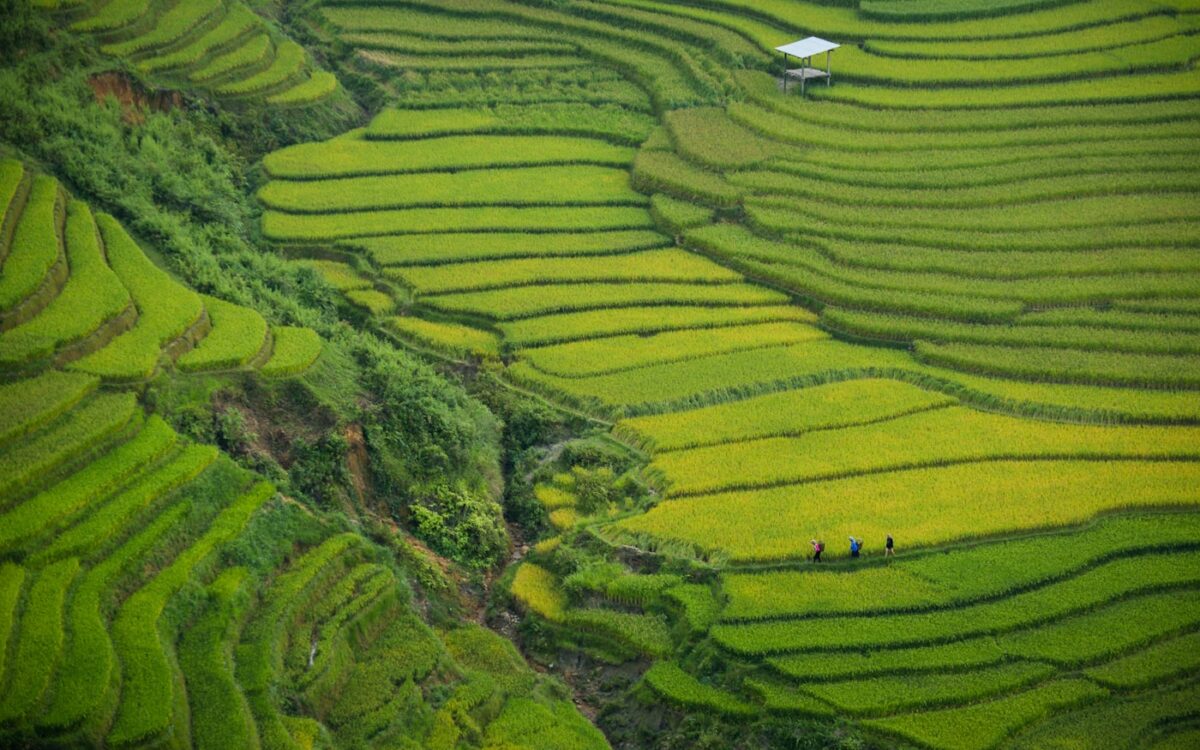
Your Day Master (日主 rìzhǔ) is Jǐ 己 — Yin Earth: the field soil — nurturing, absorbent, quietly productive. Whatever lands on a Jǐ gets turned into growth: projects, students, teams, families. The gift is genuine fertility — things flourish here. The shadow is absorbency without boundaries: the field takes in whatever is dumped on it, and the accounting is rarely fair.
New to Day Masters? Start with the explainer, or plot your chart to confirm yours.
The Jǐ temperament
In the five-element mechanics, Jǐ is fed by Fire, expresses itself through Metal, treats Water as its wealth, and answers to Wood as pressure and authority. Those four arrows explain most of what this stem loves and avoids: seasons, people and jobs are experienced as more or less of each.
In charts we read Jǐ as the most underrated of the ten stems. It has no drama — no blaze, no flood, no falling tree — so its work gets attributed to whoever planted in it. Under pressure Jǐ does what soil does: it absorbs the blow, holds the shape of what struck it for a while, then slowly digests the event into experience. That makes Jǐ people remarkably durable and remarkably easy to overload, because the damage never announces itself on the day. Wood — authority, demands, other people’s ambitions — ploughs Jǐ; in the right dose it is exactly what keeps the field productive, and in excess it is why so many Jǐ charts belong to the most quietly tired person in the office.
In relationships Jǐ nourishes by default — feeding, adjusting, growing whatever the partner brings home. The mature Jǐ learns crop rotation: some seasons are for others, and at least one is for the field itself.
Jǐ through the four seasons
Birth season sets the soil’s condition. Classical doctrine grades the seasonal state as 旺 wàng (Prosperous), 相 xiàng (Supported), 休 xiū (Resting), 囚 qiú (Confined) or 死 sǐ (Dormant) — solar-term seasons, not calendar months.
| Season | Branches | Dates | Jǐ’s state |
|---|---|---|---|
| Jǐ born in spring | 寅卯辰 | Feb 4 – May 4 | 死 sǐ — Dormant |
| Jǐ born in summer | 巳午未 | May 5 – Aug 6 | 相 xiàng — Supported |
| Jǐ born in autumn | 申酉戌 | Aug 7 – Nov 6 | 休 xiū — Resting |
| Jǐ born in winter | 亥子丑 | Nov 7 – Feb 3 | 囚 qiú — Confined |
Spring Wood controls Earth: the weakest baseline, where support and timing matter more than effort. Summer Fire produces Earth: strong by backing, comfortable, resourced, sometimes over-sheltered. In autumn the field feeds the season’s Metal — energy flows out, a mild drain, the retired-general state after harvest. In winter Earth holds the Water it controls — a wealth season fought uphill against the times: effortful, gritty.
Earth carries one extra rule: classical doctrine also gives Earth its own prosperity in the four transitional months 辰未戌丑 (土旺四季 tǔ wàng sì jì), strongest in late summer (未). A Jǐ born in one of those months is richer soil than the season-core state suggests — the four season pages unpack this properly.
Strong Jǐ, weak Jǐ
A strong Jǐ can host more than anyone realises — but should charge for it: formal roles, named credit, real equity. A weak Jǐ is depleted soil, still giving; the correction is Fire (recognition, rest, replenishment) and the unfamiliar discipline of letting one field lie fallow.
Not sure which you are? Season is half the verdict — see strong vs weak, properly judged, then favorable elements for Earth Day Masters for what follows from the answer.
The Ten Gods for a Jǐ Day Master
Relative to Jǐ, every stem becomes one of the Ten Gods (十神 shíshén) — and the yin polarity matters: for Jǐ it is Jiǎ, the tall tree, that arrives as the courteous Direct Officer, while Yǐ, the creeping vine, plays the harsher Seven Killings. The full reading is in the Ten Gods for Jǐ Earth.
| Stem | Ten God for Jǐ |
|---|---|
| Jiǎ 甲 (Yang Wood) | Direct Officer 正官 |
| Yǐ 乙 (Yin Wood) | Seven Killings 七杀 |
| Bǐng 丙 (Yang Fire) | Direct Resource 正印 |
| Dīng 丁 (Yin Fire) | Indirect Resource 偏印 |
| Wù 戊 (Yang Earth) | Rob Wealth 劫财 |
| Jǐ 己 (Yin Earth) | Friend 比肩 |
| Gēng 庚 (Yang Metal) | Hurting Officer 伤官 |
| Xīn 辛 (Yin Metal) | Eating God 食神 |
| Rén 壬 (Yang Water) | Direct Wealth 正财 |
| Guǐ 癸 (Yin Water) | Indirect Wealth 偏财 |
Career and money
Development roles: HR and people-building, agriculture and food, education, product incubation, community, care with structure attached. Water is the wealth element — many small flows absorbed and made productive; Jǐ prospers on volume and patience rather than the single big kill.
Your six Jǐ day pillars
Jǐ sits on one of six day branches, and the pair — the day pillar (日柱 rìzhù) — is the real unit of reading. As a yin stem, Jǐ pairs with: Jǐ Chǒu 己丑, the field under winter frost; Jǐ Mǎo 己卯, the field thick with young crops; Jǐ Sì 己巳, the field warmed by early summer; Jǐ Wèi 己未, the field in its own late-summer month; Jǐ Yǒu 己酉, the field after harvest; and Jǐ Hài 己亥, the field beside the river. The day branch doubles as the spouse palace, so these six differ most in marriage questions — each page reads one closely.
Jǐ in 2026 — the Bǐng Wǔ year
2026’s Fire warms the soil all year — a growing season. Strong Jǐ should plant deliberately: whatever is sown in a double-Fire year germinates fast, weeds included. Weak Jǐ gets the nourishment year it needed — take it, and for once let someone else do the feeding.
For how a double-Fire year works in general, read the 2026 Fire Horse guide.
Go deeper
A Day Master is the first sentence of a chart, not the whole paragraph. The season you were born into, the hidden stems beneath your branches, and your current luck pillar decide which version of Jǐ is on duty this decade. For the whole chart in plain English — with the next twelve months mapped — book a reading, or see the other nine stems in the field guide.
First, find your Day Master — plot your chart free with the Ba Zi calculator and see which Jǐ pillar, in which season, your field was given.